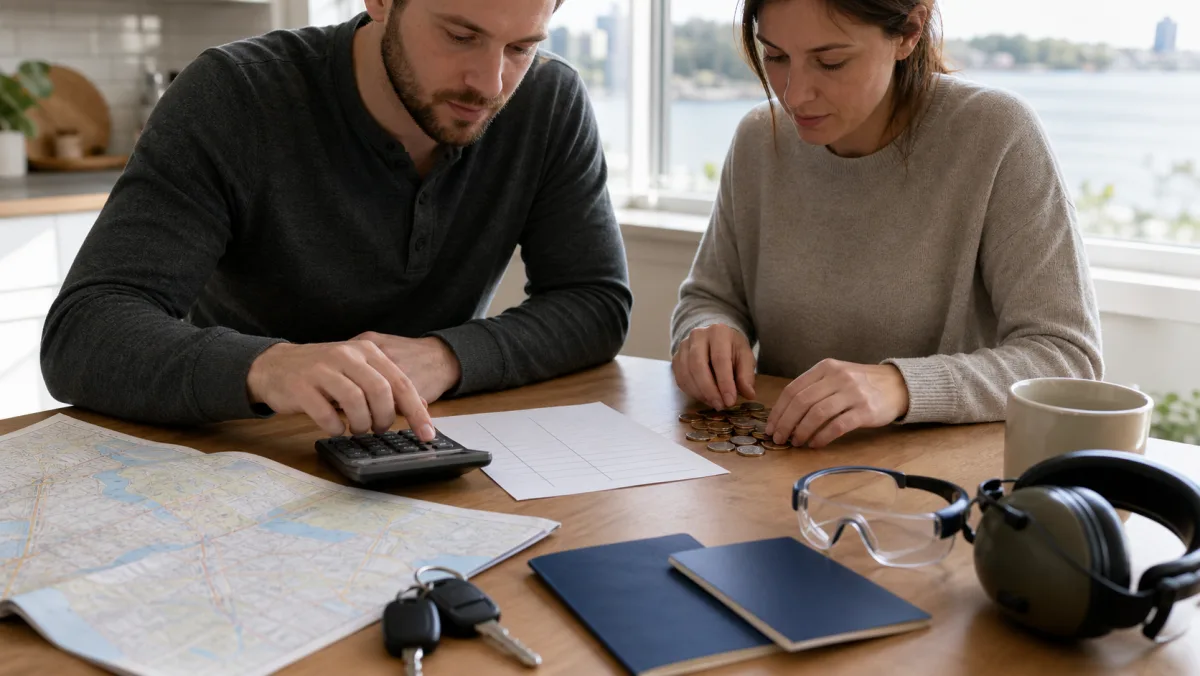
The cost of a Windsor-to-Michigan shooting range day is not one admission price. It is the total of an international round trip, the range session, currency conversion, and whatever the group adds before returning to Canada. A low lane rate does not create a low-cost day if tolls, ammunition, food, and card fees were ignored.
Range 313 is an indoor range at 1125 Fort Street in Lincoln Park, Michigan. Eligible Canadian visitors can call about lanes, rentals, eye and hearing protection, training, and current policies. Because prices, inventory, tolls, and exchange rates change, this guide does not freeze a total that will become inaccurate. Instead, it gives you a worksheet that produces a realistic number for your date and group.
The best budget is not the smallest possible total. It is a complete estimate that lets everyone participate safely, avoids pressure to rush, and leaves enough reserve for a border delay or changed route.
Use three budget columns
Divide the trip into shared, individual, and optional costs.
Shared costs may include vehicle fuel, round-trip tolls, parking, and any group reservation fee. Divide these according to the agreement made before departure.
Individual costs can include lane participation, a rental share, ammunition, target, eye and hearing protection, instruction, food, and personal foreign-transaction fees.
Optional costs include a second rental, additional ammunition, upgraded protection, a longer lesson, shopping, entertainment, and a more expensive meal.
This structure prevents one friend from advertising only the lane charge and collecting unexpected money later. It also lets a non-shooter understand which costs still apply to them, such as transport and lunch.
Create the worksheet in U.S. dollars first because most Michigan charges will be billed that way. Convert the final per-person number into Canadian dollars using the rate and fees your actual payment method will apply.
Cost 1: Lane time or group arrangement
The lane is the foundation of the on-site budget. Ask Range 313 whether pricing is per lane, per person, per time block, or part of a group package for the date involved. Also ask how many people may safely share a lane and how rotations are handled.
Do not reduce the estimate by placing more people on a lane than policy permits. A crowded lane creates distraction and can make a short session feel rushed. The correct number of lanes is a safety and experience decision, not only arithmetic.
Questions for the call:
- What is the current lane charge?
- How much time does the charge include?
- How many guests may be assigned to one lane?
- Is there an additional-shooter fee?
- Does a group need a reservation or deposit?
- Are taxes included?
- What is the cancellation policy for a border delay?
- Does orientation count against paid lane time?
Record the date of the quote. If the trip moves by several weeks, verify it again.
Cost 2: Rental equipment
An eligible Canadian visitor may ask about on-premises rental firearms. Rental pricing can vary by equipment, session, package, or the number of models used. Availability is not guaranteed.
For a first visit, one suitable rental often provides better value than several unfamiliar options. Each change takes time for staff questions, equipment-specific controls, ammunition confirmation, and safe adjustment. Paying for variety that the group rushes through is not a saving.
Ask:
- What rental options are appropriate for the participants’ experience?
- Is the price per firearm, per person, or per session?
- May eligible guests on the same lane share a rental under current policy?
- Is a second rental an additional fixed charge?
- What identification or other conditions apply?
- Must the range’s ammunition be used?
Do not pack a personal firearm to avoid a rental charge. Temporary U.S. importation and Canadian return rules can apply. For a simple trip, confirm the rental and keep the vehicle free of personal firearm equipment.
Cost 3: Approved ammunition
Ammunition is often the most flexible range expense. The total depends on caliber, current pricing, package size, number of shooters, shooting pace, and how many rentals the group uses.
Budget from a deliberate session plan, not the largest amount people can afford. Beginners need time to listen, load, establish position, fire controlled groups, inspect results, and rest. A high ammunition count can encourage speed precisely when attention should stay slow.
Ask Range 313:
- Which ammunition must be purchased for the chosen rental?
- What package sizes and current prices apply?
- Is all purchased ammunition required to stay with the on-site rental session?
- How is unused ammunition handled?
- Does switching rentals require a different caliber?
Use only ammunition approved by the facility. Do not carry ammunition from Canada to lower the cost, and do not plan to take leftovers home. Cross-border import, export, declaration, and transport rules are not a casual budgeting tool.
Cost 4: Targets and protective equipment
Some visitors already own ordinary safety glasses or earmuffs, but the range decides what equipment satisfies its requirements. Prescription glasses may not be enough by themselves. Ask before relying on personal protection.
Include:
- Paper targets
- Target backers or clips if separately charged
- Eye protection rental or purchase
- Hearing protection rental or purchase
- Optional double hearing protection for comfort
Reusable protection can provide value over several visits, but a first-time Canadian guest should not buy equipment simply to shave a few dollars from one outing. On-site options reduce packing and let staff confirm suitability.
Do not turn target selection into a large souvenir expense. One clear target at a suitable distance can support more useful practice than a stack of novelty designs.
Cost 5: Instruction
Instruction is sometimes treated as an upgrade, but for a true beginner it may be the most valuable part of the budget. A counter explanation and lane orientation do not automatically replace a structured lesson.
Tell Range 313 how many participants are new, what experience they have, and whether they can independently follow basic handling rules. Ask what format is appropriate:
- General orientation
- Brief individual assistance
- Private lesson
- Group instruction
- Scheduled beginner course
Record the duration, student limit, prerequisites, included equipment, ammunition requirements, and cancellation terms. If formal instruction makes the total exceed the group’s budget, reduce optional rentals, ammunition, food, or entertainment—do not remove the support the beginner needs.
Cost 6: Crossing tolls
Windsor travelers can compare the Detroit–Windsor Tunnel, Ambassador Bridge, and Gordie Howe International Bridge. Each publishes current toll and payment information. Rates can differ by direction, vehicle, payment method, currency, account, or program.
Check official pages on the travel date:
- Detroit–Windsor Tunnel toll rates
- Ambassador Bridge auto toll rates
- Gordie Howe International Bridge toll information
Enter two toll lines in the budget: Canada to the United States and United States to Canada. Do not double one direction’s price automatically. Note the currency and payment method for each.
Frequent-traveler accounts may offer value to regular crossers, but a one-time visitor should not treat a program’s lowest rate as the default. Include enrollment costs, funding rules, and how long an account or tag takes to activate.
Cost 7: Fuel and vehicle expenses
Fuel depends on the starting community, crossing, traffic, vehicle efficiency, idling, detours, and other stops. A visitor from central Windsor has a different Canadian-side distance from someone in Leamington or Amherstburg.
Estimate fuel this way:
- Use the complete round-trip distance from the actual pickup points.
- Add a modest distance reserve for crossing changes and local detours.
- Multiply by the vehicle’s real fuel consumption, not the advertised ideal.
- Apply a current fuel price in the currency where refueling is expected.
Parking may be free at one destination and paid at a downtown activity. Include it if the range day continues elsewhere. Also account for vehicle insurance or rental-car terms if the driver is not using a personal vehicle.
Do not choose a distant crossing solely to save a small toll amount if the extra fuel, time, or traffic removes that saving.
Cost 8: Currency conversion and card fees
The exchange rate shown in a search result is not always the rate your bank applies. A card issuer may add a foreign-transaction percentage. A cash exchange service may build its margin into the buy-and-sell spread. Dynamic currency conversion at a terminal can use another rate.
Ask each participant to identify their likely method:
- Canadian credit card with a foreign-transaction fee
- No-foreign-fee card
- U.S.-dollar card or account
- U.S. cash obtained at a known rate
- Debit card accepted by the merchant
Create a conversion buffer rather than promising an exact Canadian-dollar total days in advance. If the group organizer pays everything, share the final receipts and actual posted conversion rather than profiting from a guessed exchange rate.
Avoid carrying an unnecessarily large amount of cash. Know the rules for declaring currency when applicable and store payment securely.
Cost 9: Food and the optional second activity
A cross-border day often includes breakfast, lunch, coffee, or dinner. Food becomes expensive when the group treats it as invisible. Set the meal category before departure:
- Packed ordinary snack for outside the range
- Quick-service meal
- Casual sit-down restaurant
- Celebration meal
Alcohol does not belong before or during the range portion. If adults choose to drink after all shooting is finished, the driver remains sober and the group stays within border and road laws. Cannabis does not cross the international border.
An optional museum, event, or shopping stop should have its own budget line. Do not use regulated firearm products, ammunition, magazines, knives, or sprays as souvenirs. Retail availability in Michigan does not establish lawful export or Canadian import.
Cost 10: The contingency reserve
Set aside roughly one modest expense category—not a fixed percentage—as a reserve. It might cover:
- A changed crossing with a different toll
- Parking added by a road closure
- A second target
- Replacement protection that fits correctly
- A longer meal after a border delay
- A necessary instruction upgrade
- Fuel used in detours or idling
The reserve is not permission for impulse spending. It protects the group from making unsafe compromises because the original estimate was too tight.
If unused, return it to each participant or leave it uncharged. Transparent handling builds trust for future outings.
A blank worksheet that stays current
Fill in the following with live quotes:
Shared vehicle total
- Outbound toll: $_____
- Return toll: $_____
- Fuel: $_____
- Parking: $_____
- Shared reservation or group fee: $_____
- Shared subtotal: $_____
- Number sharing: _____
- Shared cost per person: $_____
Individual range total
- Lane/person charge: $_____
- Rental share: $_____
- Approved ammunition: $_____
- Targets: $_____
- Eye protection: $_____
- Hearing protection: $_____
- Instruction: $_____
- Taxes: $_____
- Individual range subtotal: $_____
Day-trip total
- Shared cost per person: $_____
- Individual range subtotal: $_____
- Food: $_____
- Optional activity: $_____
- Currency/card fee allowance: $_____
- Contingency: $_____
- Estimated U.S.-dollar total: $_____
- Estimated Canadian-dollar total: C$_____
Write the quote date beside the sheet. Recalculate if the group size, crossing, rental, or session changes.
Three budget styles
Focused first visit
Share one vehicle, choose the crossing from current traffic, use the lane arrangement Range 313 recommends, select one manageable rental, buy a modest amount of approved ammunition, use available protection, and have a simple meal. Spend on necessary instruction before optional variety.
Social group day
Divide vehicle costs, reserve enough lanes for safe rotations, confirm group rental conditions, set individual ammunition amounts, and choose one post-range meal. Use a written cost split and a designated sober driver. Skip extra attractions if border timing changes.
Training-first day
Allocate the largest on-site portion to structured instruction. Use the equipment and ammunition the lesson requires, reduce entertainment spending, and leave the afternoon flexible. This often produces more lasting value than maximizing rental variety.
Ways to control cost responsibly
Good savings preserve safety and clarity:
- Call for current prices before travel
- Share a properly insured vehicle
- Compare crossings by total route cost, not toll alone
- Choose one appropriate rental
- Set a deliberate ammunition plan
- Bring suitable ordinary clothing
- Use a payment method with known foreign fees
- Eat a simple meal after the range
- Choose a flexible free or low-cost second activity
- Divide receipts transparently
Bad savings create risk:
- Skipping needed instruction
- Overfilling a lane
- Rushing rotations
- Bringing personal ammunition across the border
- Using unapproved protection
- Planning a last-minute arrival near final check-in
- Removing the border contingency
Confirm the plan with Range 313
Call (313) 436-0197 and accurately describe the visitors’ citizenship or immigration status, group size, and experience. Confirm eligibility, ID, lanes, rentals, ammunition, targets, protection, instruction, hours, final check-in, and all current charges.
The Range 313 contact page lists current facility information. The broader Michigan shooting range cost guide explains on-site pricing variables, while this article adds the cross-border trip around them.
Eligibility is not something a budget can solve. Every person must be admissible to the United States and legally permitted to possess or use a firearm. Review CBP Canadian visitor documents and ATF nonimmigrant guidance , then obtain qualified advice when individual facts are uncertain.
Final cost check before departure
- Replace every placeholder with a current direct quote.
- Confirm which figures are U.S. dollars and which are Canadian dollars.
- Add both directions of toll travel.
- Include actual card or conversion fees.
- Divide shared expenses by the confirmed group, not the invited group.
- Protect instruction, appropriate lanes, and required equipment from cost cutting.
- Keep personal firearms and ammunition out of a rental-based border trip.
- Add a modest contingency.
- Share the estimate and cancellation rules with everyone.
- Reconcile actual receipts after returning to Canada.
There is no responsible universal answer to what a Windsor-to-Michigan range day costs. There is a reliable calculation. Add the crossing, vehicle, complete Range 313 session, exchange, food, and reserve; then divide only the truly shared items. The result will be more accurate than a headline price and much easier for the group to trust.
Sources
- Range 313 contact and visitor information
- Detroit–Windsor Tunnel current toll rates
- Ambassador Bridge current auto toll rates
- Gordie Howe International Bridge toll FAQ
- U.S. Customs and Border Protection wait times
- CBP Canadian visitor document guidance
- ATF nonimmigrant firearms questions and answers
This article offers general budgeting information, not a price quote or legal advice. Facility prices, tolls, exchange rates, policies, and individual eligibility change; verify them directly before traveling.