
Understanding firearm calibers begins with one safety-critical idea: a caliber number is not enough information to select ammunition. Beginners often hear “nine millimeter,” “twenty-two,” “three eighty,” “twelve gauge,” or “five five six” used as if each phrase describes one obvious product. In reality, cartridge names follow different measurement systems and histories, and similar-looking ammunition is not automatically interchangeable.
This Michigan beginner guide explains caliber, cartridge, gauge, headstamp, rimfire, centerfire, recoil, practice cost, range restrictions, and storage in plain language. It is written for new owners and shoppers in Lincoln Park, Detroit, Dearborn, Allen Park, Southgate, Taylor, Wyandotte, and throughout Metro Detroit who want to ask better questions before buying or shooting.
The guide is educational, not a compatibility chart. The firearm’s exact markings, current owner’s manual, ammunition packaging, and manufacturer guidance control. If any of those sources conflict or remain unclear, keep the firearm and ammunition separated and ask the manufacturer, qualified range staff, or a qualified gunsmith.
Understanding firearm calibers at a glance
| Term | Beginner meaning | Why it matters |
|---|---|---|
| Caliber | A cartridge designation or an approximate bore/projectile diameter, depending on context | The number alone does not prove compatibility |
| Cartridge | One complete round of ammunition | The full cartridge name must match manufacturer guidance |
| Case | The main body that holds the cartridge components | Similar case appearance does not make two cartridges equivalent |
| Headstamp | Markings on the base of many cartridges | Helpful for identification, but packaging and manufacturer guidance still matter |
| Chamber | The part of the firearm designed to accept a specific cartridge | Chamber design determines what the manufacturer permits |
| Gauge | The naming system used for most shotgun bores | It is not the same naming system used for most rifles and handguns |
| Rimfire | A cartridge ignition design with priming material in the rim | Firearm and ammunition must be designed for this system |
| Centerfire | A cartridge ignition design with a primer in the center of the case head | It is a broad category, not a compatibility statement |
| Load | One manufacturer’s particular version of a cartridge | Products sharing a cartridge name can still differ in specifications and purpose |
What does caliber actually mean?
The Sporting Arms and Ammunition Manufacturers’ Institute defines caliber in several related ways. It can designate the cartridge for which a firearm is chambered, approximate the diameter formed by the lands of a rifled barrel, or appear as a numerical term within a cartridge name to roughly indicate projectile diameter.
That is why context matters. A salesperson may ask, “What caliber is the firearm?” while actually requesting the complete chambering designation. A technical document may use caliber to discuss a bore measurement. A customer may use it as shorthand for ammunition.
For a beginner, the safest working definition is:
Caliber helps identify a firearm or cartridge, but the complete manufacturer-approved cartridge designation determines what ammunition may be used.
Understanding firearm calibers therefore requires more than memorizing numbers. Learn to read the complete name and confirm it across the firearm, manual, and ammunition box.
Caliber and cartridge are not identical terms
SAAMI defines a cartridge as a single complete round consisting of the case, primer, propellant, and one or more projectiles, with the definition also applying to shotshells. “Caliber” may be one part of that cartridge’s name.
Consider the difference between an address and a street number. The number helps, but it does not identify the destination without the rest of the address. In the same way, a numerical caliber label can appear in more than one cartridge name.
The complete name may include:
- A diameter expressed in inches or millimeters.
- A case-length reference.
- A manufacturer, designer, or historic name.
- A word such as Short, Long, Magnum, Special, Auto, or other designation.
- A metric format with two dimensions separated by an “x.”
- An abbreviation recognized by an industry standard.
Do not remove the words or suffix because two products “look close.” Those details can distinguish cartridges that are not substitutes.
Why cartridge numbers can be misleading
New shoppers often assume the printed number is a precise measurement and that larger numbers always describe larger or stronger products. Neither assumption is dependable.
Names developed in different places, eras, and measurement systems. Some numbers are approximate. Some reflect a projectile or bore dimension. Others are joined with case length, year, powder charge history, or a brand name. Rounding and historical convention also play a role.
As a result:
- Two cartridge names can show similar numbers without being interchangeable.
- A cartridge with a numerically larger label is not automatically more suitable for a purpose.
- A decimal measured in inches should not be compared casually with a metric number.
- A suffix may be just as important as the number.
- Similar projectile diameter does not establish identical chamber dimensions or pressure standards.
Understanding firearm calibers means resisting a false shortcut: numerical order is not a reliable buying guide.
Inches, millimeters, gauge, and bore
Inch-based caliber names
Many American cartridge names use a decimal that suggests inches. A name beginning with “.22,” “.38,” or “.45,” for example, uses an inch-based convention. The label is not always a literal measurement of every part of the cartridge.
The leading zero may be omitted in everyday speech, which is why “.380” is often spoken as “three eighty.” Speech is not enough for identification. Read the box.
Metric cartridge names
Metric names often begin with a projectile-diameter reference in millimeters. Some add a second number associated with case length, such as an “A x B mm” format. Other words or abbreviations can identify a particular standard.
Do not assume cartridges sharing the first metric number are compatible. The remaining designation matters.
Shotgun gauge and .410 bore
Most shotguns use gauge rather than the rifle-and-handgun caliber convention. SAAMI’s gauge definition explains that the system relates to how many lead balls of bore diameter equal one pound. That is why a numerically smaller gauge can represent a larger bore.
The .410 is commonly called a bore rather than a gauge and uses a diameter-based name. Shotshell length is also critical. Use only the gauge and shell lengths the shotgun manufacturer expressly permits.
Understanding firearm calibers across rifles, handguns, and shotguns requires recognizing that not every category uses the same naming logic.
Rimfire and centerfire describe ignition systems
Rimfire and centerfire are broad cartridge categories. They do not tell a beginner that one cartridge fits another.
In a rimfire cartridge, the priming material is distributed within the rim of the case. In a centerfire cartridge, a primer is located in the center of the case head. Firearms are designed around the appropriate cartridge and ignition system.
Beginners most often encounter rimfire ammunition in certain small-caliber recreational and training contexts, while centerfire designs cover a large range of handgun and rifle cartridges. That general observation is not permission to substitute ammunition.
Ask three separate questions:
- What is the complete cartridge designation?
- Is it rimfire or centerfire?
- Does the firearm manufacturer specifically approve it for this model and chamber?
The first question identifies the product. The second describes its design category. The third determines whether use is permitted.
Read the firearm marking, manual, and ammunition box together
A firearm is commonly marked with its chambering on the barrel, slide, frame, or receiver. Location varies by design. Never manipulate a display firearm or personal firearm merely to search for a marking unless you are authorized, trained, and following all safety rules in a controlled location.
Use a four-source check:
- Firearm marking: Record the complete designation exactly as marked.
- Owner’s manual: Read the manufacturer’s approved-ammunition section for that exact model.
- Factory ammunition box: Confirm the complete cartridge name and product description.
- Qualified confirmation: Ask manufacturer support or qualified staff when any word, suffix, abbreviation, or marking differs.
SAAMI’s current safe ammunition storage and handling recommendations advise matching the cartridge designation on the ammunition headstamp with the designation marked on the firearm and consulting the owner’s manual when a firearm is designed to accommodate more than one cartridge.
Do not use ammunition when the firearm’s caliber or gauge marking is missing, altered, unreadable, or inconsistent with its documentation. Secure the firearm and arrange a qualified inspection.
What a headstamp can and cannot tell you
The headstamp is the group of letters, numbers, or symbols on the base of many cartridge cases. SAAMI notes that a headstamp may identify the manufacturer, caliber or gauge, and other information.
It can help confirm what came out of a labeled box, but it has limits:
- Not every type of ammunition carries the same headstamp information.
- Abbreviations may be unfamiliar.
- Manufacturer markings can differ.
- Loose ammunition may have been mixed or placed in the wrong container.
- A headstamp does not tell you the product’s complete history or condition.
- Reloaded ammunition may not match the original factory configuration suggested by the case marking.
Keep factory ammunition in its original labeled packaging when practical. Do not treat an online photo-identification tool as final authority. If loose or mixed ammunition cannot be positively identified and confirmed as appropriate, do not load it.
Understanding firearm calibers is easier when packaging, lot information, and product labels remain with the ammunition.
Similar appearance does not establish interchangeability
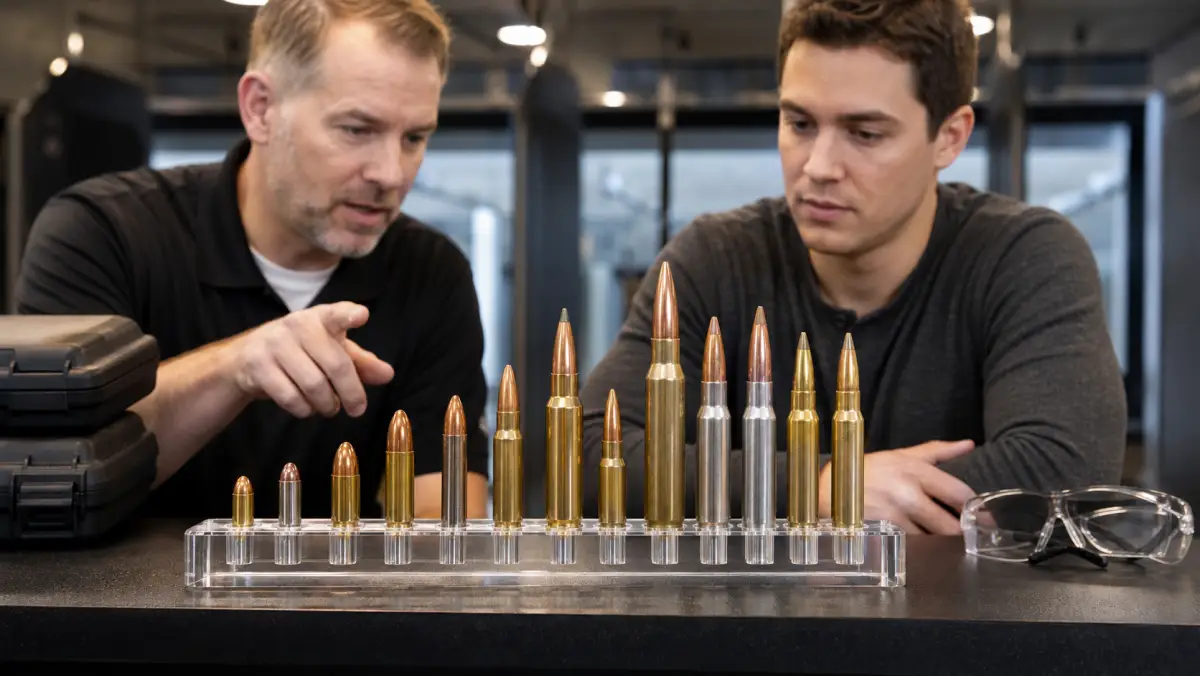
Cartridges can look remarkably similar on a counter or in a range bag. Visual comparison cannot reveal every important dimension, pressure standard, projectile construction, or manufacturer restriction.
Never test compatibility by forcing a cartridge into a chamber. SAAMI advises that ammunition should chamber easily and that a cartridge requiring unusual force should not be fired. At a range, keep the muzzle in the designated safe direction, keep the finger away from the trigger, and request staff help when a cartridge does not feed or chamber normally.
Do not assume interchangeability because:
- The numerical names match partly.
- The cases appear to be the same length.
- The cartridge enters the chamber.
- A friend says they have done it before.
- An online discussion describes a special exception.
- The magazine accepts both products.
- A used firearm has a different label on its case.
Some firearms are specifically designed and marked by the manufacturer to use more than one cartridge. That is a documented feature—not a pattern beginners should generalize to other firearms.
Why caliber alone does not predict felt recoil
Recoil is often the first question a beginner asks after caliber. The printed cartridge name is relevant, but the experience is also shaped by the firearm and shooter.
Felt recoil can vary with:
- Firearm weight and overall design.
- Grip size, shape, and texture.
- Stock fit for long guns.
- The shooter’s stance and instruction.
- Projectile weight and the particular factory load.
- Action type and operating system.
- Muzzle devices, where lawful and range-approved.
- Hearing protection and anticipation.
- Fatigue, injury, and prior experience.
That is why “smaller firearm” does not automatically mean “easier firearm.” A very compact handgun may have less surface area to grip and less mass to absorb movement. A larger firearm may fit poorly for a different student.
Do not diagnose recoil comfort by reading a caliber list. Qualified instruction and supervised comparison provide better evidence.
Practice cost and availability matter
A first-time buyer may budget for the firearm but not the recurring ammunition needed for training. Products differ in local availability and price, and those conditions change. For an owner, understanding firearm calibers also means understanding the recurring cost attached to the choice.
Before selecting a chambering, ask:
- Is factory ammunition consistently stocked in Metro Detroit?
- What is the current price per box?
- Does the range sell or require particular ammunition for rentals?
- Are several reputable manufacturers available?
- What does the firearm manufacturer recommend?
- Does the planned class require a specific round count?
- Can the buyer afford an ongoing practice schedule?
- Does the range permit that cartridge and projectile type?
A product that is difficult or expensive to obtain may reduce practice. That does not make the cartridge bad, but it changes the ownership plan.
Our guidance on range-practice frequency explains how to create a sustainable schedule around experience, coaching, goals, and budget.
Range rules can be narrower than firearm capability
A firearm and cartridge may be commercially available while a particular range prohibits that combination. Backstop rating, lane design, noise, ventilation, projectile construction, insurance, and facility policy all affect what a range permits.
Michigan DNR’s current shooting range rules illustrate how specific a range can be: different distances are designated for particular firearm types, some large centerfire rifles are prohibited, and incendiary, explosive, and tracer ammunition are not allowed. Private indoor facilities maintain their own rules.
Before visiting, provide staff with:
- The exact firearm manufacturer and model.
- The complete cartridge designation.
- The ammunition manufacturer and product line.
- Projectile construction if known.
- Any unusual feature that may affect facility policy.
Ask for confirmation before traveling. Do not rely on a social post or an answer from another customer.
Understanding firearm calibers includes understanding that compatibility with the firearm and permission at the range are separate questions.
What should a beginner consider when choosing a caliber?
There is no universal “best beginner caliber.” The responsible choice fits a lawful purpose, the student’s ability, the firearm, training access, range rules, and the total ownership plan.
Evaluate these factors together:
Lawful purpose
Recreational target shooting, collecting, hunting, and preparation for licensed carry involve different legal and practical considerations. Define the real purpose before comparing products. This guide does not recommend a firearm for use against people.
Firearm fit and operation
The shooter should be able to establish a safe grip or shoulder position, reach controls appropriately, see the sights, and follow the manufacturer’s operating sequence under instruction. Chambering cannot compensate for poor fit.
Training and rental access
A common chambering with available training firearms may be easier to experience before purchase. Confirm rental inventory and policies in advance; availability changes.
Ammunition cost and supply
Calculate a realistic first-year practice budget. Include classes, range fees, targets, eye and hearing protection, maintenance, secure storage, and ammunition.
Recoil comfort
Assess recoil only in an authorized, supervised setting after a safety orientation. Stop when pain, fear, or loss of control affects behavior.
Maintenance and manufacturer support
Confirm that manuals, magazines, replacement parts, and authorized service are available. A less common cartridge may be tied to a less common platform.
The first-handgun planning guide provides a complete decision process for shoppers considering a handgun specifically.
Use rentals for context, not a one-target verdict
Range rentals can help a beginner compare fit, controls, recoil sensation, sight visibility, and operating confidence before purchasing. They work best with qualified guidance.
Do not rent several unfamiliar firearms and race through them. Start with a clear purpose and disclose your experience. Ask staff to explain each model’s controls and the facility procedure. If you cannot handle independently, schedule instruction rather than relying on a companion’s informal coaching.
One target does not establish long-term suitability. Consider:
- Whether the firearm remained comfortable throughout the session.
- Whether controls were reachable without unsafe repositioning.
- Whether the shooter could follow the same safe sequence.
- Whether ammunition is affordable for continued practice.
- Whether secure storage fits the firearm and household.
- Whether instructor feedback supports the choice.
Range 313’s guide to visiting a shooting range without owning a gun explains rental planning, identification questions, costs, and beginner support.
Questions to ask at the retail counter
When comparing firearms and ammunition, ask specific questions rather than “Which caliber is best?” Understanding firearm calibers becomes practical when the counter conversation identifies an exact model, cartridge, and intended lawful use.
- What is the complete chambering designation for this exact model?
- Where is the designation marked on the firearm?
- Which factory ammunition does the manufacturer approve?
- Does the manual permit more than one cartridge designation?
- Is this ammunition allowed on Range 313’s lanes?
- What projectile types does the range prohibit?
- What is the current price and local availability for practice ammunition?
- Can I rent a comparable firearm before purchasing?
- Which beginner course matches this operating system?
- What secure-storage option fits the firearm and household plan?
- How is warranty or manufacturer service handled?
- What should I do with damaged or unidentified ammunition?
A trustworthy answer includes limits. Staff may need the exact box or model number before confirming compatibility. Waiting is safer than accepting a guess.
Store ammunition so identification remains clear
Safe storage is also an information-management system. Original packaging preserves the cartridge name, manufacturer, product line, lot information, and warnings.
SAAMI recommends storing ammunition in original packaging or packaging designed for the purpose, in a cool and dry place away from heat, flame, solvents, and other chemicals. Its guidance also recommends securing ammunition from unauthorized access and storing it separately from firearms.
Create a simple household system:
- Keep different cartridge designations in clearly separated containers.
- Preserve factory labels and lot numbers.
- Do not mix loose rounds into an unmarked box.
- Restrict keys, combinations, and access devices.
- Keep ammunition away from children and unauthorized people.
- Inspect packaging periodically for moisture or damage.
- Maintain a private inventory without publishing storage details.
ATF’s current firearms handling and storage guidance also emphasizes secure firearm and ammunition storage and limiting access to authorized adults.
Understanding firearm calibers becomes much harder when household storage allows labels and products to separate.
What to do with damaged or unidentified ammunition
Do not fire ammunition that is corroded, deeply dented, scratched, water-damaged, heat-exposed, contaminated, or otherwise questionable. Do not attempt to repair a cartridge or take it apart.
Keep questionable ammunition separate from usable stock in an appropriate container and contact the manufacturer, range, local law enforcement, fire department, or local hazardous-material authority for disposal guidance. Requirements differ by location. Do not place live ammunition into ordinary trash, a recycling bin, or a range’s spent-brass container unless the responsible authority specifically directs that method.
If ammunition behaves unexpectedly at the range, maintain safe direction, keep the finger away from the trigger, follow the facility’s procedure, and request immediate help. Do not turn around with the firearm or look into the muzzle.
The Michigan firearm safety basics guide explains how overlapping safety rules continue to protect people when a condition is uncertain.
Common caliber myths beginners should avoid
“The bigger number is always more powerful”
Cartridge names are not a universal performance scale. Compare manufacturer specifications for the exact product and use qualified guidance for the intended lawful activity.
“If it fits, it fires safely”
Physical fit does not establish safe compatibility. Never force a cartridge, and never test a guess by firing.
“All ammunition in one caliber is the same”
Products sharing a cartridge designation can differ in projectile weight, construction, intended use, pressure designation, and manufacturer instructions. Range restrictions may also differ by product.
“Small firearms are best for beginners”
Compact size can reduce grip area and change recoil sensation. Fit must be evaluated with the whole firearm and shooter.
“A friend can identify any loose round by sight”
Visual similarity is not proof. Preserve packaging and request qualified confirmation.
“Caliber determines skill”
Skill comes from safe behavior, instruction, deliberate practice, and honest feedback. Owning a particular chambering does not establish competence.
Understanding firearm calibers at Range 313
Range 313 combines an indoor pistol and rifle range, firearm rentals, training, a retail showroom, ammunition, secure-storage products, and gunsmithing services at 1125 Fort Street in Lincoln Park.
That connected setting allows Metro Detroit customers to ask about a cartridge at the counter, confirm current range restrictions, compare suitable rentals under the facility’s policies, and connect a purchase decision with training and secure storage.
Call (313) 436-0197 before traveling when a particular firearm, rental, caliber, or ammunition product matters. Inventory and range policies can change. Bring or photograph the complete factory box label when asking a question; do not transport loose unidentified ammunition merely for comparison.
Review Range 313’s retail firearms and ammunition information and current indoor range details before visiting from Detroit, Dearborn, Allen Park, Southgate, Taylor, Wyandotte, Riverview, Trenton, or elsewhere in Downriver.
About the author
The Range 313 Team works with first-time shoppers, rental customers, students, firearm owners, and experienced target shooters at an indoor range, training facility, retail showroom, and service counter in Lincoln Park, Michigan. Staff regularly see the difference between a useful question—“Does this exact factory cartridge match this exact manufacturer-approved chambering?”—and the unsafe shortcut of comparing numbers or appearances.
This article provides general education, not individualized compatibility advice, product endorsement, legal advice, or reloading instruction. Manufacturers, ammunition products, firearm condition, and range policies vary. Use the exact manual and current official guidance for the equipment in front of you.
The beginner takeaway
Understanding firearm calibers is not a memory contest. It is a disciplined identification process.
For a beginner, understanding firearm calibers means slowing down whenever a label, marking, manual, or range rule does not agree with an assumption.
Use the complete cartridge name. Match the firearm marking, current owner’s manual, and factory ammunition packaging. Keep products labeled and separated. Confirm range permission. Ask when a suffix, abbreviation, headstamp, or condition is unclear. Most importantly, never turn a compatibility question into a live-fire experiment.