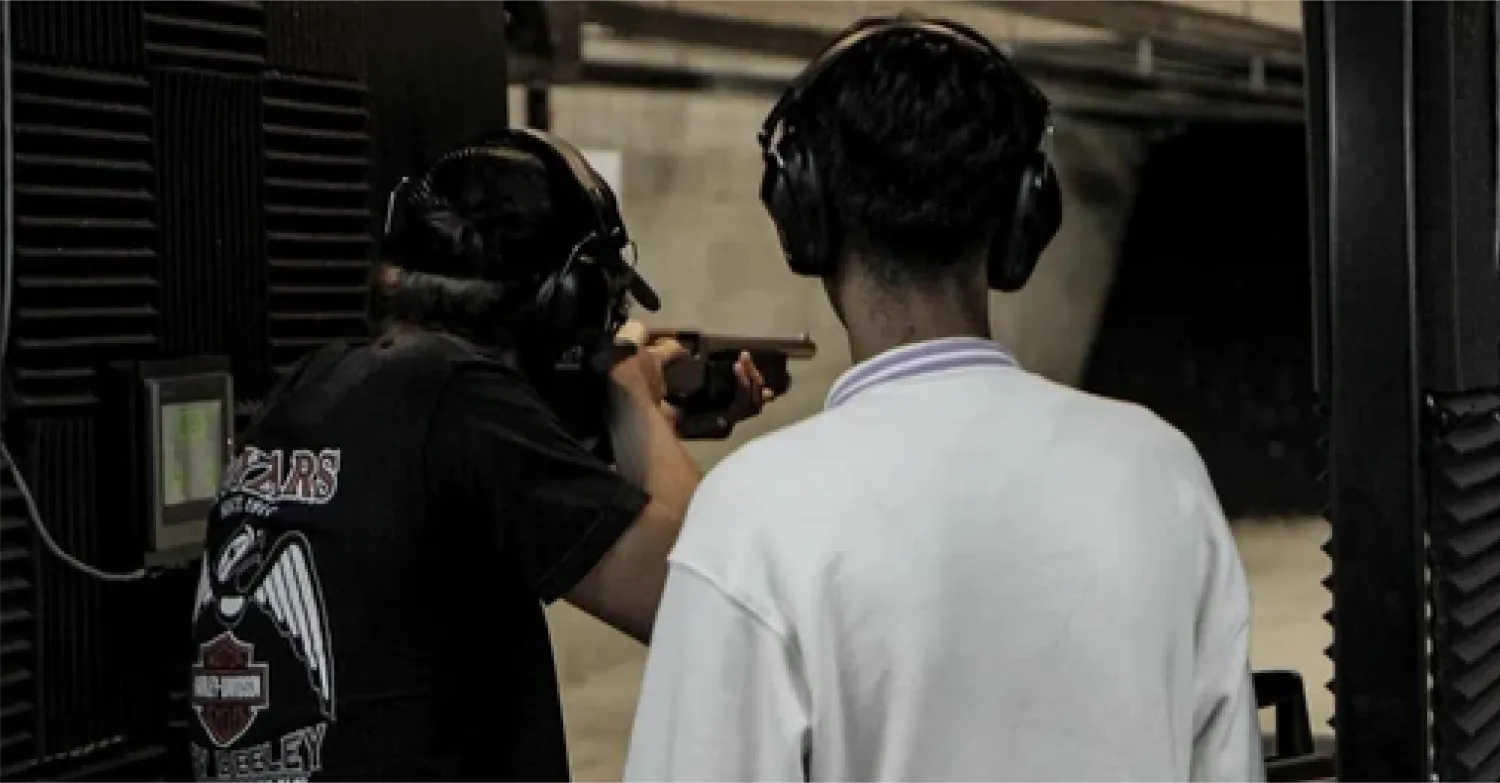
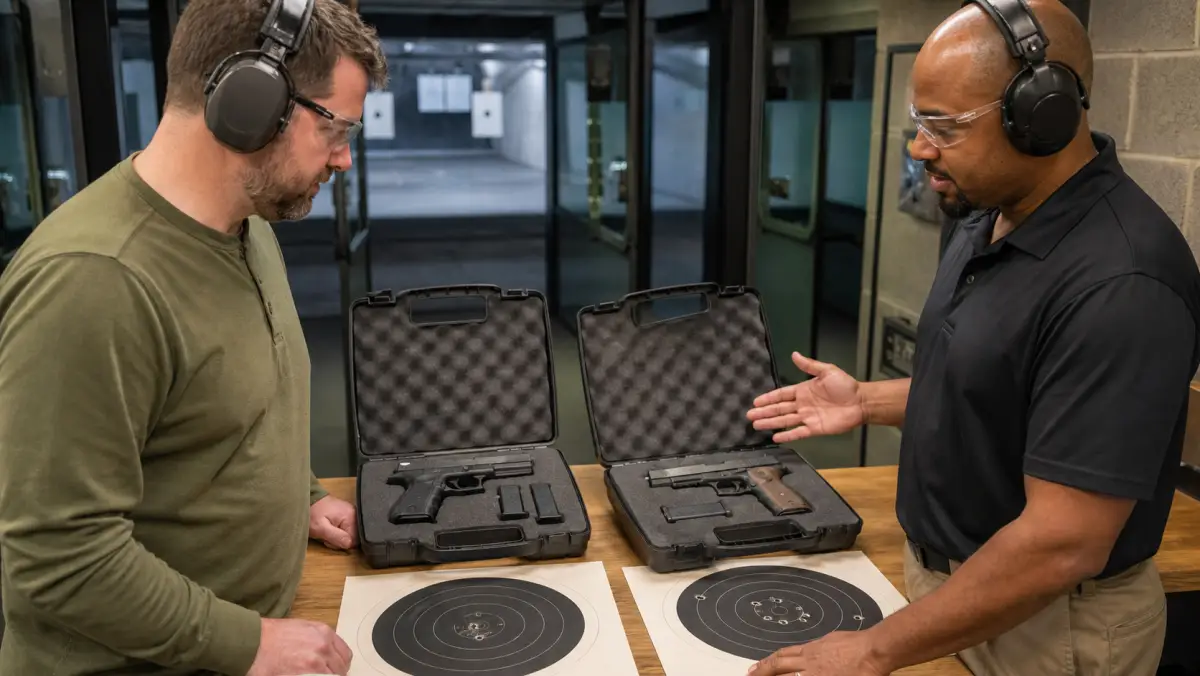
If you can try a firearm before buying it, a supervised rental session can replace assumptions with direct, limited evidence. Counter handling may show whether a grip feels comfortable for a minute. Live fire can reveal whether you can reach the controls, follow the operating procedure, see the sights, manage the noise and perceived recoil, and remain attentive as the session continues.
That does not make a rental session a final verdict. One visit cannot prove long-term reliability, settle every legal question, predict performance in every setting, or replace qualified training. Its value is narrower and more practical: it can expose a poor match before you make an expensive, long-term purchase.
For shoppers in Lincoln Park, Detroit, Dearborn, Allen Park, Southgate, Taylor, Wyandotte, and the rest of Metro Detroit, this guide explains what a responsible try-before-buy visit can reveal, what it cannot, and how to compare options without turning the experience into a rushed sales decision.
Try-before-buy answers at a glance
| Question | Useful answer |
|---|---|
| Why rent first? | To observe fit, control access, sight visibility, perceived recoil, fatigue, and learning needs under supervision. |
| Is counter handling enough? | No. It provides useful fit information but does not reproduce live-fire noise, recoil, or the full operating sequence. |
| Is one target enough to decide? | No. A target reflects the shooter, instruction, distance, pace, ammunition, fatigue, and unfamiliarity as well as the firearm. |
| How many models should a beginner compare? | Usually a short list of two or three comparable options, subject to staff guidance and current availability. |
| Should the cheapest or smallest option win? | Not automatically. Evaluate the complete system, ownership cost, secure storage, and ability to operate it safely. |
| Must the rental and retail model match? | Yes, if the experience is being used to evaluate that exact product. Similar-looking variants may differ. |
| Should a beginner train first? | Yes when the visitor cannot yet handle, load, unload, or respond to range commands safely and consistently. |
| Do rentals guarantee a good purchase? | No. They improve the quality of the decision but do not remove every unknown. |
Why counter fit is only the first filter
A retail-counter evaluation is valuable when staff controls the process and confirms the firearm is unloaded. It lets a shopper assess basic dimensions, grip circumference, control location, sight picture, weight, and whether obvious pressure points exist.
But a five-minute counter impression can be misleading. A grip that initially feels soft or small may become difficult to control during live fire. A heavier firearm may feel inconvenient at the counter yet more comfortable during a short range session. A slide, cylinder release, magazine release, safety, or other control that seems reachable once may become harder to operate repeatedly.
Appearance and reputation are especially weak substitutes for experience. A popular model may not fit a particular person. A compact design may be harder—not easier—for a new shooter to control. A feature that sounds essential in a review may add complexity without helping the buyer’s actual lawful purpose.
People who try a firearm before buying can test those first impressions under controlled live-fire conditions and identify which assumptions deserve to be discarded.
The goal is not to find the firearm that feels most exciting. It is to eliminate poor matches and identify the questions that require more instruction or research.
What live fire can reveal
When a visitor follows the range’s rules and receives appropriate supervision, live fire adds information that cannot be recreated at the counter.
Grip fit during repeated use
Grip fit is not simply whether every finger touches the frame. A useful evaluation asks whether the shooter can establish the grip as instructed, reach the required controls without losing control, maintain contact through several carefully paced repetitions, and avoid painful pressure or pinching.
Hand size alone does not determine the answer. Finger length, joint mobility, strength, past injuries, dominant-eye considerations, and instruction all affect the experience. Adjustable grip components may help on some models, but they do not make every design universal.
Do not alter the rental, add unapproved parts, or force a control. If anything feels wrong, keep the firearm pointed in the designated safe direction, remove the trigger finger, and ask staff for help.
Control reach and operating sequence
A firearm is not suitable merely because the trigger can be reached. The user must be able to follow the complete operating sequence taught for that model. Depending on the design, that may include loading, confirming status, operating a safety, opening or locking the action, unloading, and responding correctly when firing does not proceed as expected.
The comparison should reveal where instruction is needed. If a shopper repeatedly forgets a step or cannot operate a control without changing hand position, the answer is not to hurry. Pause and let a qualified instructor distinguish a training issue from an equipment-fit issue.
ATF’s current firearms handling and storage guidance emphasizes treating every firearm as loaded, maintaining a safe muzzle direction, keeping the finger outside the trigger guard until intending to fire, and wearing eye and ear protection. Those rules remain in effect while comparing products; the evaluation never takes priority over safe handling.
Sight visibility and visual comfort
Different sight systems can appear clear at the counter but behave differently against a target under range lighting. A visitor may discover that a particular front sight is easy to locate, an optic window requires more instruction, or a sight arrangement conflicts with corrective lenses or dominant-eye needs.
One poor group does not prove that the sights are defective or that the firearm is inaccurate. A new shooter may be learning grip, visual focus, and trigger control at the same time. Ask an instructor what they observe before assigning the result to the equipment.
Perceived recoil, noise, and recovery
Recoil is a property of the complete firearm-and-ammunition system as experienced by a particular person. Cartridge designation alone does not predict comfort. Firearm mass, grip shape, operating system, ammunition, technique, physical condition, and expectations all influence perceived recoil.
Noise can also distort a buyer’s judgment. An indoor range produces intense impulse sound, and adjacent lanes add to the environment. NIOSH’s indoor firing range guidance discusses firing-range noise and recommends properly fitted double hearing protection for impulse noise. Follow the facility’s requirements and ask staff how to fit plugs and muffs without compromising eye protection.
A calmer experience produces better observations. If the visitor is flinching, rushing, or anticipating every shot, more instruction may be more useful than changing models repeatedly.
Fatigue and sustained attention
A firearm can feel manageable for the first few minutes and demanding later. Hand fatigue, difficulty maintaining the taught grip, loss of visual focus, and slower control operation are meaningful observations.
Fatigue is also a safety boundary. Stop the comparison when concentration declines. Paying for lane time or ammunition does not create a reason to continue. A shorter session with reliable notes is more valuable than a long session that blends together.
What a rental session cannot prove
A try-before-buy visit reduces uncertainty; it does not eliminate it. Responsible buyers should understand the limits.
It cannot establish long-term reliability
A small number of rounds through a maintained range rental cannot predict years of use. The rental may have a different maintenance history, round count, spring condition, or component configuration from a new retail example. Conversely, a single stoppage does not establish that every firearm of that model is unreliable; ammunition, maintenance, shooter interaction, or another condition may be involved.
Record what happened and ask staff to handle any abnormal condition. Do not attempt improvised diagnosis on the lane.
It cannot prove legal suitability
Rental eligibility, possession, purchase, transportation, storage, and carry are different legal questions. A range allowing someone to use a rental on its premises does not establish that the person may buy, possess, transport, or carry the same model elsewhere.
Michigan State Police maintains the state’s official firearms and concealed-pistol resources . Laws and official interpretations can change, and individual facts matter. Review the current primary sources and obtain qualified legal advice when needed; do not rely on a blog, social-media comment, or memory of an old rule.
It cannot replace a secure-storage plan
A product that performs comfortably at the range still needs an appropriate storage plan before it enters a home or vehicle. The buyer should identify who may be present, where an authorized adult can secure the firearm, which locking device or container fits the exact product, and how ammunition will be stored.
Storage is not an accessory decision to postpone until checkout. It is part of whether ownership is currently responsible and lawful.
It cannot calculate the complete ownership cost
The sticker price is only one part of the commitment. Budget for manufacturer-approved ammunition, secure storage, eye and hearing protection, a suitable case, maintenance supplies, training, range time, replacement wear parts, and any fees or legal processes that apply.
A less expensive firearm that is uncomfortable to practice with or costly to feed may not be the economical choice. A more expensive model is not automatically better. Compare realistic annual cost, not marketing tiers.
It cannot recreate every context
An indoor lane is controlled by facility rules, fixed safe directions, known targets, lighting, and supervision. That is exactly why it is useful for learning, but it does not recreate every lawful sporting, training, or ownership context. Avoid claims that one short target proves universal capability.
An eight-step process to try a firearm before buying
The following process keeps the comparison narrow, documented, and safety centered. Confirm all details with the facility because rental availability and policies can change.
A plan to try a firearm before buying works best when each step answers one defined question and the buyer is willing to stop when the evidence is incomplete.
Step 1: Define the lawful purpose
Write one plain sentence describing the intended lawful use. Examples might include supervised target practice, participation in an approved course, or another lawful sporting purpose. Avoid starting with a brand or model.
Then list the real constraints: hand comfort, accessibility needs, storage dimensions, training availability, ammunition budget, frequency of practice, and any rule set that governs the intended activity. A product cannot be evaluated intelligently without knowing the job it is expected to do.
If the purpose is unclear, instruction is a better first purchase than equipment.
Step 2: Take beginner instruction first
Trying products is not the ideal setting for learning every safety and operating concept from zero. A complete beginner should be candid about experience and ask whether qualified instruction is required before using rentals.
Training helps separate equipment problems from new-shooter problems. It establishes a consistent safe direction, trigger-finger discipline, grip, sight use, loading and unloading procedure, response to commands, and a method for stopping when uncertain.
Range 313 offers firearms courses for different experience levels . Contact the team before visiting so the appropriate class or instructor support can be matched to the visitor rather than assumed at check-in.
Step 3: Shortlist two or three comparable rentals
A comparison works when the candidates could plausibly satisfy the same purpose. Comparing a tiny lightweight pistol, a full-size target pistol, and a specialty rental may be entertaining, but it does not isolate useful differences.
Choose two or three options in a similar category. Keep the number small enough to remember the procedures and record honest impressions. If the first model is clearly uncomfortable or unsuitable, stop using it and ask for guidance rather than trying to complete an arbitrary test.
The existing first-handgun buyer’s guide for Michigan provides a broader framework for purpose, fit, budget, dealer process, storage, and maintenance. Use that framework to build the shortlist before spending money on rentals.
Step 4: Confirm exact models and current range policy
Call before traveling. Ask about:
- The exact rental manufacturer, model, variant, and chambering.
- Whether each candidate is expected to be available.
- Government-issued identification requirements.
- Age, eligibility, guest, and first-time visitor policies.
- Whether a beginner must schedule an instructor.
- Lane, rental, target, and ammunition charges.
- Which ammunition must be purchased or used.
- Required eye and hearing protection.
- Reservations, wait times, and session length.
- Any restriction relevant to the planned comparison.
Do not assume that a rental photo or online inventory is real-time. A similar variant may have a different grip, barrel length, control layout, sight system, capacity, or operating procedure. If the retail product and rental are not the exact same configuration, record the difference instead of treating the experience as conclusive.
Range 313’s indoor range page lists firearm and hearing-protection rentals, first-time shooter assistance, orientation, and basic instruction. Current inventory and access depend on the day, so call (313) 436-0197 before making a special trip to Lincoln Park.
Step 5: Receive model-specific orientation
Even experienced visitors should listen to the facility’s rules and ask about an unfamiliar rental. Have staff or the instructor identify the controls and demonstrate the approved loading, unloading, bench, cease-fire, and stoppage procedures.
Never infer the chambering from appearance. SAAMI’s safe ammunition handling recommendations say that the cartridge designation on the ammunition should match the designation marked on the firearm, unless the firearm’s documentation specifically permits another cartridge. With a rental, use only ammunition the range supplies or expressly approves.
If the firearm does not behave as expected, keep it oriented as instructed, remove the finger from the trigger, and signal staff. The comparison pauses until the situation is resolved.
Step 6: Compare one variable at a time
Use a simple, consistent objective. The purpose is not to produce the smallest target or compete with a friend. It is to observe whether each firearm supports safe, repeatable operation under equivalent conditions.
When staff approves, keep these factors as consistent as practical:
- Target type and distance.
- Short, deliberate strings rather than a high round count.
- Approved ammunition category.
- Instructor cue and basic technique.
- Rest interval between candidates.
- Note-taking questions.
Do not change stance, grip method, distance, pace, ammunition, and firearm at once. Too many variables turn the target into noise.
Step 7: Record fit, control, comfort, and attention
Write notes immediately after each candidate. Memory tends to preserve the most exciting or most recent experience, not the most suitable one.
Use a simple zero-to-two scale:
| Category | 0 — stop or serious concern | 1 — needs more evaluation | 2 — comfortable under instruction |
|---|---|---|---|
| Grip fit | Pain, pinching, or unstable contact | Usable with adjustment or fatigue | Repeatable grip without strain |
| Control reach | Cannot operate as taught | Can operate with coaching or grip change | Reaches and operates consistently |
| Sight visibility | Cannot acquire the sight system | Inconsistent or needs correction | Clear enough for the task |
| Recoil comfort | Loses safe control or becomes distressed | Manageable briefly with coaching | Remains controlled and attentive |
| Procedure recall | Misses critical steps | Requires repeated prompts | Follows the sequence consistently |
| Fatigue | Attention or control degrades quickly | Some strain appears | Remains stable for the short test |
This is not a universal product score. A “2” means only that the candidate was comfortable for that person, on that day, under those conditions. Add the instructor’s observations separately; do not rewrite them to match the preferred brand.
Step 8: Wait and review the complete decision
Do not let the cost of the rental create pressure to buy immediately. Take the notes home. Compare the exact retail model, warranty, manual, training access, maintenance expectations, secure-storage options, ammunition availability, and realistic annual cost.
Visit the Range 313 retail and firearm-services page to understand the categories of purchasing assistance, firearms, secure storage, protective gear, maintenance supplies, and transfers available in store. Product availability changes, and every transaction remains subject to current law and eligibility requirements.
If two options remain close, another short supervised session after rest may be more useful than choosing from memory. If neither candidate works, that is a successful comparison: it prevented a poor purchase.
Use a decision scorecard, not a target contest
New buyers often overvalue the paper target. A good group feels objective, but it combines too many influences to serve as a product verdict: instruction, distance, pace, visual focus, anticipation, grip, trigger control, ammunition, unfamiliar controls, fatigue, and random variation.
Instead, organize the decision into four groups. This scorecard helps a shopper try a firearm before buying without mistaking a single target for a complete product test.
Safety and operation
- Can the visitor follow every range command?
- Can the firearm remain in the designated safe direction throughout handling?
- Are loading, unloading, and status checks understood?
- Can each necessary control be operated as taught?
- Does confusion increase as the session continues?
Any serious safety or operating concern outweighs appearance, capacity, popularity, and price. A qualified instructor may be able to resolve a technique issue; a poor physical fit may justify eliminating the model.
Physical fit and comfort
- Is the grip repeatable without painful pressure?
- Can the shooter see the sight system with their normal corrective lenses?
- Does recoil remain manageable without losing the taught grip?
- Do hot spots, pinching, or joint strain appear?
- Does fatigue arrive unusually quickly?
Comfort does not mean the firearm should feel like a toy or require no training. It means the person can operate it responsibly without fighting avoidable incompatibility.
Learning and practice
- Is qualified instruction available for this operating system?
- Can the owner afford regular, purposeful practice?
- Is suitable, manufacturer-approved ammunition locally available?
- Can the user explain the safe procedure after coaching?
- Is the model’s manual and manufacturer support accessible?
A firearm that will not be practiced with is a weak long-term choice. The buying decision should include the next class and next range visit, not end at the register.
Ownership and storage
- Is there a lawful secure-storage solution for the exact firearm?
- Can unauthorized people be prevented from gaining access?
- Does the budget include the locking container or device?
- Is lawful transportation understood?
- Are maintenance tools and a safe cleaning location available?
These questions may reveal that the right decision is to delay ownership. Renting for supervised practice remains an option for eligible visitors who meet the facility’s current policies.
Common try-before-buy mistakes
Choosing the smallest firearm first
Small dimensions may help with one constraint, but they can reduce gripping surface and change perceived recoil. Let purpose, fit, instruction, and the whole ownership plan guide the shortlist.
Comparing too many models
A long rental marathon creates fatigue and blurs procedures. Two carefully chosen candidates with clear notes usually teach more than six unrelated ones.
Letting a friend choose
An experienced friend can support the visit, but their hand size, preferences, skill, and intended use do not transfer to the buyer. Range staff and qualified instructors should control safety and equipment orientation.
Hiding inexperience
Claiming experience to avoid instruction makes the visit less safe and the comparison less useful. Tell staff what is unfamiliar. The purpose of the session is to learn.
Treating discomfort as a challenge
Pain, inability to operate controls, distress from noise, or declining attention are signals to stop. They are not hurdles that must be pushed through to prove commitment.
Buying the winner immediately
The most comfortable rental may still be incompatible with the storage plan, budget, lawful purpose, or exact retail configuration. Review the decision after the excitement of the session has passed.
Ignoring cleaning and lead hygiene
Indoor-range use involves noise and potential lead exposure. Follow facility hygiene instructions, wash hands and exposed skin after the session, keep food and drinks out of prohibited areas, and avoid bringing contaminated clothing or footwear into spaces where children may be exposed. NIOSH’s firing-range guidance explains why ventilation, housekeeping, and hygiene matter alongside personal protection.
Trying a firearm at Range 313 in Lincoln Park
Range 313 serves new and experienced shooters from Lincoln Park, Detroit, Dearborn, Allen Park, Melvindale, Ecorse, Southgate, Taylor, Wyandotte, and communities throughout Downriver and Metro Detroit. The facility offers pistol and rifle lanes, firearm rentals, specialty rentals, hearing-protection rentals, first-time shooter assistance, orientation, and basic instruction.
Before visiting to try a firearm before buying, call (313) 436-0197 and explain the goal clearly. Ask whether the exact models are available, which identification to bring, what ammunition is required, what the visit will cost, and whether an instructor should be scheduled.
Metro Detroit shoppers who try a firearm before buying should plan enough time for check-in, orientation, a short comparison, note-taking, and rest rather than treating the visit as a quick stop before checkout.
Visitors who do not own equipment can also use the detailed guide to visiting a Michigan shooting range without owning a gun . That article explains the broader rental check-in, clothing, protective equipment, cost, and first-visit process.
The range session and retail conversation should remain separate enough for the customer to think. A useful staff discussion identifies what the customer experienced, corrects misunderstandings, confirms exact product differences, and leaves room to go home without purchasing.
About the author
The Range 313 Team works with first-time visitors, rental customers, students, recreational shooters, and firearm owners at an indoor range and retail facility in Lincoln Park, Michigan. This guide combines daily customer questions with official ATF, CDC/NIOSH, SAAMI, and Michigan resources. It provides general educational information, not legal advice or individualized instruction. Facility policies, inventory, laws, and individual needs change; confirm current details directly.
The responsible conclusion
The strongest reason to try a firearm before buying is not to crown a winner after one target. It is to discover what you do not yet know while the experience is supervised, limited, and reversible.
A responsible rental comparison can reveal fit problems, difficult controls, sight-visibility issues, recoil discomfort, fatigue, and gaps in training. It can also confirm that a short-listed option deserves further research. What it cannot do is guarantee reliability, answer every legal question, create a storage plan, or replace professional instruction.
Define the lawful purpose, train first when needed, compare a small number of exact models, keep the conditions consistent, record observations, and wait before buying. Sometimes the best result is confidence in a careful choice. Sometimes it is the money saved by walking away. Both are valuable.