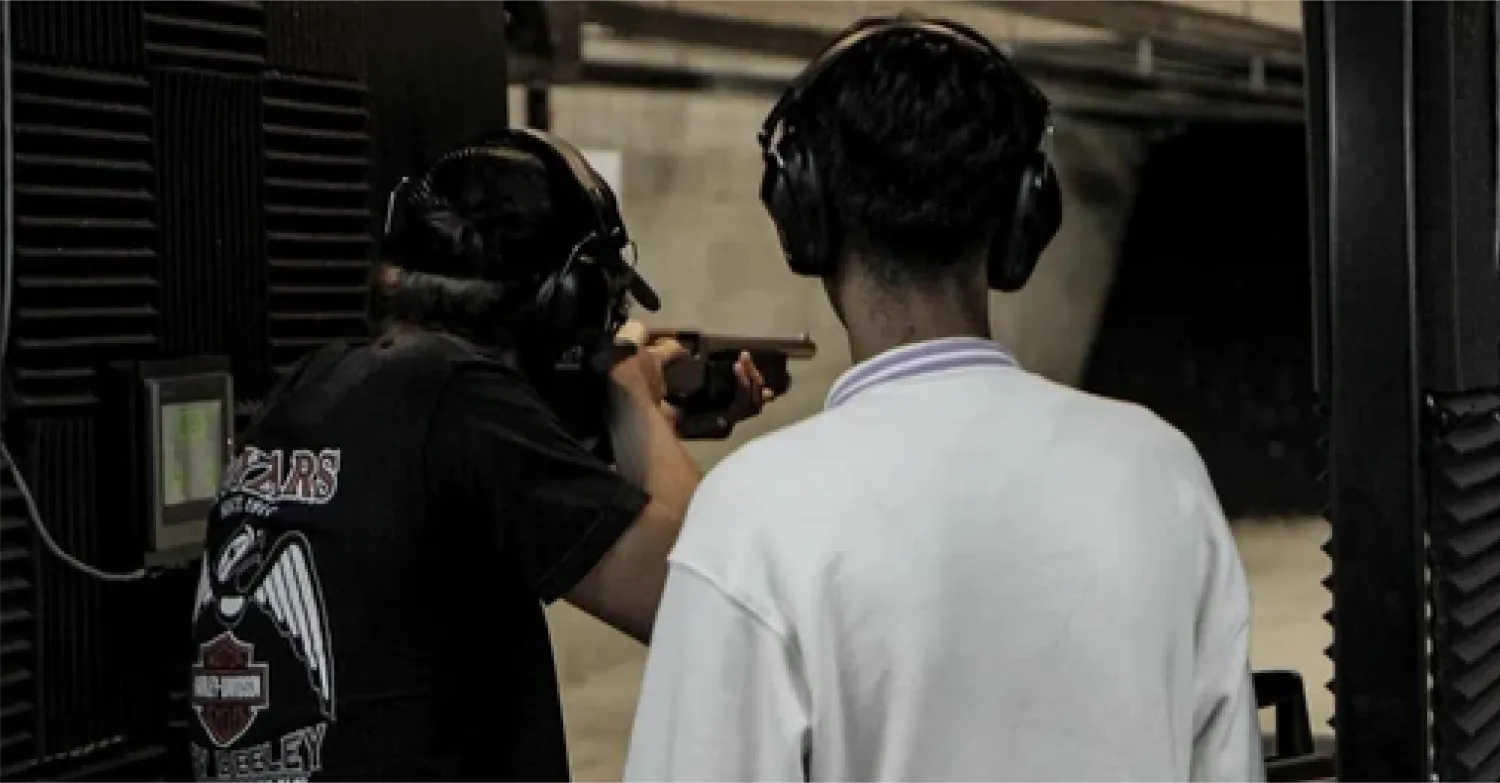
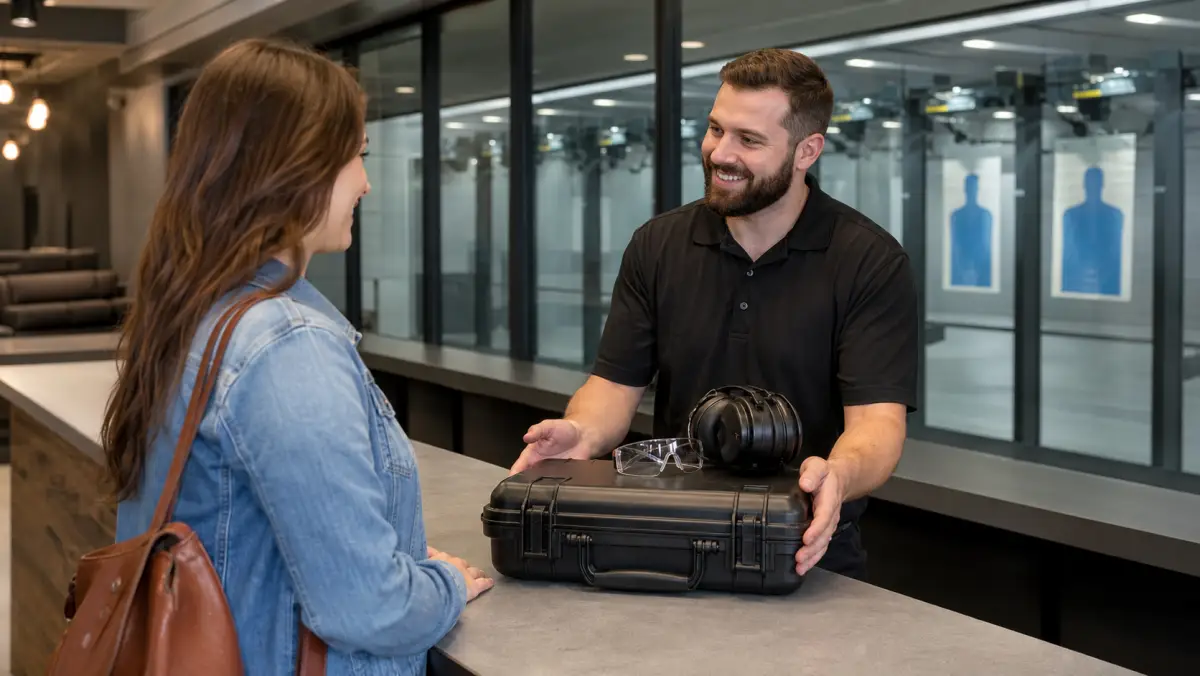
Yes, you can visit a shooting range without owning a gun. Many indoor ranges rent firearms for use on their premises, making a supervised range visit possible for beginners, travelers, occasional target shooters, and people researching a future purchase. Ownership is not the starting requirement. What matters is meeting the facility’s current identification and eligibility rules, completing its check-in process, following every safety command, and getting appropriate instruction when you do not yet know how to handle a firearm independently.
At Range 313 in Lincoln Park, firearm rentals, specialty rentals, hearing protection rentals, pistol lanes, rifle lanes, and first-time shooter assistance are available. Rental inventory and policies can change, so call before making a special trip—particularly if you are coming from another Michigan city or crossing from Ontario.
This guide explains how a rental range visit works, what to bring, what costs to expect, when instruction is the right first step, and how trying a firearm at the range can inform a later buying decision. It is general educational information, not legal advice.
The short answer: ownership is not required
Going to a shooting range without owning a gun usually means renting a firearm that remains at the facility and is used only on the assigned lane. The range controls which rentals are currently available, which ammunition may be used, who is eligible to rent, and what supervision or prior experience is required.
That last point is important: there is no single rental policy shared by every indoor range. A policy may address age, identification, group composition, first-time visitors, international guests, ammunition, protective equipment, or whether an instructor must be scheduled. Do not assume that a policy described by a friend or another business applies everywhere.
| Question | Practical answer |
|---|---|
| Must I own a firearm? | No, if the facility offers a suitable rental and you meet its current policies. |
| Can I arrive with no experience? | Be honest about your experience and ask whether orientation or instruction is required. |
| Do I need identification? | Yes. Bring valid government-issued photo identification and confirm accepted documents. |
| Is ammunition included? | Do not assume it is. Ask what must be purchased for the rental. |
| Are eye and hearing protection required? | Expect both to be required in the live-fire area; ask whether rentals are available. |
| Can I choose any firearm? | Selection depends on inventory, eligibility, lane limits, and staff judgment. |
The safest plan is a short phone call before you leave. Range staff would rather answer a basic question in advance than have you arrive without required identification, clothing, or enough time for instruction.
How firearm rentals at an indoor range work
Although check-in details differ, a responsible rental visit follows a predictable sequence. Understanding it reduces uncertainty and helps a first-time guest focus on safety instead of trying to absorb everything at once.
Confirm the rental policy before traveling
Tell the range whether you are visiting alone or with others, whether anyone is under the age threshold set by the facility, and whether each person has prior shooting experience. Ask which identification is accepted, whether reservations are recommended, and what rental options are expected to be available.
If you are a complete beginner, ask a direct question: “Should I schedule an instructor for my first visit?” The answer may depend on staffing and your group. Basic range orientation explains facility procedures, but it is not automatically a substitute for a firearms safety class or one-on-one instruction.
Range 313’s indoor shooting range information lists firearm rentals, first-time shooter assistance, safety orientation, and basic instruction. Contact the team to confirm current availability before driving to Lincoln Park.
Bring valid identification and arrive early
Bring current, valid government-issued photo identification. International visitors should confirm which original documents are accepted before crossing the border or beginning a long drive. A photograph of an identification document on a phone may not be accepted.
Arrive early enough to read and complete the waiver carefully. You may also need time for rental selection, protective equipment, rules, and lane assignment. Rushing is especially unhelpful when every procedure is new.
Do not consume alcohol, cannabis, or any impairing substance before a range visit. The Michigan DNR shooting range rules prohibit alcohol and people under the influence on the firing line. Private indoor facilities maintain their own rules, which may be stricter. If medication or a health condition could affect safe participation, obtain appropriate professional advice before visiting.
Complete orientation and listen to staff
The orientation should explain safe direction, trigger-finger placement, how firearms enter and leave the lane, cease-fire commands, target procedures, and what to do if the firearm does not behave as expected. Listen even if someone in your group says they already know the rules. The facility’s procedure governs that facility.
Ask questions before handling anything. A useful phrase is, “Please show me what you want me to do at this range.” It invites a clear, site-specific explanation without pretending that knowledge transfers perfectly from another location.
When a range officer gives a command or correction, stop and follow it immediately. Clarifying questions can come after the situation is stable.
Select a rental for learning, not appearance
The most recognizable or smallest firearm is not automatically the easiest place to begin. Tell staff about your experience, hand comfort, physical limitations, and learning goal. A suitable first rental should allow you to establish a secure grip, reach the controls appropriately, see the sights, and follow instruction without unnecessary strain.
Do not turn the first visit into a challenge to tolerate the largest caliber or most unusual rental. Novelty can be saved for later. A calm session with manageable equipment gives you better information and a better opportunity to learn.
The rental firearm, approved ammunition, and lane must be treated as one system. Use only the ammunition supplied or approved under the range’s rental policy. Never bring unknown loose ammunition and assume it can be used in a rental.
What to bring when you do not own equipment
Visiting a shooting range without owning a gun does not mean arriving empty-handed. A little preparation improves comfort and prevents common problems.
Bring:
- Valid government-issued photo identification accepted by the facility.
- A payment method for lane time, rental fees, ammunition, targets, and protective equipment.
- Closed-toe shoes with stable footing.
- A crew-neck or similarly close-fitting shirt that reduces the chance of a hot cartridge case falling inside the neckline.
- Prescription eyewear or other personal items you need, while confirming how they work with required safety glasses.
- A hair tie if long hair could interfere with eye or hearing protection.
- Any questions you wrote down before the visit.
Avoid low necklines, open-toe shoes, loose scarves, dangling accessories, or clothing that interferes with movement and protective equipment. A brimmed cap can add coverage from ejected cases, but it must not break the seal of earmuffs or obstruct vision.
Eye and hearing protection are essential. CDC/NIOSH notes that firearm discharge at indoor ranges can exceed occupational peak-noise guidance and discusses correctly fitted protection in its indoor firing range safety guidance . Range 313 offers hearing protection rentals, but you should confirm what eye protection is available and whether you prefer to bring properly rated equipment that fits you.
Our detailed eye and ear protection guide explains plugs, earmuffs, safety glasses, fit, and common mistakes.
What a rental range visit costs
The advertised firearm rental price is only one part of the session. Build a complete estimate before choosing a range. Depending on the facility and rental, the total may include:
- Lane time.
- Firearm rental.
- Facility-approved ammunition.
- Targets.
- Eye and hearing protection.
- Instruction or a beginner class.
- Additional-person or guest fees.
- Taxes or other disclosed charges.
Ask whether lane time is sold by the half hour or hour, whether a rental allows access to more than one model, and whether unused ammunition can be handled under the facility’s policy. Do not select the shortest session if it leaves no time for a careful orientation.
A more expensive visit with qualified instruction can offer better value than an unsupervised session spent confused or uncomfortable. Measure value by what you learn and how safely the session runs, not by the number of rounds fired.
Can a complete beginner go to the range?
Yes, beginners are welcome at many indoor ranges, but “beginner-friendly” should mean more than friendly conversation at the counter. A beginner needs clear expectations, a controlled pace, understandable commands, appropriate rental options, and access to qualified help.
Tell staff if you have never handled a firearm. Do not say that you are “basically familiar” because you watched videos or accompanied someone years ago. Honest disclosure helps the team decide whether a lane orientation is sufficient or structured instruction should come first.
Consider booking firearms training at Range 313 before or alongside your first independent range session if you cannot confidently:
- Keep the muzzle in the required safe direction at all times.
- Keep your finger clearly outside the trigger guard until instructed and ready to fire.
- Identify the firearm’s condition under supervision.
- Follow loading, unloading, and cease-fire procedures.
- Stop immediately and ask for help when something feels wrong.
A class gives the instructor time to explain, demonstrate, observe, and correct. Friends can offer encouragement, but an experienced friend is not automatically a qualified instructor.
What your first rental session should look like
A first session should be deliberately modest. You are learning the building, commands, protective equipment, rental system, firearm, sights, recoil, target carrier, and checkout process at the same time.
Start with one clear objective
Choose a goal such as completing orientation safely, learning the basic controls under supervision, or firing a small number of careful groups. Do not make accuracy scores or speed the standard for success.
Keep the bench simple
Place only approved items on the bench. Keep drinks, phones, bags, and unused equipment out of the way. If you want a photograph, ask about the facility’s policy and handle it only when the firearm is secured as directed. Never interrupt another person’s live-fire sequence for content.
Pause when you become tired
Indoor ranges are loud and mentally demanding. Fatigue can reduce attention even during a short visit. Step away according to staff directions when you need a quiet break. There is no obligation to use every minute or every round.
Finish under the range’s procedure
When the session ends, do not improvise the return process. Ask staff how the rental must be cleared, positioned, and returned. Leave the lane organized and wash your hands with cold water and soap after shooting. Avoid eating or touching your face before washing.
For a complete arrival-to-departure plan, use our first-time Michigan shooting range checklist .
Renting before buying can prevent an expensive mistake
One major benefit of visiting a shooting range without owning a gun is the opportunity to learn before purchasing. Counter handling can reveal some aspects of fit, but live fire adds information about recoil comfort, sight tracking, control reach, and whether you can operate the firearm consistently under supervision.
Compare one variable at a time. If you try several dramatically different models while also changing ammunition and technique, the experience becomes difficult to interpret. Take notes after each rental rather than relying on memory.
Useful comparison questions include:
- Can I establish a repeatable grip without strain?
- Can I reach the controls appropriately after instruction?
- Are the sights easy for me to see?
- Can I operate the slide or action safely?
- Is the recoil manageable enough to practice good habits?
- Does the model fit my lawful purpose, training plan, and secure-storage plan?
Do not buy solely because the first rental felt exciting. Take training, compare reasonable alternatives, understand the total ownership cost, and prepare secure storage. Our Michigan first-handgun buying guide provides a structured next step.
Local considerations for Metro Detroit and Ontario visitors
Range 313 is at 1125 Fort Street in Lincoln Park, convenient to Downriver communities including Allen Park, Southgate, Taylor, Wyandotte, Dearborn, and Detroit. A shooting range without owning a gun can be particularly useful for visitors who do not want to transport personal equipment or who are exploring target shooting for the first time.
The Range 313 site states that domestic and international visitors are welcome with valid identification. Visitors from Windsor, LaSalle, Tecumseh, Essex, Amherstburg, Kingsville, and Leamington should still call before traveling. Border rules, admissibility, accepted identification, age requirements, and rental policies are separate questions; a range rental does not create an exception to any applicable law.
Ask what original identification to bring, whether advance booking is recommended, and how much time to allow. Never transport a firearm, ammunition, magazine, component, or other regulated item across an international border without confirming and complying with every applicable requirement. When the plan is only to use a facility rental, keep it that simple.
Common mistakes to avoid
First-time rental guests can avoid most frustration by not making these assumptions:
Assuming every rental is always available
Inventory can be in use, out for maintenance, or changed. Call if a particular type matters to your visit, while remaining open to staff recommendations.
Treating orientation as optional
Even experienced visitors must learn the facility’s rules. Pay attention and ask before acting.
Choosing equipment to impress a friend
Your first rental should support safe learning. Competition, teasing, and social pressure do not belong in the decision.
Planning too much for one session
Three rentals, a long ammunition list, photos, and a tight schedule can overwhelm a beginner. Start smaller and leave wanting to return.
Hiding uncertainty
If you do not know what a control does or what a command means, keep the firearm pointed as directed, remove your finger from the trigger area, stop, and ask staff for help. Uncertainty is manageable; pretending is dangerous.
Plan your first Range 313 rental visit
You can absolutely enjoy a shooting range without owning a gun. The responsible approach is to confirm the rental policy, bring accepted identification, dress appropriately, budget for the complete visit, and arrange instruction when your experience does not support independent lane use.
For Metro Detroit and Windsor-area guests, Range 313 combines indoor pistol and rifle lanes, firearm rentals, first-time shooter support, training, and a retail counter in one Lincoln Park location. Call (313) 436-0197 before your visit to ask about current rental availability, identification, lane access, and the best starting option for your experience level.
Ownership can wait. Start with safety, instruction, and a well-planned first experience.