

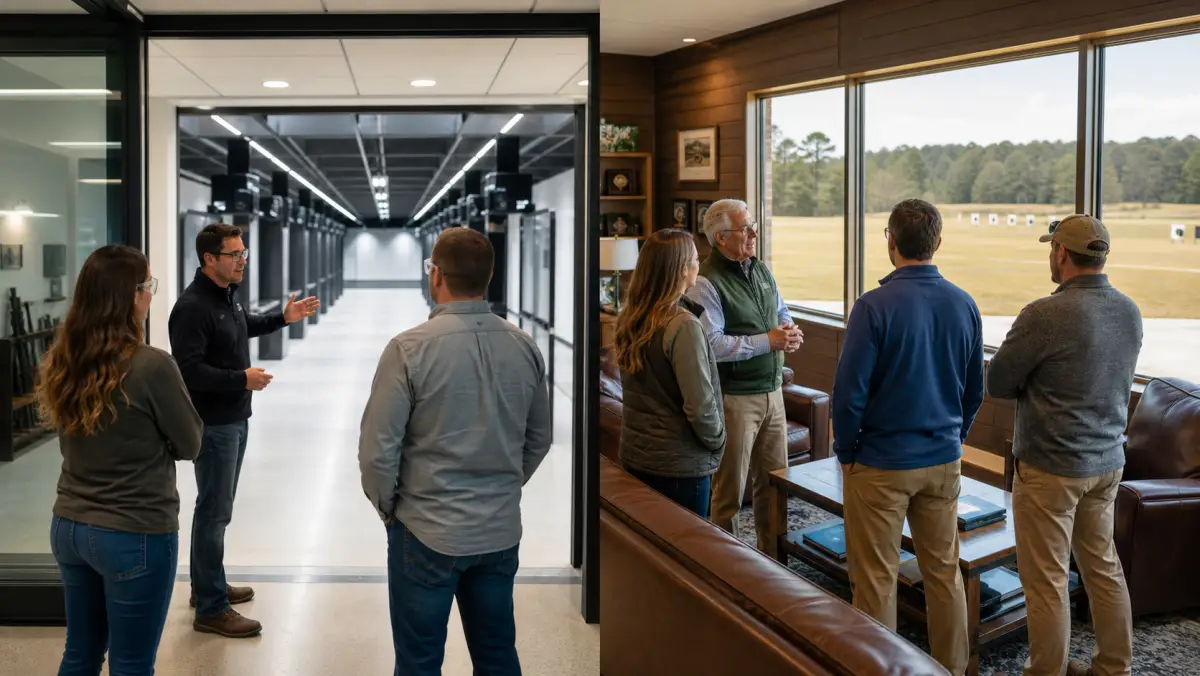
The shooting range vs gun club distinction is simpler than the names sometimes suggest: a shooting range is primarily a place designed for shooting, while a gun club is primarily a membership organization formed around shared shooting interests. The two can overlap. A gun club may own and operate one or more ranges, and a public-facing shooting range may offer memberships without becoming a traditional private club.
For a Michigan shooter deciding where to practice, the label matters less than the actual access policy, facilities, supervision, training, cost, and culture. One “club” may welcome the public on certain days. Another may require sponsorship, orientation, dues, and volunteer hours. One commercial indoor range may offer walk-in lanes, rentals, instruction, retail support, and optional monthly memberships in the same building.
This guide explains those differences from a practical Metro Detroit perspective so you can choose a facility that fits your experience, schedule, and goals.
Shooting range vs gun club: the quick comparison
No universal naming rule forces every facility to use “range,” “club,” “sportsmen’s association,” or “conservation league” in the same way. Treat the name as a clue, then verify the policies.
| Feature | Public-facing shooting range | Traditional gun club |
|---|---|---|
| Primary identity | A facility where approved shooting activities occur | A membership organization built around shared shooting interests |
| Typical access | Walk-in, reservation, day fee, or optional membership | Membership, approved guest, event, or limited public access |
| Payment model | Lane fees, rentals, classes, retail purchases, and memberships | Initiation fee, annual dues, assessments, guest fees, or work hours |
| Common setting | Indoor commercial facility or staffed public range | Often outdoor property, though clubs may operate indoor ranges |
| Equipment rentals | More common at commercial indoor ranges | Varies widely and may be unavailable |
| Community role | Customer relationships, classes, events, and recurring members | Member meetings, leagues, competitions, workdays, and governance |
| Rules | Facility rules and range-officer commands | Facility rules plus bylaws, membership duties, and guest procedures |
| Best fit | Convenience, first visits, rentals, training, weather consistency | Long-term community, specific disciplines, outdoor distances, leagues |
These are patterns, not promises. The Michigan DNR’s statewide shooting range list includes facilities named gun clubs, sportsmen’s clubs, conservation clubs, public shooting ranges, retailers, and commercial ranges. That mix demonstrates why shoppers should compare what a facility does rather than make assumptions from its name.
What is a shooting range?
Michigan law uses a broad physical definition. The state’s Sport Shooting Ranges Act defines a sport shooting range as an area designed and operated for archery, rifles, shotguns, pistols, silhouettes, skeet, trap, black powder, or similar sport shooting. The official Legislature publication Firearms Laws of Michigan includes the Sport Shooting Ranges Act and its operating framework; it does not turn “range” into one particular business model.
In everyday use, a shooting range is the physical place where shooting occurs under established rules. It may be:
- A commercial indoor range open to customers.
- A state-operated or municipal public range.
- A private range owned by a club.
- A training range with scheduled access.
- A facility focused on pistol, rifle, shotgun, archery, or several disciplines.
The word “range” tells you about function, not necessarily ownership. A range can be operated by an individual, business, club, government entity, school, or other organization, subject to applicable requirements.
What a commercial indoor range commonly offers
A public-facing indoor range often emphasizes convenient access and services a visitor can use during one trip. Depending on the business, those services may include lane rental, firearm rental, ammunition and targets, eye and hearing protection, safety orientation, classes, private instruction, memberships, retail products, gunsmithing, and group events.
Indoor ranges also offer protection from Michigan weather. Consistent lighting, target distance, ventilation, and footing make it easier to schedule practice during winter, rain, high wind, or summer heat.
That does not mean every indoor range is identical. Ask about permitted firearms and ammunition, maximum distance, lane time, reservation procedures, ventilation, range-officer coverage, accessibility, rental requirements, and beginner support.
What is a gun club?
A gun club is generally an organization of members who share an interest in target shooting, firearms education, competition, collecting, conservation, or related recreation. The organization may own or lease a physical range, but the club is the group and governance structure—not merely the firing line.
Some clubs are informal associations. Others are incorporated nonprofit or for-profit entities. Some may seek federal tax treatment as social or recreational organizations, while others use different structures. The IRS explains that qualifying Section 501(c)(7) social clubs generally involve limited membership, personal contact among members, and support from dues, fees, and assessments. That tax framework does not define every gun club, but it illustrates the membership-centered nature of a traditional club.
Common club features include:
- Applications, sponsors, interviews, orientations, or probationary periods.
- Initiation fees and annual dues.
- Member meetings and elected leadership.
- Bylaws and voting rights.
- Volunteer workdays or service-hour requirements.
- Organized leagues, matches, youth programs, or discipline-specific groups.
- Guest limits and member-supervision requirements.
- Shared responsibility for property, safety, maintenance, and club culture.
Membership can create community and long-term stewardship. It also creates obligations that a person seeking an occasional one-hour session may not want.
A club may still welcome nonmembers
“Club” does not always mean completely closed. Some Michigan clubs host public matches, sight-in days, classes, charity events, youth programs, or limited guest access. Others appear on public range directories even though their everyday access is membership-based.
Ask what “public” means in practice. It could mean daily access for a fee, attendance only at scheduled events, or use as a member’s guest. Confirm the rule before traveling with equipment.
The biggest difference is usually access
When comparing a shooting range vs gun club, begin with how you are allowed through the door.
A commercial range may allow a qualified visitor to walk in, present accepted identification, complete a waiver and orientation, pay for lane time, and use approved equipment. A reservation may help during busy periods, but a long-term relationship is not necessarily required.
A private club may require you to apply, pay dues, attend orientation, receive a membership card, complete volunteer hours, or wait for approval before independent use. Guests may need to remain with a member and may have visit limits.
Neither model is automatically better. Walk-in access serves someone who wants flexibility, rentals, or a first experience. Membership-controlled access may serve someone who values a particular outdoor discipline, club calendar, or long-term community.
Before visiting, ask:
- Is the facility open to the public today?
- Do I need a reservation or a member sponsor?
- What identification and orientation are required?
- May beginners use the facility without an instructor?
- Are rentals, targets, and protective equipment available?
- What firearm, ammunition, and lane restrictions apply?
Range 313’s Lincoln Park indoor range is public-facing and welcomes walk-in inquiries, while its memberships are optional plans for people who want recurring benefits.
Membership at a range is not the same as club membership
The word “membership” causes much of the confusion. A commercial range can sell a membership plan without operating like a private member-governed club.
A range membership is often a service subscription. It may include lane access, discounts, priority, guest benefits, or other stated features. Customers choose a plan under published business terms; they generally do not vote on company leadership or take responsibility for maintaining the property.
A traditional club membership can be more participatory. Members may vote, serve on committees, attend meetings, help maintain ranges, supervise guests, and follow obligations established in bylaws.
The useful question is not “Does it call me a member?” Ask, “What rights, benefits, responsibilities, and cancellation terms come with this arrangement?”
If you are evaluating recurring access, use our Michigan shooting range membership guide to compare visit frequency, actual savings, priority access, guest policies, and training goals.
Indoor range vs outdoor club facilities
Many Metro Detroit shooters are really comparing an indoor commercial range with an outdoor club. The setting changes what you can practice and how reliably you can schedule it.
Indoor range strengths
An indoor range can provide consistent lighting, defined target distances, weather protection, established lanes, and immediate staff support. Commercial indoor facilities are also more likely to combine rentals, retail products, classes, and services.
This format is useful for first-time visits, handgun fundamentals, controlled groups, equipment familiarization, and shorter practice sessions near home or work. It can be especially practical during Michigan winter.
Potential limits include fixed maximum distance, caliber and ammunition restrictions, busy periods, lane-time pricing, and less access to shotgun or action-shooting disciplines.
Outdoor club strengths
An outdoor club may offer longer rifle distances, separate pistol bays, trap, skeet, sporting clays, archery, muzzleloading, or organized competition. The property can support disciplines that an indoor building cannot.
The tradeoffs may include weather, seasonal hours, travel distance, maintenance closures, limited staff presence, membership duties, and stricter guest access. Some clubs provide excellent beginner programs; others expect new members to arrive with training and equipment.
For a deeper facility comparison, read Indoor vs. Outdoor Shooting Range in Michigan .
Compare safety systems, not just amenities
A long feature list is not enough. The best facility for you should have rules and supervision appropriate to its design and activities.
Ask how orientation works, who can stop the firing line, how cease fires are communicated, where firearms may be uncased, and what happens when a shooter needs help. Review posted rules before handling equipment. Staff corrections should be immediate, clear, and treated seriously.
At a staffed commercial range, range safety officers may monitor active lanes and assist visitors throughout business hours. At a club, members may qualify to use the property during less-staffed periods or rotate line-control duties during organized events. The exact system varies.
Do not assume a quiet property is automatically safer than a busy indoor facility, or vice versa. Safety depends on design, maintenance, rules, training, supervision, and participant behavior.
Beginners should ask whether qualified instruction is available. A facility can be friendly without having the staffing or program needed to teach someone from the beginning. Range 313 offers firearms training courses for visitors who need more structure than a basic lane orientation.
Compare the complete cost
The shooting range vs gun club cost question cannot be answered from one lane fee or one annual-dues number.
For a public-facing range, calculate:
- Lane fees at your realistic visit frequency.
- Rental firearms and protective equipment, if needed.
- Ammunition and targets.
- Instruction.
- Travel time and fuel.
- Optional membership cost and benefits you will actually use.
For a club, calculate:
- Application and initiation fees.
- Annual or monthly dues.
- Assessments.
- Required work hours and the value of your time.
- Guest fees.
- Match, league, or discipline fees.
- Equipment the club does not supply.
- Travel time, seasonal access, and closures.
A club with low annual dues may be excellent value for a weekly shooter who participates in workdays. It may be poor value for someone who visits three times a year. A public indoor range may cost more per visit but save hours of travel and make a 45-minute weekday practice session realistic.
Use your previous six months of behavior when comparing costs. Do not build the calculation around a schedule you have never maintained.
Community and culture feel different
A traditional gun club can provide a durable social network. Members may see one another at meetings, matches, maintenance days, and recurring leagues. That continuity can support mentorship and introduce a shooter to new disciplines.
It can also feel formal to someone who wants privacy and flexibility. Applications, meetings, volunteer obligations, and established social groups are valuable to some people and unnecessary to others.
A commercial range community often forms through staff relationships, classes, memberships, group events, and familiar faces rather than member governance. You may develop consistency without attending meetings or taking responsibility for operations.
Visit before committing. Notice whether staff and members answer beginner questions respectfully, whether rules are applied consistently, whether the property is maintained, and whether the atmosphere supports your goals. Good culture is visible in ordinary interactions, not only marketing language.
Which option is better for a beginner?
A beginner usually benefits from the option that provides the clearest path to safe instruction and supervised practice. That may be a commercial indoor range with rentals and classes, or a club with a strong new-member program.
Choose based on evidence:
- Is there a true beginner course rather than only a waiver video?
- Can you rent appropriate equipment before buying?
- Are instructors qualified and available?
- Will staff slow down and answer questions?
- Are commands and procedures easy to understand?
- Can you return often enough to reinforce what you learned?
Do not join a club merely because an experienced friend belongs. Do not choose an indoor range merely because it is close. A beginner-friendly facility should make safe participation easier to understand and should be candid when a visitor needs instruction before independent lane use.
Our indoor shooting range Michigan guide explains ventilation, lanes, check-in, rentals, range commands, and questions first-time visitors should ask.
Which option is better for an experienced shooter?
Experienced shooters should begin with the training task. A person maintaining handgun fundamentals may value a nearby indoor range with reliable hours. A precision-rifle shooter may need outdoor distance. A shotgun competitor may need trap, skeet, or sporting clays. Someone who enjoys organized leagues may prefer a club even if another range is closer.
It is reasonable to use both. An indoor range can support frequent fundamentals and winter consistency, while a club supports longer-distance or discipline-specific practice. The choice does not need to be permanent or exclusive.
Experience also does not exempt anyone from local rules. Complete orientation, follow commands, and ask before using unfamiliar equipment or ammunition.
Where Range 313 fits in the comparison
Use the shooting range vs gun club distinction when comparing Range 313 with private clubs, public ranges, and other Metro Detroit facilities.
Range 313 is a public-facing indoor shooting range in Lincoln Park, not a traditional member-governed gun club. Visitors can inquire about walk-in pistol and rifle lanes, firearm rentals, first-time assistance, training, memberships, retail products, firearm services, and private events in one location.
Optional Range 313 memberships are designed for recurring range users who value included access and other plan benefits. A visitor does not need to apply to a private social club simply to ask about a first visit, rent a lane under current policy, or schedule training.
That model suits shooters from Lincoln Park, Allen Park, Southgate, Taylor, Wyandotte, Dearborn, Detroit, and nearby communities who want indoor access without a long drive or club application. It can also help Windsor–Essex visitors planning a supervised rental experience, subject to identification, eligibility, border, and facility requirements.
Call (313) 436-0197 before a special trip to confirm lane availability, rentals, accepted identification, current pricing, and whether instruction is appropriate for your experience.
Questions to ask before choosing
Whether the sign says range or club, ask the same practical questions:
Access and schedule
- Is access public, membership-only, guest-only, or event-based?
- What hours and seasonal closures apply?
- Are reservations available or required?
- Can I tour the facility before committing?
Facilities and equipment
- Which disciplines, distances, firearms, and ammunition are permitted?
- Are rentals, targets, and protective equipment available?
- How are ventilation, lighting, backstops, and target systems maintained?
- Are the lanes and common areas accessible for my needs?
Training and supervision
- What orientation is required?
- Are range safety officers present during use?
- Which beginner and advanced classes are offered?
- What qualifications and class sizes should I expect?
Cost and commitment
- What is the complete first-year cost?
- Are dues recurring automatically?
- Are work hours, assessments, meetings, or sponsorship required?
- What are the cancellation and guest policies?
Written answers are easier to compare than a vague impression from a tour.
The practical bottom line
In the shooting range vs gun club comparison, a range is primarily the physical place where approved shooting occurs; a club is primarily the member organization built around shared recreation. The same property can be both, and a commercial range can offer memberships without functioning as a private club.
Choose a public-facing indoor range when you value convenience, rentals, professional services, weather consistency, and flexible access. Consider a club when you value member community, specific outdoor disciplines, leagues, property stewardship, and long-term participation. Many committed shooters use both for different purposes.
Most importantly, compare current policies—not names. Confirm access, facilities, safety systems, training, total cost, and culture before joining or arriving with equipment. The right place is the one you can use safely, consistently, and productively.