

A storage plan is easiest to judge on an ordinary busy evening. You arrive home, the phone rings, dinner needs attention, and a range bag is still beside the door. If your routine depends on remembering to deal with that bag later, the gap between ownership and secure storage is already visible.
Secure firearm storage in Michigan is both a legal subject and a practical household responsibility. Understanding the law matters, but a useful plan must also work when guests arrive, schedules change, or someone else tidies the room. The strongest arrangement is one authorized adults understand and can maintain consistently.
This guide focuses on planning, questions to ask when choosing storage, and everyday habits that reduce uncertainty. It does not prescribe a single product for every home or replace advice about a specific legal situation. Start with the official requirements, then examine how your own household actually functions.
Begin with the Michigan rule, then assess your home
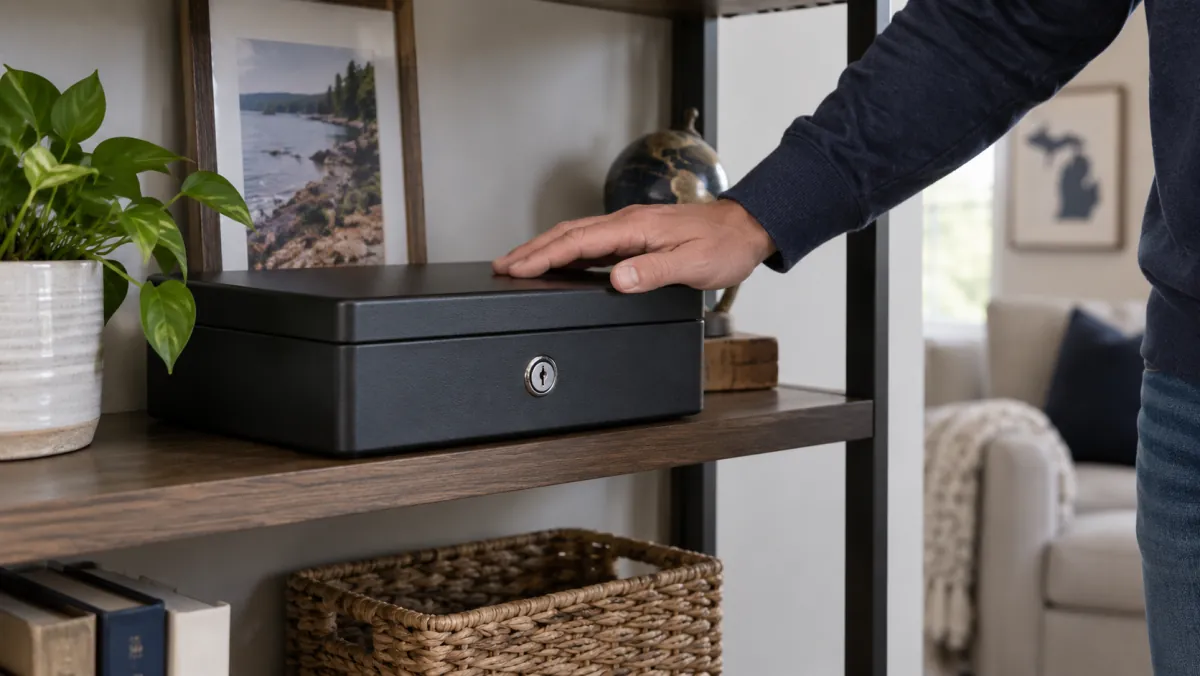
Michigan’s secure-storage law addresses firearms on premises where a minor is or is likely to be present. State guidance describes storage in a locked box or container, or keeping the firearm unloaded and secured with a properly engaged locking device. Review the Michigan Department of Health and Human Services guidance and MCL 28.429 for the full requirements and exceptions.
That legal starting point is not a complete household inventory. Think about children who live elsewhere but visit, relatives who stay for a weekend, maintenance workers, roommates, and anyone who could encounter your belongings. A home without resident children can still have changing access needs.
Avoid making a plan around a narrow prediction that nobody will look in a particular drawer. People move furniture, search for chargers, help with laundry, and explore unfamiliar rooms. A storage arrangement should create an actual barrier to unauthorized access rather than rely on everyone avoiding the right place.
Define who is authorized to access each item
Begin with a simple question: who should be able to open the storage? The answer should be deliberate, not determined by who happens to know an old code. Ownership, household membership, and legal eligibility are different considerations. Do not assume every adult in a home should automatically have access.
Discuss the arrangement privately with authorized adults. Decide how keys or combinations will be controlled and what happens when access needs change. If someone moves out, a key is lost, or a code is shared accidentally, the plan should identify who will address the problem promptly.
Keep sensitive access details out of visible notes, shared family calendars, or photographs. A locked container loses much of its purpose when the key is stored beside it or its code is easy for an unauthorized person to discover. The access method deserves as much thought as the container itself.
Match the storage to the actual firearm and location
A product photograph tells you little about whether a container fits your equipment and living space. Measure the intended location, read the manufacturer’s specifications, and consider what must fit inside without forcing the lid or interfering with the locking mechanism. Allow room for the arrangement the manufacturer permits.
Think about how the container will be supported or secured. Follow the manufacturer’s installation instructions and consider whether a qualified installer is needed for the mounting surface. Do not improvise alterations to a safe or locking device; a change that seems convenient can affect how the product functions.
The surrounding room also matters. A location that is easy for an authorized adult to use consistently may support a better routine than an awkward location nobody wants to reach. At the same time, convenience should not expose keys, codes, or the contents to people who are not authorized to access them.
Understand what a product actually promises
Storage marketing uses terms such as secure, quick access, portable, fire resistant, and tamper resistant. Those descriptions address different qualities. Ask which claims are supported by the product’s documentation and which are simply broad advertising language.
A travel case, a small lockbox, and a larger safe may serve different purposes. Compare their construction, locking method, installation needs, capacity, and maintenance requirements. A container that is suitable for one task is not automatically suitable for every setting or sufficient under every applicable rule.
If a salesperson recommends a model, ask them to explain the fit between its documented features and your specific needs. You should leave understanding why the product suits your space and access plan. Avoid buying solely because a device looks substantial or because an online reviewer uses it in a very different household.
Test usability without turning it into a handling exercise
Before placing a firearm into a new storage system, learn the product’s operation with the container empty, following its instructions. Confirm that authorized users understand the lock, indicators, maintenance requirements, and any documented backup access procedure. Store backup access items with the same care as the primary method.
Electronic systems may have battery or power requirements. Mechanical systems have their own inspection and maintenance needs. Read the manual instead of assuming that a familiar-looking lock behaves like one you have used before. Keep the product information somewhere accessible to authorized adults.
If the device does not close or lock reliably, stop using it for its intended purpose until the issue is resolved through the manufacturer or a qualified professional. Do not normalize a sticking latch, an intermittent indicator, or a workaround that defeats a feature. Storage should not depend on remembering an unofficial trick.
Build the return-home routine first
Many people spend more time planning how to pack for the range than how to put everything away. Reverse that order. Before your visit, decide where firearms, ammunition, protective equipment, and paperwork belong when you return. Make sure the appropriate storage is available and ready.
On arrival home, complete the secure-storage routine before starting unrelated tasks. Follow the safe handling procedures you have been taught and the manufacturer’s instructions; if you are uncertain about a firearm’s condition or operation, obtain qualified help rather than experimenting. Keep unauthorized people away from the process.
Do not let a closed range bag become a temporary exception that lasts overnight. A bag left in an entryway, spare bedroom, or vehicle can be forgotten precisely because it looks packed. A defined endpoint for the visit helps: the outing is finished when the equipment is appropriately secured, not merely when you pull into the driveway.
Plan for visitors before they arrive
Visitors change a household’s routines. A spare room may become a bedroom, a normally closed door may stay open, and people may put luggage in places you rarely use. Review storage before a visit instead of waiting to notice a conflict after everyone is inside.
This review should include visiting children and teenagers even if they have received firearm safety education. Education and secure storage serve different purposes. Do not assign a child responsibility for keeping other children away from a firearm or for deciding whether an item is safe to handle.
When staying in someone else’s home, clarify arrangements beforehand and review applicable law. A host’s permission to visit does not answer every question about firearms, transport, or access. If you cannot establish a lawful and secure arrangement, change the plan rather than arriving with an unresolved problem.
Keep ammunition and other equipment organized
A complete plan accounts for ammunition as well as firearms. Follow manufacturer guidance and applicable law, and choose a secure arrangement that prevents unauthorized access. Avoid loose items scattered across drawers, bags, and vehicles, where their presence becomes difficult to track.
Keep identification and packaging information needed to avoid confusion. Do not treat similar appearance as proof that ammunition is interchangeable. If you discover damaged, unknown, or questionable ammunition, ask a qualified professional how to address it rather than trying it to see whether it works.
Cleaning supplies and maintenance tools also need appropriate storage, particularly in homes where children may visit. Read their labels and keep them away from food preparation areas and unauthorized users. Organizing the whole collection reduces the chance that someone will need to rummage through firearm storage to find an unrelated household item.
Keep vehicle decisions separate from home storage
A vehicle introduces different legal and security questions. Transport rules can depend on the firearm, the person, and the circumstances. A household lockbox purchase should not be treated as a complete answer to vehicle transport or unattended storage.
Plan your route and stops before leaving, and consult current official guidance for your situation. If a destination prohibits firearms or creates a storage problem, resolve that before the trip. Avoid making an improvised decision in a parking lot because the next stop was added at the last minute.
Our Michigan firearm safety guide provides broader planning context. For a particular legal question, use the appropriate authorities or qualified counsel. Range staff can explain facility arrival procedures, but a facility policy does not replace state or federal law.
Review the plan when the household changes
Storage needs can change after a move, a new roommate, a relationship change, a new child in the extended family, or a change in who is authorized to access equipment. Put those events on your list of reasons to review the arrangement rather than assuming the original setup remains suitable indefinitely.
An occasional review can be brief. Check that containers and locks function as intended, access remains controlled, equipment fits without crowding, and the return-home routine still works. Address a small inconvenience before it becomes the reason someone repeatedly leaves equipment unsecured.
If an authorized adult finds the system difficult to use, discuss the specific issue and seek a suitable alternative through a qualified source. The answer should preserve security while improving usability. Removing the lock or sharing access more widely merely shifts the problem to someone else.
Make storage part of responsible ownership from the start
For a new owner, storage belongs in the initial budget and planning conversation. It should not be postponed until after buying accessories or completing several range visits. Ask practical questions early, compare documented product features, and make the home arrangement ready before it is needed.
For an experienced owner, the most useful improvement may be a routine rather than another purchase. Controlling keys, dealing with a crowded container, or finishing the return-home process promptly can address a real weakness in an otherwise reasonable setup. Assess your actual habits with the same care you give equipment.
Range 313 in Lincoln Park can be a starting point for questions about responsible ownership and available instruction. Contact the team to discuss educational needs, and use Michigan’s official resources for legal requirements. A clear storage plan is one you can explain, maintain, and follow on a busy evening without leaving the important steps for later.