Choosing private firearms training vs. group classes is not simply a choice between “better” and “cheaper.” It is a decision about pace, feedback, comfort, objectives, supervision, and how much of the curriculum should be adapted to one student. A complete beginner with significant anxiety may need something different from an experienced target shooter correcting one persistent problem. A Michigan CPL applicant also has different requirements from someone seeking a general orientation.
This guide compares both formats for students in Lincoln Park, Detroit, Dearborn, Allen Park, Southgate, Taylor, Wyandotte, and throughout Metro Detroit. It explains when each format can work, what questions to ask, and why the instructor and course design matter more than the marketing label.
Private firearms training vs. group classes at a glance
| Factor | Private training | Group class |
|---|---|---|
| Pacing | Can usually be adjusted to one student | Follows a shared schedule and curriculum |
| Feedback | Instructor attention is concentrated | Individual feedback is divided across students |
| Questions | More time for personal concerns | Students benefit from questions others ask |
| Cost | Usually higher per student | Often lower per student |
| Social environment | Quieter and more private | Shared learning can feel supportive or distracting |
| Equipment comparison | May allow focused fit and operation review | Must fit within class equipment policies and time |
| Curriculum | May be customized when the provider permits | Usually standardized around published outcomes |
| Scheduling | May offer appointment flexibility | Depends on published dates and minimum enrollment |
| Observation | Every repetition may receive close review | Instructor must manage the whole line |
| Legal-course use | Counts only if the exact program satisfies requirements | Counts only if the exact program satisfies requirements |
Neither column guarantees quality. “Private” does not prove that an instructor is qualified, and “group” does not prove that a course is impersonal. Evaluate the actual program.
What is private firearms training?
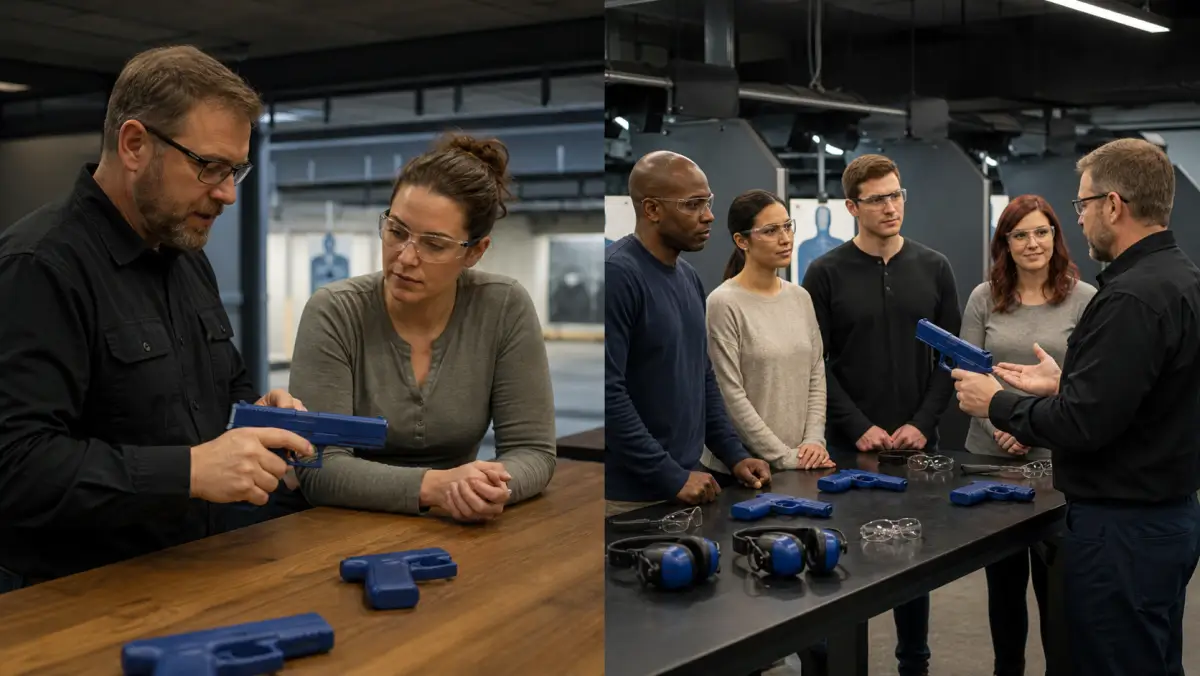
Private firearms training is instruction designed around one student. Some providers also use “one-on-one lesson,” “individual coaching,” or “personal instruction.” A private session may cover a standard beginner curriculum, concentrate on one recurring issue, or prepare a student for a later group course.
The student and instructor should agree on a realistic objective before the appointment. Examples include:
- Learning range procedure as a complete beginner.
- Receiving a model-specific orientation.
- Checking whether equipment fits and can be operated safely.
- Rebuilding fundamentals after a long break.
- Correcting one repeated accuracy problem.
- Preparing for the prerequisites of a more advanced course.
- Accommodating a physical, hearing, vision, or learning need.
- Reducing uncertainty before entering a larger class.
Private firearms training should not become an unstructured range visit with an instructor standing nearby. A professional lesson still needs prerequisites, safety boundaries, learning objectives, a defined start and end, and an explanation of what the student should do next.
At Range 313, the current firearms training catalog identifies Marksman 1 as including one-on-one instruction, accuracy development, and trigger control. Course details, schedules, prerequisites, rentals, and availability are subject to confirmation, so contact the team before planning around a specific format.
What is a group firearms class?
A group firearms class teaches multiple students through a shared curriculum. It may combine classroom explanation, demonstration, controlled handling, questions, and supervised range work. The number of students, number of instructors, length, prerequisites, and live-fire structure can vary significantly.
A strong group class is not merely a lecture followed by unsupervised shooting. It should make transitions explicit, control when equipment may be handled, verify understanding, and provide enough observation to identify unsafe behavior.
Group learning has genuine benefits:
- Students hear questions they did not know to ask.
- Demonstrations can be observed from multiple perspectives.
- A standardized curriculum may keep important topics from being skipped.
- Shared milestones can reduce the feeling of being the only beginner.
- The per-person price may be more accessible.
- Published dates can create a clear commitment to attend.
The limitation is that the instructor cannot devote every minute to one person. A student who needs repeated explanation, extensive equipment adjustment, or a substantially different pace may benefit from private preparation first.
Choose based on the learning objective
The best format begins with a concrete outcome. “Learn everything about firearms” cannot fit responsibly into one session. “Understand the safety rules, range commands, and model-specific controls needed for a supervised first experience” is clearer.
Use private training when the objective is narrow and personal. Use a group class when the objective is standardized and shared. That distinction is more useful than assuming beginners always need one format and experienced students always need the other.
Objectives that often fit private training
- Diagnosing one recurring error.
- Working at a slower or more deliberate pace.
- Reviewing a specific firearm with qualified guidance.
- Returning after injury, illness, surgery, or a long absence.
- Planning accommodations before live fire.
- Addressing strong noise sensitivity or range anxiety.
- Confirming readiness for a course with prerequisites.
Objectives that often fit group classes
- Completing a published foundational curriculum.
- Learning standard terminology and range procedures.
- Participating in a scheduled course with clear outcomes.
- Sharing a structured learning experience with peers.
- Completing a legally relevant course that satisfies all current requirements.
- Progressing through a provider’s established course sequence.
The word “often” matters. A provider may offer a standardized class privately or build an unusually small and attentive group. Ask about the actual delivery format.
Compare the amount and timing of feedback
Feedback has two dimensions: how much a student receives and when they receive it. Immediate correction is especially important when an unsafe or counterproductive repetition could become familiar.
In a private lesson, the instructor can observe nearly every transition, question, and repetition. They may notice that the student’s protective equipment shifts, a control is difficult to reach, attention drops after a certain period, or one instruction is being interpreted incorrectly. The lesson can pause before the problem repeats.
In a group class, the instructor must distribute attention. Good course design compensates with clear demonstrations, controlled rotations, assistant instructors when appropriate, and deliberate observation points. Students may also learn by watching corrections made to others, provided the range remains controlled and respectful.
When comparing private firearms training vs. group classes, ask:
- How many students are expected?
- How many instructors or range staff will supervise?
- When does each student receive individual observation?
- What happens if someone falls behind?
- Can an instructor remove a student from live fire for additional coaching?
- Is private follow-up available after the course?
A provider should answer these questions directly. “Everyone gets plenty of attention” is not as useful as a description of how the class is organized.
Decide how much pacing flexibility you need
A group course must respect its schedule. The instructor cannot redesign every segment for one participant without affecting everyone else. That predictability can be valuable: students know the start time, curriculum, breaks, and expected outcome.
Private instruction can usually adjust more easily. If the student masters one point quickly, the instructor may move forward. If equipment fit, terminology, or anxiety requires more time, the lesson may slow down. However, private time is still finite, and responsible instructors should not rush into advanced material merely because time remains.
Choose a private starting point if you:
- Need extra time to process verbal instructions.
- Prefer demonstrations to be repeated without social pressure.
- Have not handled a firearm and feel uncomfortable in a larger group.
- Need to discuss accessibility or medical considerations privately.
- Are using equipment that requires a qualified fit assessment.
- Have a persistent problem that a general class is unlikely to diagnose.
Choose a group class if you can meet the published prerequisites, follow a shared pace, and ask for clarification promptly. Being nervous does not automatically exclude someone from a group, but hiding uncertainty can create problems in either format.
Consider comfort without avoiding necessary correction
Some students assume private instruction will prevent embarrassment. It can provide privacy, but it should not remove direct correction. Around firearms, an instructor must interrupt unsafe behavior immediately and clearly.
Other students prefer a group because being surrounded by beginners makes the experience feel normal. They may gain confidence from hearing peers ask similar questions. Yet a group can feel distracting when personalities, noise, or different experience levels compete for attention.
Ask yourself:
- Do I learn better by observing several examples or by receiving direct coaching?
- Will I ask questions honestly in front of others?
- Does a busy environment make it difficult to hear or process commands?
- Would I benefit from seeing that other beginners also need correction?
- Is privacy important because of an accessibility need or past negative experience?
- Can I remain focused while waiting for other students?
Comfort should support learning, not create a promise that the session will be easy. Good instruction challenges errors while protecting dignity.
Compare price by outcome, not only hourly rate
Private training usually costs more per student because one person receives the instructor’s scheduled time. A group class spreads instruction and facility costs across multiple students. The posted tuition may not include every expense.
Before comparing prices, request the complete cost:
- Tuition or instructor fee.
- Range or lane fee.
- Ammunition requirement and current price.
- Firearm rental.
- Eye and hearing protection rental or purchase.
- Targets.
- Required equipment.
- Certificate or administrative fees.
- Rescheduling and cancellation terms.
- Follow-up lesson or remediation cost.
A lower-priced group class can become expensive if the curriculum does not match the student and private remediation is needed afterward. A private lesson can also be poor value if it has no plan, no defined outcome, or too much idle range time.
Value is the amount of useful, safe learning—not the number of shots fired. A fair comparison of private firearms training vs. group classes therefore considers whether the format produces the feedback and understanding the student actually needs. Our guide to building good shooting habits explains why deliberate repetitions and review matter more than a large ammunition count.
Evaluate safety and supervision separately from format
Private lessons are not automatically safer than group classes. Safety depends on the instructor, facility, student readiness, range controls, and willingness to stop when something becomes unclear.
A responsible program should explain:
- How firearms arrive and where they may be uncased.
- When eye and hearing protection must be worn.
- Who controls the live-fire line.
- Which commands students must know.
- How instructors verify firearm condition.
- What happens during a suspected malfunction or equipment issue.
- Whether the range separates classroom and live-fire handling.
- How students are supervised during every live-fire exercise.
- When a student must pause or leave the line.
ATF’s current firearms handling and storage guidance emphasizes treating every firearm as loaded, maintaining safe direction, keeping the finger outside the trigger guard unless intending to fire, using eye and ear protection, and securing firearms against unauthorized access.
CDC/NIOSH also documents potential lead and noise exposure at indoor firing ranges . The class should address protection, live-fire boundaries, hygiene, and facility procedures regardless of how many students attend.
Check instructor qualifications and teaching practices
An impressive course title does not establish teaching quality. Ask who will teach—not only which organization appears on the certificate.
Useful questions include:
- What training or certification is relevant to this course?
- How much experience do you have teaching students at my level?
- What are the prerequisites and learning outcomes?
- Is the instructor insured or teaching through the facility?
- How is live fire supervised?
- How are students assessed?
- What happens if I cannot complete an exercise safely?
- Does the course make legal claims, and what official sources support them?
- What certificate is issued, if any?
- What continuing education do you recommend afterward?
Watch for an instructor’s willingness to define limits. A firearms instructor is not automatically an attorney, physician, audiologist, mental-health professional, or gunsmith. Trust grows when the instructor refers questions outside their scope to the right source.
Red flags include humiliation, political distractions, pressure to buy equipment, vague safety boundaries, promises of mastery in one session, refusal to explain credentials, and claims that facility rules do not apply to the instructor’s students.
Michigan CPL training is a separate decision
A private lesson and a Michigan CPL course are not interchangeable labels. The relevant question is not whether the instruction is private or group-based; it is whether the exact program satisfies current law.
Michigan State Police states that a CPL applicant must have appropriate knowledge and training in the safe use and handling of a pistol. Review the current Michigan CPL requirements before enrollment. Ask the provider in writing whether the exact program meets current requirements, who teaches it, what it includes, and which completion certificate successful students receive. Cross-check those answers with official state information and your county clerk rather than relying on the course name alone. Requirements can change, and individual circumstances differ.
Do not assume:
- Every private pistol lesson counts toward a CPL application.
- Every course using “CPL” in an advertisement is compliant.
- A general beginner certificate can substitute for the required certificate.
- Prior range experience removes statutory training requirements.
- A certificate remains usable indefinitely.
Ask the provider to identify the program, instructor qualification, total hours, curriculum, live-fire requirement, and certificate before payment. Verify the answers against current official sources. This article is educational and does not provide legal advice.
Which format is better for a complete beginner?
Many beginners succeed in well-structured group classes. A beginner course can normalize questions, provide a comprehensive foundation, and introduce range procedure through a shared sequence. The class needs transparent prerequisites and sufficient supervision.
Private training may be the more responsible starting point when the student:
- Has no experience and does not feel ready for independent handling.
- Needs substantial help with equipment fit or controls.
- Experiences strong anxiety around noise or recoil.
- Has a physical limitation that changes the learning process.
- Needs instructions repeated or presented differently.
- Previously had an unsafe or humiliating learning experience.
- Is returning after many years.
- Wants to assess readiness before enrolling in a longer class.
Range orientation is not automatically a substitute for either format. Orientation explains facility rules; a class or private lesson develops skills through instruction and observation.
The beginner firearms safety class guide explains what new students should expect from registration through classroom work and supervised live fire.
Which format is better for an experienced shooter?
Experience alone does not answer the question. An experienced shooter pursuing a standardized advanced curriculum may benefit from a group class. Working beside peers can expose the student to different questions and provide a shared performance framework.
Private coaching is often useful when the student has one persistent issue, unfamiliar equipment, a long gap in practice, or a goal that does not match a scheduled course. Individual observation can distinguish a technique problem from poor equipment fit, an inconsistent visual process, or fatigue.
Experienced students should still state their background accurately. Years of ownership do not prove current competence, and competition, hunting, military, law-enforcement, or recreational experience may not transfer directly to a different course.
Ask the instructor to assess the starting point rather than accepting a self-selected “advanced” label.
Can couples, friends, or families train together?
Semi-private instruction can be a useful middle ground. Two or several people share the lesson while receiving more attention than they might in a larger class. This format works best when their experience, goals, and pacing are reasonably compatible.
Before booking, ask:
- Is the session private to our group?
- What is the maximum number of participants?
- Does each person receive individual observation?
- Can one participant pause without pressuring the others?
- Are age, identification, and eligibility policies clearly published?
- Are rentals and ammunition confirmed for every participant?
- Is the curriculum suitable for the least experienced person?
- What happens if abilities differ significantly?
Do not use a shared lesson to pressure a reluctant person into handling or firing. Every participant should receive the safety briefing, follow commands independently, and be free to stop.
A practical decision worksheet
Score each statement based on your current needs. More checks in the private column suggest starting one-on-one; more checks in the group column suggest evaluating a structured class. A tie may point to a private orientation followed by a group course.
| Your situation | Private may fit | Group may fit |
|---|---|---|
| I need a highly flexible pace | ✓ | |
| I want a standardized start-to-finish curriculum | ✓ | |
| I have one specific recurring problem | ✓ | |
| I learn from hearing other students’ questions | ✓ | |
| I need to discuss accommodations privately | ✓ | |
| Cost per student is the main constraint | ✓ | |
| I am unsure whether I meet course prerequisites | ✓ | |
| I can follow a published pace and ask questions promptly | ✓ | |
| I want direct observation of most repetitions | ✓ | |
| I need a legally qualifying course | Verify exact program | Verify exact program |
Use the worksheet to begin a conversation, not to self-certify readiness.
Questions to ask before enrolling
Whether you choose private firearms training vs. group classes, contact the provider with the same core questions:
- Is this designed for my exact experience level?
- What should I be able to do before attending?
- What will I be able to do safely after successful completion?
- Is the session private, semi-private, or open enrollment?
- How many students and instructors are expected?
- Does the course include classroom and live-fire work?
- What equipment, ammunition, rentals, and protection are required?
- What is the total expected cost?
- Which credentials are relevant to the instructor and course?
- What happens when a student needs extra help?
- Does the certificate have a legal or licensing purpose?
- What is the recommended next training step?
Save the written course description and confirmation. Policies, schedules, staff, and inventory can change.
A hybrid path often works best
The decision does not need to be permanent. Many students benefit from moving between formats.
A practical sequence might be:
- One private readiness assessment.
- A foundational group class.
- Several focused range-practice sessions.
- A private follow-up on one recurring issue.
- The next group course after prerequisites are verified.
This sequence uses private instruction for diagnosis and group training for a complete curriculum. It also prevents the student from paying for repeated individual lessons when a structured course would address the broader need.
Use the Michigan beginner firearm-training roadmap to connect instruction with purposeful practice, storage, equipment decisions, and continued education.
Compare training options at Range 313
Range 313 offers firearms training at 1125 Fort Street in Lincoln Park, serving Detroit, Dearborn, Allen Park, Southgate, Taylor, Wyandotte, Riverview, Trenton, and communities throughout Downriver.
The current course catalog includes Basic Pistol, advanced pistol and rifle courses, low-light and specialty options, Marksman 1, and CPL classes. Marksman 1 specifically lists one-on-one instruction. Other formats, dates, prerequisites, ammunition requirements, rentals, and availability should be confirmed with the team.
Call (313) 436-0197 and explain:
- Your real experience level.
- Whether you own or need to rent equipment.
- The skill or decision you want help with.
- Any accessibility or comfort concern.
- Whether you need a Michigan CPL-qualifying program.
- The days and times you can attend.
You can also review the indoor shooting range information before planning a live-fire visit.
About the author
The Range 313 Team works with complete beginners, returning firearm owners, rental customers, CPL students, and experienced target shooters at an indoor range, training facility, retail showroom, and service counter in Lincoln Park, Michigan. The team sees why format matters: some questions need individual time, while others are answered effectively through a structured shared curriculum.
This guide offers general educational information. It does not guarantee course availability, establish anyone’s eligibility, replace direct instruction, or provide legal or medical advice. Confirm current Range 313 policies and consult official Michigan sources for licensing requirements.
The final choice
The best answer to private firearms training vs. group classes is the format that gives you appropriate supervision, honest prerequisites, a clear objective, and enough useful feedback to take the next responsible step.
Choose private training when the lesson needs to adapt substantially to you. Choose a group class when a well-designed shared curriculum matches your ability and goal. If the answer remains unclear, begin with a candid conversation or a private assessment—not a guess about your readiness.