An advertisement for an online CPL class in Michigan can sound convenient: complete a course from home, download a certificate, and move directly to the license application. That promise leaves out an essential fact. Michigan’s qualifying initial training currently includes supervised firing-range instruction and actual live fire.
Online learning can support preparation. It may even appear as one part of a carefully designed course. A screen alone, however, cannot deliver the complete statutory structure for a new Michigan CPL applicant.
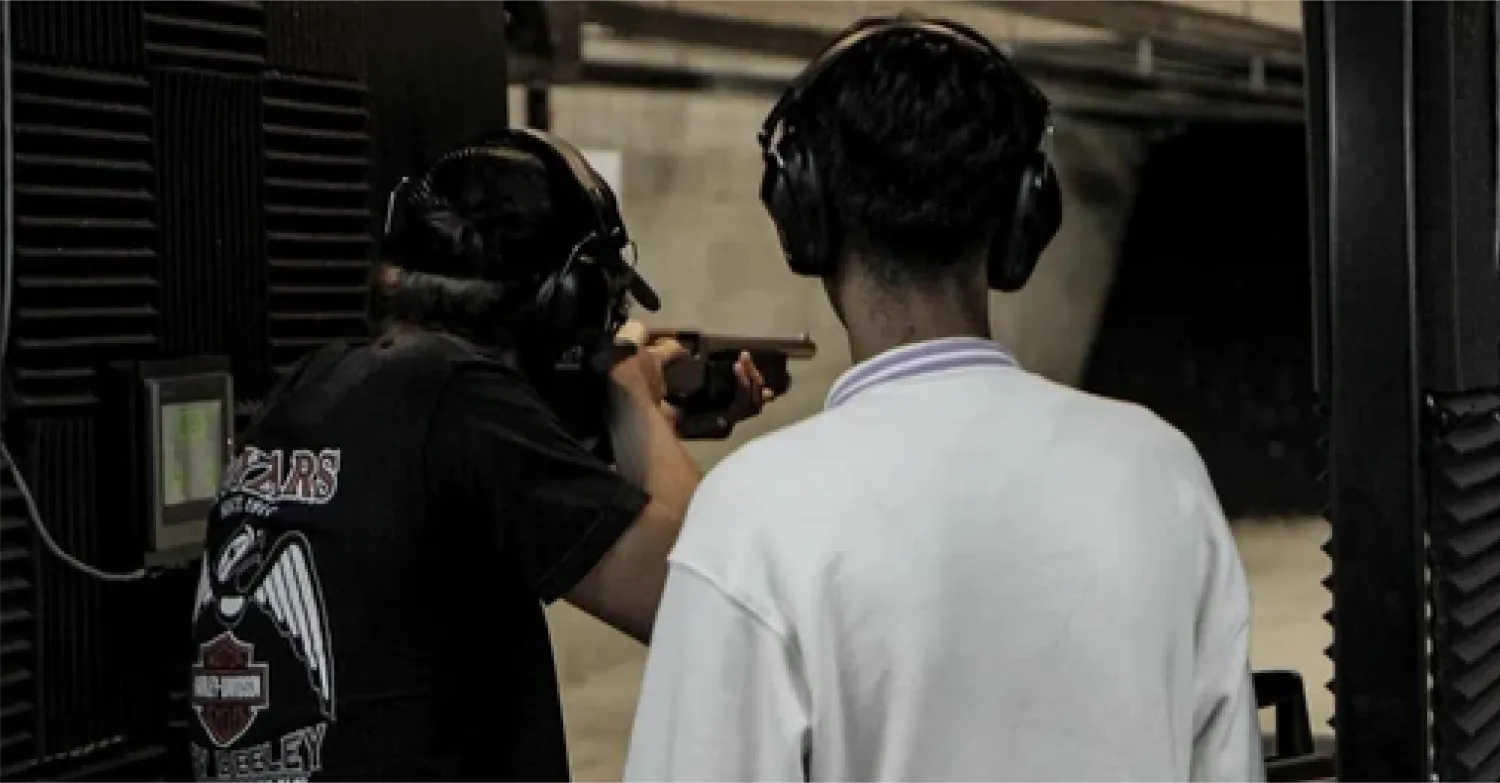
Range 313 offers an in-person Michigan CPL class with classroom and live-fire instruction at its Lincoln Park indoor range. Call (313) 436-0197 to confirm current dates, seats, price, rentals, and preparation requirements.
This guide explains how to evaluate online, hybrid, and in-person course claims. It is general education, not legal advice. Training and licensing rules can change, so review current statutes and Michigan State Police instructions before registering or applying.
What Michigan currently requires
MCL 28.425j describes the qualifying pistol training or safety program for a new application. The statute currently requires at least eight hours of instruction.
The structure includes:
- At least five hours covering required knowledge and topics.
- At least three hours of firing-range instruction.
- At least 30 rounds fired by the student.
- Qualified instruction.
- A compliant certificate after successful completion.
Required topics include safe storage, use and handling of a pistol, ammunition knowledge, shooting fundamentals, pistol positions, firearms law, civil liability, use of deadly force, avoiding criminal attack, controlling a violent confrontation, and laws applying to concealed carry in Michigan.
Read the current text in the official Firearms Laws of Michigan . The live-fire language is why a course completed entirely through prerecorded videos or online quizzes cannot by itself provide the whole initial program.
Online preparation is not the same as qualifying completion
There is nothing inherently wrong with learning from a computer. Students routinely use online material to review safety rules, learn terminology, check provider instructions, or read official law. The problem begins when a seller blurs the line between useful education and a certificate intended for a Michigan CPL application.
Ask what the product actually is:
- General firearm education?
- Preparation for a later in-person class?
- The classroom component of a hybrid program?
- A renewal review resource?
- A certificate advertised as sufficient for a new Michigan application?
Those are different products. The landing page should state which one it offers and which legal requirement it claims to satisfy.
Can a Michigan CPL course use a hybrid format?
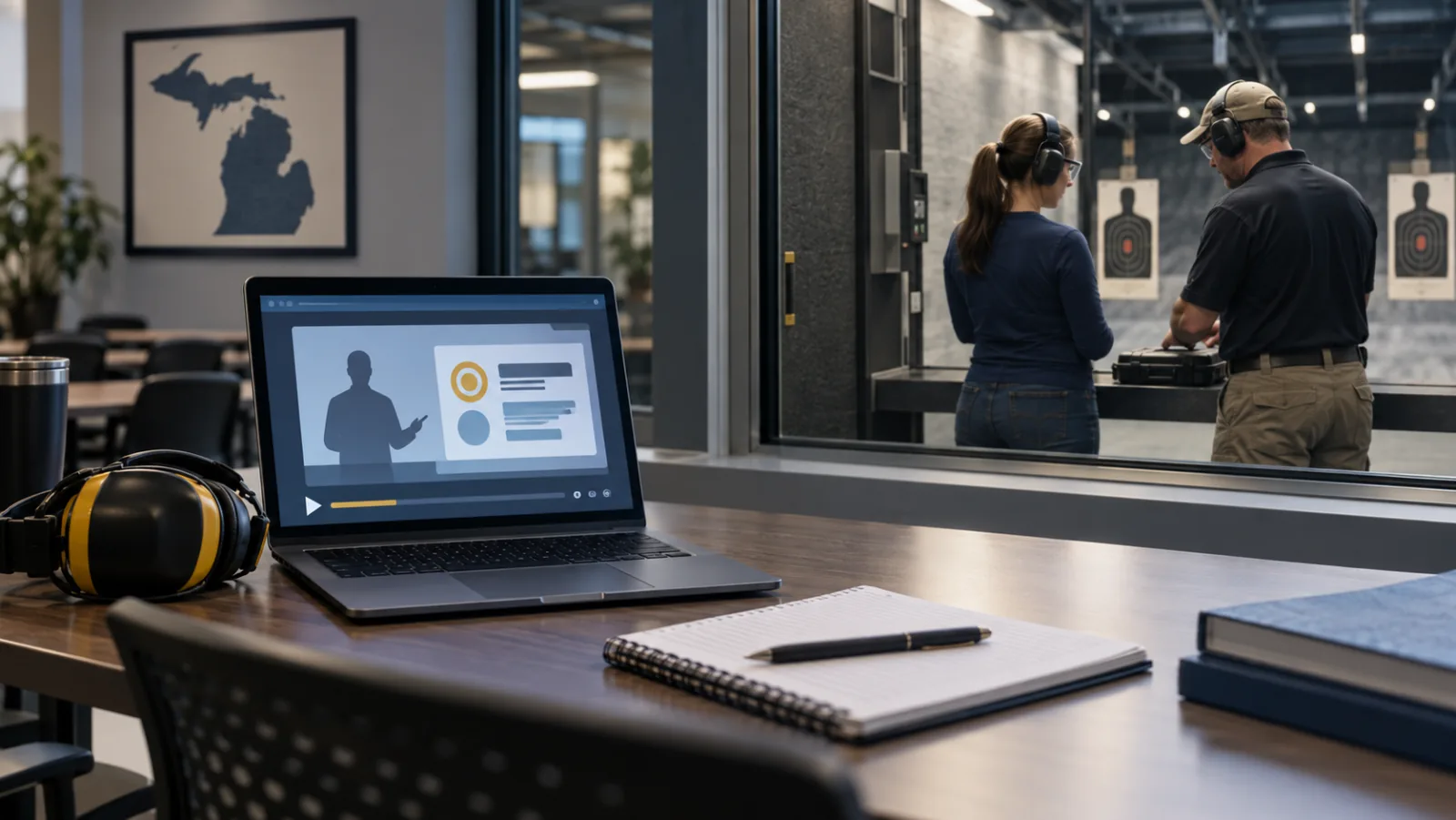
Technology may appear in a compliant course, but the complete program still has to satisfy current law. A provider offering a hybrid structure should explain how every requirement is delivered and verified.
Before enrolling, obtain clear answers to these questions:
- Which hours are online, and which are in person?
- Is the online portion live or prerecorded?
- How is identity and participation verified?
- Who teaches each required topic?
- Where do the firing-range hours occur?
- Who supervises live fire?
- How many rounds are required?
- What must the student demonstrate for successful completion?
- Who signs the completion certificate?
- Does the provider state that the complete program complies with current MCL 28.425j?
Do not assume that an online provider’s separate list of “range partners” automatically makes the combined experience compliant. Ask who is responsible for the complete curriculum and certificate.
Why live instruction still matters
Pistol safety is physical as well as intellectual. A student may earn a perfect quiz score and still struggle to keep a muzzle oriented safely, understand a range command under noise, operate an unfamiliar control, or respond correctly to a malfunction.
Direct supervision lets an instructor observe:
- Muzzle direction.
- Trigger-finger discipline.
- Grip and stance.
- Loading and unloading procedure.
- Response to commands.
- Equipment compatibility.
- Accuracy and consistency.
- Whether the student stops and asks for help appropriately.
A video can demonstrate a procedure. It cannot see what the student actually does on the firing line or intervene when something changes.
Classroom interaction matters too
The legal and judgment topics in CPL training are not trivia. Students need to distinguish current Michigan law from advice meant for another state, a facility policy, or an internet opinion.
Live access to a qualified instructor allows a student to ask for clarification and hear the boundaries of the answer. A responsible instructor should say when a question requires an official source or individualized legal advice.
Online material can still be useful when it is current, well sourced, and integrated carefully. The risk is passive clicking: a video plays in another tab while the student works, drives, or manages other tasks. A compliant provider should be able to explain how meaningful participation is required.
Recognize misleading certificate language
Read marketing claims literally. Be cautious when a site says:
- “Instant Michigan concealed-carry certificate.”
- “No range required.”
- “Complete in under an hour.”
- “Valid in every state.”
- “Guaranteed approval.”
- “Just print and apply.”
- “Lifetime legal certification.”
Those phrases conflict with important parts of Michigan’s current training or licensing structure. A training provider also cannot guarantee that the government will approve an applicant. Eligibility involves separate state and federal requirements.
The word “certified” is not enough. Ask which statute the complete program satisfies, who the instructor is, what live fire occurs, and what exact document successful Michigan students receive.
A training certificate is not a CPL
Even a valid completion certificate does not authorize concealed carry. It proves successful completion of qualifying training for purposes of an application.
Michigan State Police says an eligible applicant files with the county clerk in the county where the applicant resides, includes the required certificate, pays applicable fees, and completes fingerprinting after filing. A passport-quality photograph may be required when the applicant lacks a digitized photograph on file with the Michigan Secretary of State.
Read the current CPL application and instructions . Do not carry concealed simply because a website issued a PDF or because an application has been started.
Michigan eligibility is a separate question
Course enrollment does not prove licensing eligibility. Michigan State Police publishes a detailed CPL requirements page addressing age, residency, identification, criminal history, court orders, firearm-possession restrictions, and other state and federal conditions.
An online seller may know very little about the student. Avoid any service that treats a credit-card payment as evidence of eligibility.
If your circumstances involve a conviction, pending charge, protection order, immigration issue, involuntary commitment, restoration of rights, or another legal complication, consult the appropriate authority or qualified Michigan attorney. Do not disclose sensitive information to an unverified training website merely because a form asks for it.
Protect personal information online
Course websites may request a legal name, address, birth date, identification, photographs, or payment data. Before submitting anything, determine who operates the site and why each field is needed.
Look for:
- A real business name and physical contact information.
- A clear privacy policy.
- Secure payment processing.
- Instructor identity and qualifications.
- Transparent refund and cancellation terms.
- An explanation of how records are stored.
- A clear connection to the in-person range component.
Do not upload government identification to an unknown site just to reveal a price or download a generic guide. Never post a training certificate publicly; it contains personal and instructor information.
Questions for any hybrid provider
A serious provider should answer without pressure:
Course structure
- How does the full schedule reach the current minimum hours?
- Which required topics are taught online?
- Are online hours supervised or independently completed?
- Can students ask questions in real time?
Range component
- Where is the range?
- Is the range date reserved at registration?
- How many hours and rounds are included?
- Who provides supervision?
- Are rental, ammunition, targets, and protection included?
Certificate
- Who signs it?
- When is it issued?
- Does issuance require successful completion of every component?
- Does it contain the information and statements required by current Michigan law?
Cost and cancellation
- Is the displayed price for the complete program or only the online portion?
- What fees are due to a separate range partner?
- What happens if the student cannot schedule the range component?
- Can the online portion expire?
Get the complete cost before paying. A low online price may exclude the part that requires facilities and supervision.
When online learning helps a beginner
Used honestly, online material can make an in-person class more productive. A beginner can learn vocabulary, review the core safety rules, study range commands, and write down questions before class.
Helpful preparation includes:
- Reading the provider’s own checklist.
- Reviewing official Michigan CPL resources.
- Learning the distinction between training and licensing.
- Understanding basic pistol terminology.
- Watching a provider-approved orientation.
- Identifying personal equipment or accessibility questions.
Online preparation should reduce confusion, not create false confidence. Do not practice firearm handling at home based solely on a video. If a physical skill is new, learn it with a qualified person under controlled conditions.
Our first CPL class near Detroit guide explains how to judge whether a separate fundamentals lesson would help.
Online material and CPL renewal are different
Michigan’s renewal process uses a different training certification from a new application. MSP currently says a renewal applicant signs a statement certifying at least three hours reviewing required training and at least one hour of firing-range time during the six months immediately before applying.
Online material may support part of that review, but it cannot create the required range time. It also must be current and complete enough for the applicant to sign the official statement truthfully.
Read our Michigan CPL renewal training guide and the current MSP renewal page. Do not confuse a product labeled “online renewal class” with the government renewal application itself.
In-person class advantages
A well-run in-person program places classroom and range instruction inside one accountable structure. Students know who teaches, where live fire occurs, how equipment is inspected, and who issues the certificate.
Other advantages may include:
- Immediate answers to questions.
- Demonstration with controlled training equipment.
- Direct observation of handling habits.
- A consistent set of range commands.
- Rentals for students who do not own a pistol.
- Familiarity with a local facility for future practice.
- Easier verification of the instructor and business.
In-person does not automatically mean high quality. Students should still compare instructor qualifications, total schedule, class size, beginner support, price, and course culture. Use our guide to choosing a Michigan CPL class .
Red flags beyond the word “online”
The delivery method is only one clue. Avoid a course that:
- Does not identify its instructor.
- Avoids mentioning MCL 28.425j.
- Offers no specific firing-range plan.
- Issues a certificate before live fire.
- Promises government approval.
- Claims the certificate is a temporary license.
- Hides the complete price.
- Uses countdown timers or extreme pressure to force payment.
- Has no refund terms or physical contact information.
- Tells students to ignore the county clerk or Michigan State Police.
A compliant provider should welcome verification against official law.
A simple decision process
Before buying an online or hybrid course:
- Read the current Michigan training statute.
- Review the MSP eligibility and application pages.
- Ask the provider for the complete schedule.
- Identify the actual range, instructor, and live-fire plan.
- Confirm the full cost.
- Verify what certificate is issued and when.
- Compare with at least one established local in-person provider.
- Do not pay until every requirement is accounted for.
If the provider becomes evasive when asked about the three range hours or 30 rounds, choose another program.
Complete Michigan CPL training at Range 313
Range 313’s CPL course page describes classroom and live-fire instruction at the same Lincoln Park facility. The current listed price is $100, and rentals are available. Students should still confirm dates, seats, exact hours, included items, ammunition, rental charges, and required identification.
Review the Range 313 CPL Classes page , then call (313) 436-0197 . Tell the team whether you are a complete beginner and whether you need a rental.
Online education can be a useful tool. For a new Michigan CPL applicant, it should support—not erase—the supervised, physical, and judgment-focused work required of the complete course.