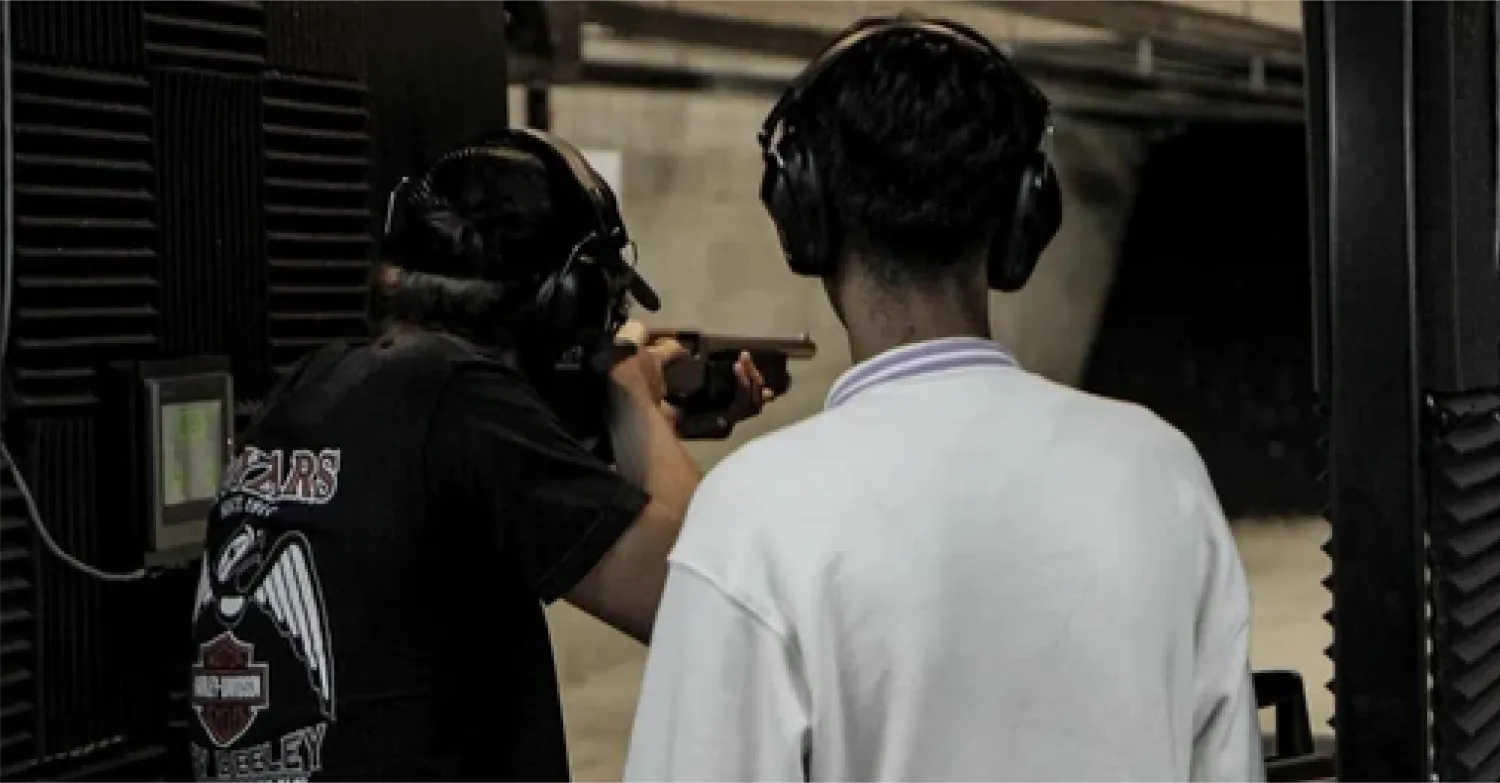
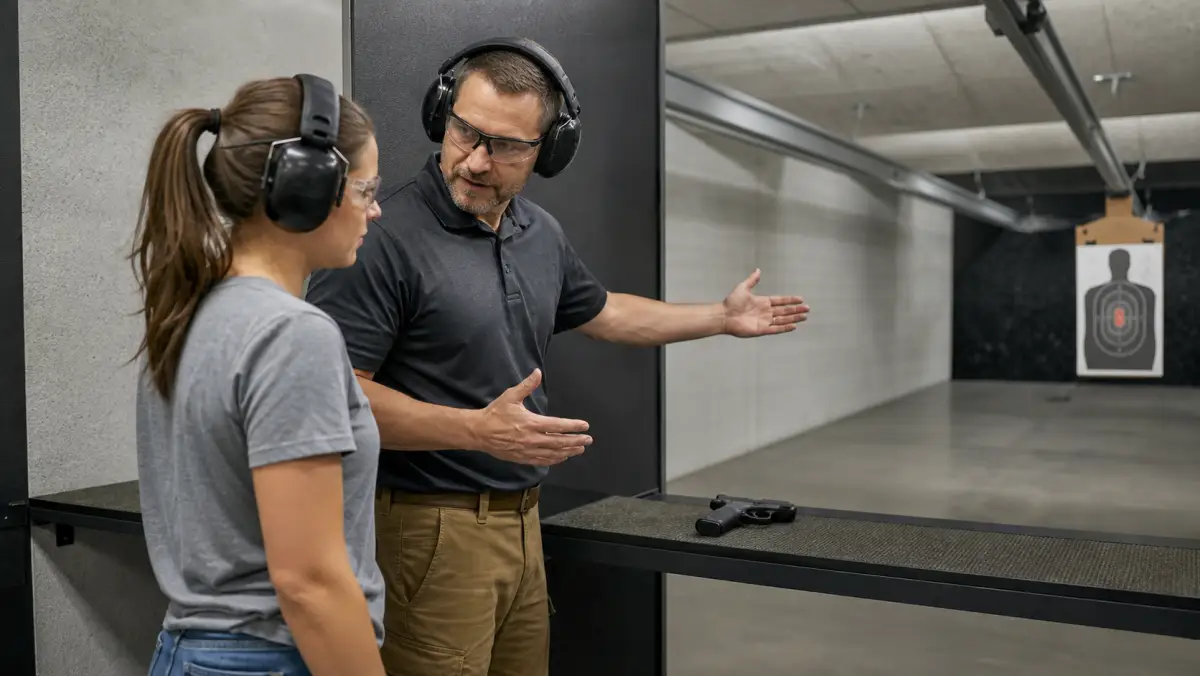
Most new shooter mistakes do not begin with bad intentions. They begin with rushing, embarrassment, unclear instructions, poor preparation, or the belief that one successful range visit proves more skill than it does. A beginner may focus so hard on the target that they forget safe direction, wear protection that does not fit, copy a friend’s technique, or keep shooting after attention has faded.
These problems are preventable. A professional range, qualified instructor, realistic first-session goal, and willingness to pause can turn uncertainty into safe learning.
This guide identifies 15 common new shooter mistakes and explains safer responses for visitors in Detroit, Lincoln Park, Dearborn, Allen Park, Southgate, Taylor, and across Michigan.
New shooter mistakes at a glance
| Mistake | Why it causes problems | Safer response |
|---|---|---|
| Hiding inexperience | Staff cannot provide the right level of support | State your experience honestly at registration and check-in |
| Relaxing the rules when “unloaded” | Assumptions replace overlapping safety layers | Maintain safe direction and trigger discipline at all times |
| Following the target with the muzzle | Attention shifts the firearm toward people or structures | Secure the firearm before turning or redirecting attention |
| Skimming range rules | Facility-specific boundaries are missed | Read every rule and ask about unfamiliar terms |
| Uncasing in the wrong place | Firearms enter uncontrolled common areas | Keep the firearm cased until staff direct you at the approved bench |
| Wearing poor protection or clothing | Noise, debris, or hot brass can create injury and distraction | Use properly fitted protection and practical clothing |
| Choosing equipment by popularity | Fit, operation, and purpose are ignored | Compare manageable options with qualified guidance |
| Treating rentals as self-explanatory | Unfamiliar controls create uncertainty | Request a model-specific orientation before handling |
| Starting with a complex goal | Attention is divided across too many tasks | Choose one simple safety or fundamentals objective |
| Chasing speed or round count | Rushed repetitions reinforce errors | Use small, deliberate groups with pauses |
| Handling an equipment problem alone | A suspected issue can become more dangerous | Maintain safe direction and ask staff for help |
| Ignoring fatigue or anxiety | Judgment and coordination decline | Stop early and debrief outside the live-fire area |
| Copying friends or videos | Advice may not fit the shooter, firearm, or range | Use qualified instruction and current manufacturer information |
| Skipping hygiene and maintenance | Lead residue or equipment issues go unmanaged | Wash after shooting and follow the exact service plan |
| Treating storage as an afterthought | Unauthorized access risk continues after the range | Prepare lawful secure storage before the firearm comes home |
The pattern behind many new shooter mistakes is simple: the person acts before the environment, equipment, or instruction is clear.
1. Hiding your experience level
One of the most common new shooter mistakes is pretending to understand more than you do. Beginners sometimes worry that asking a basic question will delay a group or make them look unprepared. That silence prevents staff from slowing the process, explaining a command, or recommending instruction.
At registration or check-in, describe your experience accurately:
- “This is my first range visit.”
- “I have shot before, but not this model.”
- “I have not practiced in several years.”
- “I am not comfortable handling independently.”
- “I need help choosing an appropriate class.”
Those statements give the instructor or range staff usable information. They do not guarantee that a walk-in orientation will be enough; the responsible next step may be a scheduled class or private session.
Range 313’s beginner firearms safety class guide explains course levels, classroom topics, live-fire preparation, costs, and how to evaluate an instructor.
The safer correction for embarrassment-driven errors is disclosure: say what you know, what you do not know, and where you need help.
2. Treating “unloaded” as permission to relax
New shooter mistakes often appear when someone believes an unloaded firearm no longer requires strict handling. They may point it casually, place a finger inside the trigger guard, or hand it to another person without controlling direction.
The safety rules remain active regardless of believed condition. ATF’s current firearms handling and storage guidance directs people to treat every firearm as loaded, keep it pointed in a safe direction, keep the finger outside the trigger guard unless intending to fire, use protection, and store firearms securely.
Condition verification is model-specific and must be taught using the manufacturer’s procedure. Seeing another person check the firearm does not remove your responsibility to maintain safe handling when you receive it.
Overlapping rules exist because people make mistakes. If a status check is incomplete, safe direction and trigger discipline still reduce risk.
The correction is consistency: the firearm safety rules do not turn on and off with confidence, location, or ammunition state.
3. Letting the muzzle follow your attention
Among serious new shooter mistakes, this one can happen quickly. Someone hears their name, wants to show a target, drops an item, or turns toward an instructor while the firearm moves with their body.
At an indoor range, the designated safe direction is generally downrange toward the approved backstop. Keep the muzzle there while handling at the lane. If you need to turn, speak, adjust clothing, or retrieve something, follow the instructor’s process for securing or setting down the firearm first.
Do not point at a wall, floor, ceiling, lane divider, door, or furniture because the firearm is believed to be unloaded. Ordinary building materials are not automatically safe backstops, and people may be on the other side.
If hot brass or a distraction occurs, resist the urge to spin or grab. Maintain direction, remove the finger from the trigger area, place the firearm down as instructed, and then address the problem.
Correcting muzzle-direction errors requires slowing the body before redirecting attention.
4. Skimming the facility’s rules
Every range has design and operating limits. Calibers, ammunition, targets, rates of fire, holster work, age policies, rental rules, and lane procedures can differ.
New shooter mistakes happen when visitors rely on a friend’s summary or assume every facility uses the same commands. Read the current waiver and posted rules yourself. Ask before handling if a word or restriction is unfamiliar.
Michigan DNR’s shooting range rules offer a public example of formal discipline: firearms enter cased and unloaded, handling occurs at established stations, eye and hearing protection are required, and range officer commands control the firing line. A private indoor range has its own policies, and those rules govern your visit.
Do not argue that another range allows the activity. The backstop, ventilation, insurance, staffing, and physical layout may support different limits.
The safer response to rule confusion is simple: read, ask, and comply immediately.
5. Uncasing or handling in the wrong area
A firearm may be lawful to possess and still be handled in an unacceptable place. Parking lots, lobbies, restrooms, seating areas, classrooms, and retail counters are not automatically approved handling zones.
One of the most disruptive new shooter mistakes is opening a case to show staff the firearm before being directed. Keep it closed and secured. Tell staff what you brought and wait for instructions about where and how the case enters the lane.
Before leaving home, call about:
- How personal firearms must arrive.
- Whether ammunition remains separate.
- Where cases are inspected.
- Which entrance or check-in process to use.
- Whether a class has different requirements from ordinary lane use.
- What to do with unusual, damaged, or inherited equipment.
Do not handle a firearm inside a vehicle to prepare for check-in. Avoid unnecessary stops, keep equipment out of sight, and follow applicable law.
Case-handling errors are prevented by maintaining the case as the boundary until facility staff deliberately change it.
6. Wearing unsuitable protection or clothing
Eye and hearing protection must fit, remain in place, and work with other equipment. A loose earmuff, poorly inserted plug, or damaged lens can reduce protection. Ordinary headphones are not a substitute simply because they reduce background sound.
CDC/NIOSH’s current hearing-protection guidance explains that hearing protection works when selected correctly, fitted well, and worn consistently. It also discusses double protection for impulse noise.
New shooter mistakes also include clothing choices that create avoidable distraction. Open-toe shoes, low necklines, loose scarves, and dangling jewelry can expose skin to hot brass or interfere with protection. Wear closed-toe shoes, a crew-neck shirt, and comfortable clothing that allows normal movement.
Keep protection on throughout the live-fire area. Do not lift an earmuff to hear someone while another lane may fire. Move to the designated quiet area before adjusting or conversing.
Our shooting-range eye and ear protection guide covers common options, fit, prescription glasses, and indoor-range preparation.
Protection-related problems are solved before the first shot: fit equipment, check compatibility, and ask for help.
7. Choosing a firearm by popularity, size, or power
The most advertised, smallest, largest, lightest, or most powerful firearm is not automatically appropriate for a beginner. Friends often recommend what works for them without considering the new shooter’s hand size, strength, vision, control reach, experience, and purpose.
Common equipment-selection errors include:
- Assuming smaller means easier to control.
- Choosing by appearance or internet reputation.
- Ignoring whether controls can be reached safely.
- Buying before trying comparable rentals.
- Spending the entire budget on the firearm while skipping training and storage.
- Adding accessories before identifying a real need.
Counter handling provides limited information. A supervised rental session may help a student compare available options under live conditions, but the exact rental inventory and policies must be confirmed.
Do not use one good target as proof that a firearm is right for long-term ownership. Consider fit, safe operation, manufacturer support, magazines, secure storage, maintenance, and continuing training.
The correction for product-driven errors is a purpose-and-fit process led by qualified guidance rather than popularity.
8. Treating a rental as self-explanatory
Rentals allow people to visit without owning a firearm and may support informed comparison. They remain unfamiliar equipment.
New shooter mistakes occur when someone accepts a rental, recognizes its general type, and assumes they know the controls. Similar-looking models may have different safeties, releases, indicators, magazines, and status-checking procedures.
Before handling, ask staff to explain:
- The exact manufacturer and model.
- The controls and facility-specific procedure.
- Approved ammunition.
- How the rental arrives at and leaves the bench.
- What to do if it behaves unexpectedly.
- Whether additional instruction is required.
Do not rely on the person beside you unless they are the authorized instructor. If the explanation moves too quickly, ask for it again. If independent handling remains unsafe, pause and arrange instruction.
The safer response to rental uncertainty is model-specific orientation followed by supervised, limited use.
9. Starting with a complex or vague goal
“Get better,” “shoot fast,” and “try everything” are not useful first-session objectives. They give the shooter no way to decide whether the session was productive.
Goal-setting errors include changing target distance, firearm, ammunition, grip, sights, and pace at the same time. When results change, no one knows why.
A better first goal might be:
- Complete check-in and orientation calmly.
- Follow every handling boundary correctly.
- Use one firearm under instruction.
- Fire a small number of deliberate groups at an appropriate distance.
- Identify one instructor correction to practice later.
Write the goal before entering the lane. If the range is busy or the equipment is unavailable, adjust the plan with staff rather than improvising a more advanced activity.
Beginner performance problems become easier to diagnose when one variable changes at a time.
10. Chasing speed or ammunition count
High round counts can feel productive because the target fills quickly and the session feels active. Speed and volume also make it easier to repeat an error before anyone notices.
Pace-related errors include firing before the sights are understood, rushing because another shooter is faster, or trying to “get money’s worth” from lane time by avoiding breaks.
Use small, deliberate groups. Pause to observe the target, physical comfort, equipment condition, and instructor feedback. Speed should not increase until safe handling and accuracy remain stable and the facility permits the activity.
Stop if your grip weakens, protection shifts, concentration fades, or shots become hurried. Unused ammunition can return home under the appropriate storage and transportation plan; it does not need to be fired to justify the trip.
The correction for speed-driven errors is quality over volume. A short session with one useful lesson can be a success.
11. Responding incorrectly to an unexpected problem
An unusual sound, different recoil sensation, repeated malfunction, damaged cartridge, loose optic, or control that does not operate normally requires a stop.
Some of the most dangerous new shooter mistakes happen when the person turns toward the instructor while holding the firearm, looks into the muzzle, tries several improvised fixes, or fires again to see whether the problem repeats.
Keep the firearm pointed downrange or in the safest direction identified by staff. Keep the finger outside the trigger guard. Follow the range officer’s or instructor’s commands and request assistance without moving the firearm away from the approved orientation.
Do not diagnose an unknown problem through live fire. If staff cannot resolve it within their role, secure the firearm and arrange inspection by a qualified gunsmith or the manufacturer.
Unsafe responses to malfunctions are prevented by deciding in advance that uncertainty means stop—not experiment.
12. Ignoring fatigue, anxiety, pain, or overload
Noise, concentration, recoil, unfamiliar equipment, and the desire to perform well can exhaust a beginner quickly. A first visit does not need to use the full reservation or every cartridge.
Attention-related errors include continuing with shaking hands, blurred vision, pain, frustration, or rising anxiety. Those conditions can affect judgment and physical control.
Tell the instructor what is happening. Step out according to range procedure and recover in a quiet area. Hydrate and eat only in designated clean spaces. End the session if attention does not return.
Never handle firearms while affected by alcohol, cannabis, illegal drugs, or medication that impairs judgment, balance, coordination, vision, or alertness. Fatigue and emotional crisis are also reasons not to handle.
The correction for endurance problems is permission to stop early. Safe learning is not measured by how long discomfort is tolerated.
13. Treating friends or videos as complete instruction
A responsible friend can introduce someone to the idea of range practice, but friendship does not establish teaching credentials. Online videos cannot see your safe direction, finger placement, fit, misunderstanding, or physical limitation.
Instruction-related errors include copying a drill designed for another experience level, using advice for a different firearm, or following a confident personality whose methods conflict with the range.
Qualified instruction adds observation and accountability. The instructor can stop unsafe behavior, adapt communication, select an appropriate pace, and identify whether the issue is technique, equipment, or understanding.
Range 313 offers firearms training courses for different experience levels. Contact the team before enrolling so prerequisites, equipment, class size, and learning objectives match your needs.
The safer alternative to advice-driven errors is simple: use manufacturer documentation for the equipment and qualified instructors for performance.
14. Skipping hygiene, inspection, and maintenance
The session does not end when the case closes. Indoor shooting can leave lead and other residue on hands, clothing, bags, and equipment. Firearms also need model-specific inspection and maintenance.
After-range new shooter mistakes include eating before washing, placing a range bag on a kitchen surface, storing damp equipment, or cleaning without reading the exact manual.
After shooting:
- Wash hands, forearms, and face before eating.
- Keep range shoes and bags away from food and children’s areas.
- Inspect the case and equipment for obvious damage.
- Follow the manufacturer’s cleaning and lubrication instructions.
- Stop if cracks, corrosion, loose parts, recurring malfunctions, or other concerns appear.
- Record service or problems for follow-up.
Do not disassemble beyond your training, force a part, alter a safety device, or assume more lubricant is better. Arrange professional service when the procedure or condition is unclear.
The correction for maintenance oversights is a written post-range routine.
15. Waiting until afterward to plan storage and transportation
Secure storage must exist before a firearm comes home. A vehicle console, drawer, closet shelf, or hidden location is not automatically a secure system.
Storage-related new shooter mistakes include buying the firearm first, leaving keys beside the container, sharing combinations casually, or assuming children do not know where equipment is kept.
Michigan’s secure-storage law guidance explains requirements when a firearm is unattended on premises where a minor is, or is likely to be, present. The statute, definitions, exceptions, and individual facts matter; obtain qualified legal advice when needed.
A complete plan considers:
- Unauthorized adults, minors, visitors, and prohibited persons.
- Firearm and ammunition access.
- Key, combination, and backup control.
- Anchoring and theft resistance.
- Fire, flood, and emergency access.
- Transportation between home, range, dealer, and gunsmith.
- Temporary storage during household crisis.
Our firearm safety basics for Michigan owners explains storage, transportation planning, household communication, records, crisis preparation, and maintenance.
The safest response to storage errors is to build, test, and review the system before possession.
Mistakes instructors and experienced guests should avoid
Beginners are not the only people who shape a first visit. Instructors, staff, and companions can create unnecessary pressure.
Avoid:
- Handing over unfamiliar equipment without orientation.
- Giving several corrections at once.
- Using jargon without explanation.
- Pushing a hesitant person to continue.
- Comparing beginners publicly.
- Treating a direct safety correction as entertainment.
- Selecting equipment based on the experienced person’s preference.
- Encouraging prohibited speed or activities.
- Assuming agreement means understanding.
- Taking photos or video without permission.
The best way to reduce new shooter mistakes is to create a setting where questions are normal and boundaries are unambiguous.
A first-visit recovery plan
Making a correctable mistake does not mean someone should give up. The response matters.
Stop and stabilize
Follow the instructor’s command, preserve safe direction, and place or secure the firearm as directed. Do not rush to explain.
Identify one behavior
Ask what specific action was unsafe or ineffective. Avoid vague conclusions such as “I am bad at this.”
Rehearse under supervision
Repeat the corrected process slowly with qualified observation. If the instructor recommends stepping back to inert equipment or classroom work, accept the change.
Validate later
Return to live fire only when the instructor determines it is appropriate. Use a small number of deliberate repetitions.
Record the lesson
Write down the cue, correction, and next practice goal after the session. That note prevents the same problems from returning because the detail was forgotten.
A 30-day safer-start plan
Week 1: learn the system
Take a beginner class or private lesson. Review the exact firearm manual, range rules, transportation questions, and storage plan.
Week 2: supervised fundamentals
Use a short session with one objective. Ask the instructor to observe safe direction, trigger discipline, and response to commands.
Week 3: correct one issue
Use only instructor-approved dry practice or inert training to reinforce the identified correction. Keep live ammunition out of the controlled practice environment.
Week 4: validate and review
Return to the range for limited live validation. Stop before fatigue, record results, and decide whether more coaching is needed.
Use our first-time Michigan shooting-range checklist to prepare identification, clothing, protection, check-in questions, and a first-session goal.
This plan addresses new shooter mistakes through instruction, deliberate practice, and review—not speed.
How Range 313 helps beginners avoid mistakes
Range 313 combines indoor pistol and rifle lanes, firearm rentals, first-time support, structured training, retail products, secure-storage options, FFL transfers, and firearm services at 1125 Fort Street in Lincoln Park.
Visitors from Detroit, Dearborn, Allen Park, Southgate, Taylor, Wyandotte, and throughout Downriver can call ahead to discuss current lane availability, rentals, class schedules, identification requirements, and equipment policies.
The Range 313 indoor range provides a controlled place to learn facility procedure and practice with staff nearby. Tell the team if it is your first visit or first time with a particular firearm.
Our role is not to make a beginner move faster. It is to help identify the correct starting point, enforce clear boundaries, and connect the visitor with training or service when needed.
Slow down before small errors become habits
New shooter mistakes are easiest to correct before repetition turns them into normal behavior. Disclose your experience, maintain the safety rules regardless of firearm condition, read the facility’s policies, use protection that fits, choose manageable equipment, and stop when anything is unclear.
Plan the complete ownership cycle—not only the exciting part at the lane. That includes lawful transportation, secure storage, hygiene, maintenance, records, and continued instruction.
A successful beginner session is not the one with the fastest pace or fullest target. It is the one where the shooter leaves with safe habits, a clear correction, and a responsible next step.