
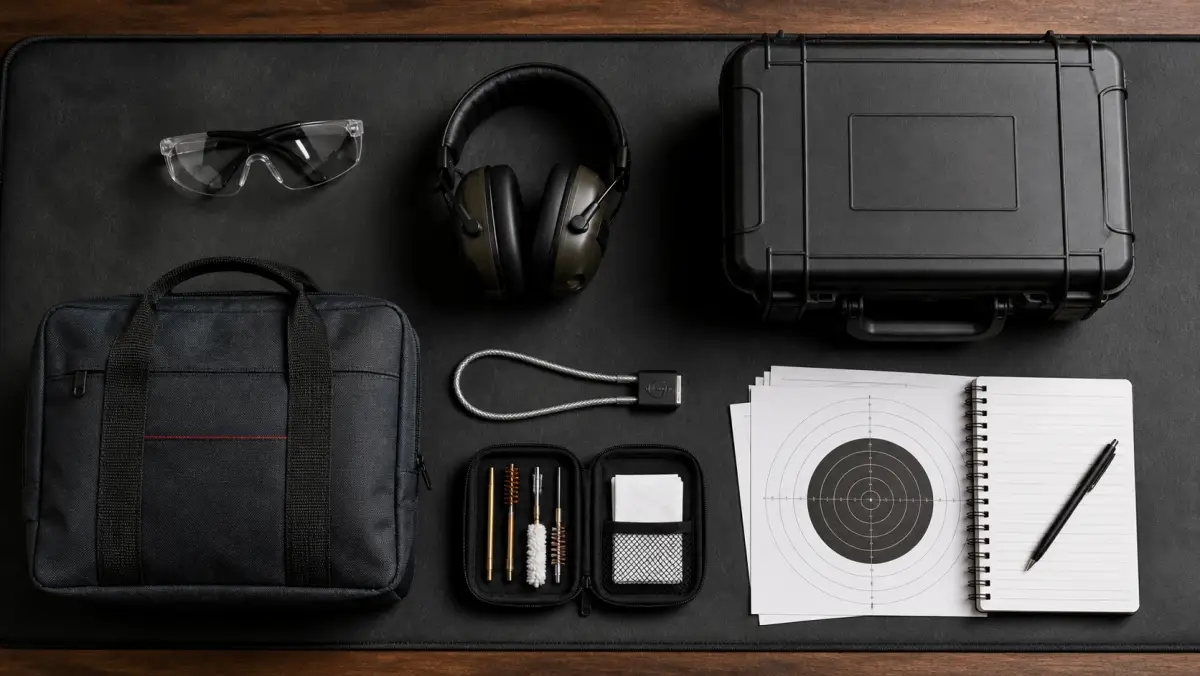
The best new gun owner accessories are not the most dramatic products in the display case. They are the items that help a lawful owner secure the firearm, transport it appropriately, protect vision and hearing, train consistently, use the exact approved ammunition, and maintain the equipment according to the manufacturer’s instructions.
A first-time buyer can easily spend hundreds of dollars on optics, holsters, lights, oversized range bags, and replacement parts before buying a suitable safe or taking a class. This guide reverses that order.
For new owners in Lincoln Park, Detroit, Dearborn, Allen Park, Southgate, Taylor, Wyandotte, and across Metro Detroit, the right accessory plan begins with the entire ownership system: home, vehicle, range, training, maintenance, household access, and continuing cost.
New gun owner accessories at a glance
| Priority | Item | Why it belongs there |
|---|---|---|
| Buy before pickup | Secure storage or appropriate locking device | Prevents unauthorized access and supports Michigan compliance |
| Buy before the first range visit | Protective case | Supports secure, lawful transportation and facility check-in |
| Buy before live fire | Eye protection | Protects against debris, gas, fragments, and other range hazards |
| Buy before live fire | Hearing protection | Firearm impulse noise can permanently harm hearing |
| Budget immediately | Qualified training | Explains the firearm, safety rules, range procedure, and practice plan |
| Buy carefully | Manufacturer-approved factory ammunition | Must match the exact chambering and current range rules |
| Buy after reading the manual | Basic maintenance supplies | Keeps cleaning compatible and avoids unnecessary tools |
| Useful soon | Small range bag and notebook | Organizes inspected gear without becoming permanent firearm storage |
| Buy when justified | Spare magazine or speedloader | Helpful only when compatible and relevant to the training plan |
| Usually wait | Holster and belt | Requires an exact lawful purpose, fit, training, and configuration |
| Usually wait | Optic, laser, light, or replacement sights | Adds cost, compatibility questions, maintenance, and training needs |
| Usually avoid early | Internal modifications | Can affect reliability, warranty, safe operation, and resale value |
Essential accessory 1: secure storage
Secure storage is not an optional add-on after the firearm comes home. Choose, install, and test it before pickup.
Michigan’s current secure-storage resource explains that when an individual stores or leaves a firearm unattended on premises where the person knows or reasonably should know a minor is present or likely to be present, the firearm must be stored under specified conditions. Read the official guidance and current law for definitions, requirements, and exceptions; this article is not legal advice.
Storage options include:
- A properly designed and installed firearm safe.
- A lockbox or locking cabinet appropriate to the firearm.
- A manufacturer-compatible cable lock.
- A compatible trigger lock used according to its instructions.
- Another locked container meeting applicable requirements and the household’s risk plan.
Evaluate more than advertised access speed. Ask:
- Can children, guests, roommates, contractors, or other unauthorized people reach it?
- Can the safe or box be carried away without anchoring?
- Who controls keys, combinations, backup codes, and biometric enrollment?
- What happens when the battery fails?
- Does the firearm fit after any approved accessory is installed?
- Is ammunition stored securely and clearly labeled?
- Does the system address theft as well as casual access?
- Can the owner use it consistently under ordinary daily conditions?
The most important new gun owner accessories protect people when the owner is not actively handling the firearm. A hidden drawer, vehicle console, high shelf, closet, backpack, or locked room is not automatically secure storage.
Essential accessory 2: a proper transport case
A firearm should not travel loose in a vehicle, grocery bag, ordinary backpack, or retail box that does not provide suitable protection and control.
Michigan transportation requirements depend on firearm type, licensing status, route, purpose, and other facts. Michigan DNR’s firearms and transportation information provides official guidance for relevant activities and directs handgun-law questions to current Michigan State Police resources. Verify the law that applies to your circumstances before traveling.
A useful case should:
- Fit the exact firearm without forcing controls or sights.
- Close fully.
- Support the required locking method.
- Protect the firearm from impact and moisture.
- Avoid advertising contents unnecessarily.
- Keep the firearm controlled through check-in.
- Meet the destination range’s current policy.
- Accommodate approved optics or accessories without pressure.
Do not assume the manufacturer’s cardboard or plastic retail box meets every transport, security, or airline need. Airline travel involves additional carrier and federal requirements beyond an ordinary trip to a local range.
Call Range 313 before arriving with an unfamiliar case or firearm. Keep it closed until staff direct you to the approved handling location.
Essential accessory 3: eye protection
Proper shooting glasses protect against hot cases, particles, splash, fragments, gas, and other hazards. Ordinary fashion glasses are not automatically impact-rated range protection.
Look for:
- A recognized impact standard appropriate to shooting.
- Full coverage around the eyes.
- A secure fit that remains stable while moving normally.
- Lenses suitable for the range lighting.
- Compatibility with prescription glasses if needed.
- Temples that do not break the earmuff seal unnecessarily.
- Clear lenses without deep scratches or distortion.
Try glasses and hearing protection together. A frame that feels comfortable by itself may lift an earmuff cup away from the head. Prescription users can consider rated over-glasses or purpose-built prescription safety eyewear.
Keep a clean backup pair in the range bag. Do not downgrade the backup to a damaged item that was already removed from service.
The shooting-range eye and ear protection guide explains standards, fit, electronic earmuffs, double protection, prescription glasses, care, and replacement in depth.
Essential accessory 4: hearing protection
Firearm impulse noise can permanently damage hearing. Regular headphones, earbuds, and noise-canceling consumer audio products are not substitutes for rated hearing protection.
Common options include:
- Disposable foam plugs: effective when the correct size is inserted properly.
- Reusable plugs: convenient when cleaned and fitted according to instructions.
- Passive earmuffs: simple and easy to inspect.
- Electronic earmuffs: amplify lower-level sound while limiting certain high-level sound, but still require fit and battery maintenance.
- Double protection: properly fitted plugs beneath earmuffs when recommended for the range and activity.
CDC/NIOSH explains that hearing protection must be selected correctly, fit well, and be used consistently . The agency also warns that earmuffs can interact with glasses and other head-worn equipment.
Buy protection that the owner will wear correctly for the entire live-fire period. The highest advertised rating is not useful if the product does not seal, is removed to hear conversation, or causes so much discomfort that use becomes inconsistent.
Protection belongs near the top of the new gun owner accessories budget, not in whatever money remains after cosmetic upgrades.
Essential investment 5: qualified training
Training is not a physical accessory, but it should be funded before optional gear. A beginner needs to learn:
- Safe direction and trigger-finger discipline.
- Firearm condition and model-specific controls.
- Loading and unloading under qualified supervision.
- Range commands and facility boundaries.
- Correct use of eye and hearing protection.
- What to do when the firearm or ammunition behaves unexpectedly.
- Secure storage and household planning.
- A realistic practice schedule.
- When a gunsmith, attorney, physician, or other professional is needed.
A counter demonstration explains a feature; it does not necessarily provide a complete safety class. Informal advice from a friend also does not replace professional observation.
Range 313 lists firearms training courses for different experience levels. Contact the team to confirm prerequisites, course format, live-fire expectations, rental availability, ammunition requirements, and current schedules.
New gun owner accessories should support the behaviors taught in class. Buy after the instructor identifies a real need whenever possible.
Essential consumable 6: the exact approved ammunition
Ammunition is not generic. Use only factory ammunition expressly approved by the firearm manufacturer for the exact chambering and permitted by the range.
Before purchasing, match:
- The complete chambering marked on the firearm.
- The exact model’s current owner’s manual.
- The complete cartridge designation on the factory box.
- The manufacturer and product specifications.
- The range’s current ammunition restrictions.
Do not rely on diameter, color, appearance, a partial name, or the fact that a cartridge fits into a magazine. Keep factory ammunition in original labeled packaging.
SAAMI’s safe ammunition storage and handling guidance recommends using ammunition only in firearms designed for that specific cartridge, matching the ammunition and firearm designations, inspecting for damage, and storing ammunition in appropriate packaging in a cool, dry place away from heat and chemicals.
Do not buy a large bulk quantity before confirming that the exact product is manufacturer-approved, range-approved, reliable in the firearm, and appropriate for the owner’s training plan. Ammunition is one of the recurring new gun owner accessories costs that should be included in the first-year budget.
Essential accessory 7: basic maintenance supplies
Read the owner’s manual before buying a universal cleaning kit. The correct tools, cleaner, lubricant, intervals, and disassembly boundaries vary.
A basic model-appropriate setup may include:
- A cleaning rod or pull-through system suitable for the barrel.
- Correct-size bore brush or cleaning element.
- Patches or clean cloths.
- A nylon utility brush.
- Manufacturer-compatible cleaner.
- Manufacturer-compatible lubricant.
- Nitrile gloves when appropriate.
- Eye protection.
- A non-porous work mat.
- A small light for external inspection.
- A closed container for used materials.
Avoid improvising with unknown chemicals, power tools, abrasive materials, or random brushes. More solvent is not better. Over-lubrication can also create problems.
Do not perform maintenance with live ammunition in the workspace. Establish a controlled safe direction, follow the exact manufacturer status-verification process, prevent interruptions, and return the firearm to secure storage afterward.
The Michigan firearm cleaning and maintenance guide covers workspace preparation, model-specific disassembly, inspection, cleaning, lubrication, reassembly, service records, and when to stop and call a gunsmith.
Useful accessory 8: a modest range bag
A range bag keeps protection, identification, targets, simple tools, and notes organized. It should not become permanent firearm storage or an oversized collection of unnecessary equipment.
A practical first bag can hold:
- Clean primary and backup eye protection.
- Earmuffs and fresh earplugs.
- Identification and membership card.
- Factory-boxed approved ammunition.
- Targets allowed by the facility.
- A notebook and pen.
- Small manufacturer-approved tools.
- A clean cloth.
- Hand-cleaning supplies appropriate for after shooting.
- An empty sealable bag for contaminated disposable items.
Keep food, drinks, cosmetics, and medication separate from range residue. After shooting, wash hands, forearms, and face before eating or close contact. Keep the range bag away from kitchens, children’s rooms, and clean clothing.
Do not leave firearms or ammunition casually stored in the range bag between visits. Return them to the planned secure-storage system.
Useful accessory 9: a training notebook
A notebook may improve more than an expensive electronic accessory. Record:
- Date and facility.
- Firearm and factory ammunition.
- Session objective.
- Instructor correction.
- Equipment or protection issue.
- When fatigue appeared.
- Maintenance observation.
- One next step.
Do not record or publish sensitive storage details, serial numbers, household schedules, or unnecessary personal information. The goal is to prevent random practice and repeated mistakes.
A notebook also makes new gun owner accessories purchases more evidence-based. If protection slips every visit, replace it. If a spare magazine repeatedly creates a documented issue, stop using it and request qualified inspection. If no real need appears for an optic or trigger modification, keep the firearm in its supported configuration.
Useful accessory 10: compatible spare magazines or loaders
A spare magazine can support classes, practice, and replacement when a magazine is damaged. A speedloader may help with certain revolvers, and a magazine-loading aid can help people with limited hand strength.
Compatibility must be exact. Confirm:
- Manufacturer and model.
- Generation or product revision.
- Chambering.
- Standard capacity.
- Baseplate and grip fit.
- Current legal limits.
- Manufacturer approval.
Do not buy large quantities of inexpensive unknown magazines before testing a small number under supervision. Mark magazines discreetly for tracking without exposing owner identity or storage information.
Loading tools should never be used to force ammunition into an incompatible magazine. If loading requires abnormal force or cartridges do not sit correctly, stop and ask staff.
These are useful new gun owner accessories after the owner understands the firearm and training plan—not before the exact model has been selected.
Is a holster essential on day one?
No. A holster is essential only when it serves a lawful, defined purpose. Range transport, home storage, and concealed or open carry are different contexts.
A suitable holster should:
- Fit the exact firearm and installed configuration.
- Fully protect the trigger area.
- Retain the firearm appropriately for the activity.
- Avoid pressing controls.
- Work with the intended belt or mounting system.
- Allow safe access and reholstering under qualified training.
- Comply with current law and facility rules.
Universal fabric pouches and products labeled “fits most” may collapse, shift, or leave the trigger area inadequately protected. A light, optic, laser, compensator, or other change can make an existing holster incompatible.
Do not practice drawing or reholstering at a range unless the facility expressly permits it and qualified instruction is controlling the exercise. Do not test holster fit with a loaded firearm.
Because the user requested a separate guide on choosing a properly fitting holster, this article keeps the subject at the decision level rather than duplicating that future topic.
When should a new owner buy an optic?
An optic can help some shooters, but it also adds:
- Cost.
- Mounting compatibility questions.
- Plates, screws, and torque requirements.
- Battery maintenance.
- Sight-in and confirmation work.
- New presentation and visual skills.
- Holster and storage fit questions.
- Additional failure points.
“Optic-ready” does not mean every optic fits or that an optic is included. Ask which mounting footprints, plates, screws, and professional services the manufacturer supports.
Start with a fundamentals class. If an instructor identifies a visual or training benefit, compare appropriate options and plan installation by a qualified professional where needed.
An optic should solve a defined problem. It should not be purchased because every photograph of the firearm includes one.
What about lights and lasers?
Lights and lasers are purpose-specific accessories, not universal first purchases. They affect controls, holster fit, storage dimensions, maintenance, training, and sometimes range policy.
Before considering one, ask:
- What lawful purpose does it serve?
- Is it compatible with the exact rail and firearm?
- Does the manufacturer approve the added weight and mounting method?
- Can every control be reached without unsafe finger placement?
- Does the storage device still close without pressure?
- Is a model-specific holster available if needed?
- What training addresses its safe use?
- How are batteries inspected and changed?
- Does the range allow the planned activity?
Avoid using a firearm-mounted light as a general-purpose search tool. Handling a firearm to illuminate something also directs the muzzle toward it. A separate handheld light may meet ordinary household needs without introducing that risk.
Internal upgrades usually should wait
First-time owners are often offered replacement triggers, springs, connectors, barrels, controls, grips, compensators, and other components. Early modification creates several problems:
- The owner has no baseline for comparison.
- Reliability changes are hard to diagnose.
- Warranty coverage may be affected.
- Parts may be incompatible with the exact revision.
- Safe operating characteristics may change.
- Holster and storage fit may change.
- Resale value can fall.
- Range or class policy may restrict modified equipment.
Use the firearm in its manufacturer-supported configuration while building safe fundamentals. Record a recurring issue. Ask an instructor whether the issue is technique, fit, ammunition, maintenance, or mechanical condition. If a real equipment need remains, consult the manufacturer and qualified gunsmith.
New gun owner accessories should reduce uncertainty. Unsupported internal changes usually add it.
A realistic first-year accessory budget
Prices change, so build categories rather than relying on one online total.
| Budget category | Required before use? | Planning question |
|---|---|---|
| Secure storage | Before the firearm comes home | Is it installed, anchored if needed, and inaccessible to unauthorized people? |
| Transport case | Before travel | Does it satisfy the applicable law and destination policy? |
| Eye protection | Before live fire | Is it impact-rated, clear, and compatible with earmuffs? |
| Hearing protection | Before live fire | Does it fit correctly and remain comfortable? |
| Training | Before independent handling when needed | Does the course match the actual experience level? |
| Ammunition | Before live fire | Is it exact, approved, labeled, and range-permitted? |
| Maintenance supplies | Before scheduled maintenance | Does the manual approve each tool and chemical? |
| Range fees and targets | Recurring | What will a sustainable practice schedule cost? |
| Spare magazines or loaders | Optional early | Does a documented training or accessibility need exist? |
| Holster, optic, light, or upgrade | Usually later | What problem does it solve, and what new training does it require? |
Spend first on access control, protection, and competence. An inexpensive firearm with complete safe support can cost more than the sticker price; an expensive firearm does not remove those costs.
The Michigan first-handgun buying guide provides a full first-year decision worksheet covering purpose, dealer process, inspection, transportation, storage, practice, and maintenance.
Questions to ask before buying any accessory
- What exact problem does this solve?
- Is it compatible with the manufacturer, model, generation, and chambering?
- Does the manufacturer approve it?
- Does installation require a qualified gunsmith?
- Could it affect reliability or warranty?
- Does it change the firearm’s safe operating sequence?
- Will the case, safe, and holster still fit?
- Is it permitted by the range and planned class?
- Does it require additional training or maintenance?
- Is there a simpler non-firearm tool that meets the need?
- What is the total cost after mounting parts, batteries, or service?
- Can the purchase wait until the need appears in practice notes?
If the seller cannot identify the exact compatible model or supported installation method, do not buy on the promise that it will “probably work.”
Common accessory mistakes
Buying gear before training
The student has no informed basis for deciding what fits or helps. Take an appropriate class early.
Treating the included lock as the complete storage plan
An included device may be useful but may not address theft, multiple household risks, vehicle storage, or the owner’s routine. Evaluate the full system.
Buying a generic holster
Poor fit can leave the trigger area exposed or allow the product to collapse. Wait for a model-specific, purpose-specific choice.
Choosing protection only by price
Fit, rating, comfort, and compatibility matter. Protection worn incorrectly is not a bargain.
Buying bulk ammunition immediately
Confirm exact compatibility, range approval, and function before committing to a large quantity.
Modifying before establishing a baseline
The owner cannot distinguish a technique issue from an equipment issue. Keep the supported configuration while learning.
Letting the range bag become storage
A range bag is organizational gear. Return the firearm and ammunition to controlled storage after the visit.
Shop for new gun owner accessories at Range 313
Range 313 offers firearms, ammunition, targets, range bags, cases, cleaning supplies, eye and hearing protection, holsters, magazines, optics, safes, secure-storage products, training, rentals, and gunsmithing support at 1125 Fort Street in Lincoln Park.
The benefit of a connected range, training facility, store, and service counter is context. A first-time buyer can ask whether an item fits the exact firearm, whether the range permits it, whether an instructor recommends it, and whether professional installation is appropriate.
Review the current Range 313 products and firearm services and call (313) 436-0197 before traveling for a particular item. Inventory, prices, rentals, course dates, and service availability change.
The team serves customers from Detroit, Dearborn, Allen Park, Southgate, Taylor, Wyandotte, Riverview, Trenton, and throughout Downriver. Bring the exact manufacturer, model, generation, chambering, and current configuration when asking about compatibility.
About the author
The Range 313 Team works with first-time buyers, students, rental customers, firearm owners, and experienced target shooters at an indoor range, retail showroom, training facility, and service counter in Lincoln Park, Michigan. Staff regularly see which products become part of a responsible routine and which were bought before the owner understood the need.
This guide provides general education, not individualized instruction, product endorsement, compatibility confirmation, or legal advice. Verify current law, manufacturer documentation, range rules, and household circumstances before purchasing or using any firearm accessory.
The practical answer
Start with secure storage, a suitable case, correctly fitted eye and hearing protection, qualified training, exact factory ammunition, and basic model-approved maintenance supplies. Add a modest range bag, notebook, spare magazine, or loading aid when practice creates a real need.
Delay holsters, optics, lights, lasers, cosmetic controls, and internal modifications until the lawful purpose, exact compatibility, training requirement, storage impact, and total cost are clear.
The best new gun owner accessories make responsible behavior easier. If a product adds complexity without solving a documented problem, leave it on the shelf for now.