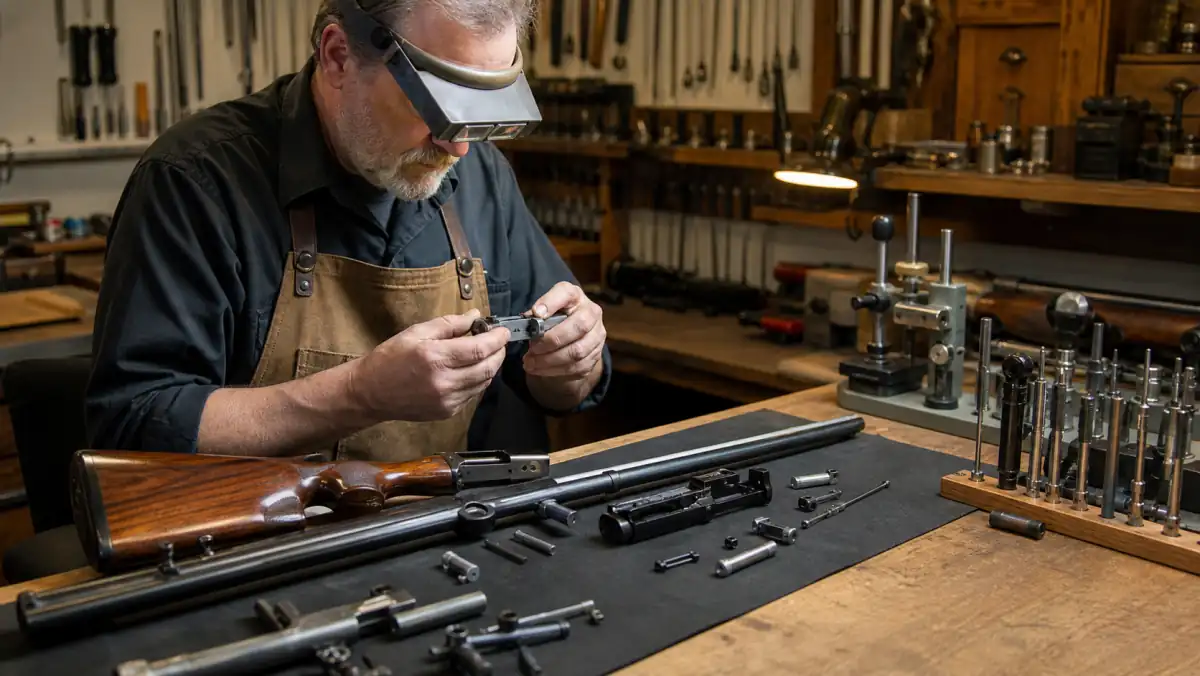
Professional gunsmithing Michigan firearm owners use can address problems that routine cleaning and owner-level maintenance cannot. A gunsmith may inspect damage, diagnose repeated malfunctions, replace parts, mount sights or optics, evaluate corrosion, and perform manufacturer-specified work. The owner’s responsibility is to stop using questionable equipment, describe the issue accurately, and choose a qualified provider rather than experimenting.
This guide explains when to seek service, how to prepare a work order, what questions to ask, and how to review completed work safely.
Stop using a firearm when something changes
An unusual sound, abnormal recoil, repeated failure, loose component, visible crack, damaged control, or suspected obstruction is a reason to end the session. Keep the muzzle safely oriented, remove your finger from the trigger area, and involve range staff.
Do not fire another round to see whether the problem repeats. Do not look into the muzzle. Do not apply force or tools on the firing line.
Once safely secured, arrange gunsmithing Michigan service before returning the firearm to use. Early evaluation can prevent further damage and preserve useful evidence.
Routine maintenance versus gunsmithing
Routine owner maintenance is limited to the process the manufacturer describes: basic inspection, field stripping, cleaning, lubrication, and approved function checks. Gunsmithing involves deeper diagnosis, parts fitting, repair, specialized tools, or work affecting critical systems.
Examples of professional tasks include sight installation, trigger installation, parts replacement, barrel or chamber concerns, optic mounting, torque-sensitive work, and warranty diagnosis.
Range 313 provides gunsmithing and firearm maintenance covering cleaning, repairs, installation, optics, zeroing, and related services.
Document the issue without recreating it
Write down the make, model, caliber, approximate round count, ammunition brand and loading, magazines used, environmental conditions, and exact sequence observed. Note whether the issue appeared after cleaning, modification, impact, or storage.
Photograph visible damage without manipulating the firearm unnecessarily. Preserve ammunition packaging and identify the magazine involved.
Do not reproduce the failure for a video. A clear written description is safer and often more useful than an uncontrolled demonstration.
Check warranty requirements
Before authorizing work, review the manufacturer’s warranty. Some repairs should be handled through an authorized service center, and unauthorized modification may affect coverage.
Contact the manufacturer with the serial number and issue description if appropriate. Ask whether shipping must occur through a dealer or carrier process and who pays costs.
A local gunsmith can help assess whether factory return is the better path, but confirm responsibilities before parts are altered.
Choose a qualified provider
Ask what experience the shop has with the specific platform and task. Confirm business hours, intake procedure, estimate policy, turnaround expectations, storage security, and how additional work is authorized.
Professional gunsmithing Michigan providers should be willing to define the requested work and explain limits. Be cautious of guaranteed results before inspection or vague promises to make a firearm “better” without a measurable goal.
Licensing, insurance, manufacturer credentials, and references may matter depending on the work. Ask directly rather than assuming.
Prepare the firearm for intake
Contact the shop before arriving. Ask how the firearm must be transported and whether accessories, magazines, ammunition, or the original case should accompany it. Do not bring live ammunition unless specifically requested and lawfully transported.
Keep the firearm cased and secured until staff direct intake. Describe its condition accurately. If it may be loaded, obstructed, or unsafe to manipulate, state that immediately rather than attempting to correct it in the lobby.
Michigan transportation guidance is available from the Michigan DNR , but individual circumstances may require legal advice.
Create a precise work order
“Fix it” is not enough. The written work order should identify the complaint, inspection requested, approved work, estimated range, parts preferences, return of replaced parts when lawful, and how additional costs are authorized.
For optic or sight work, specify the equipment and intended lawful range use. For cleaning, clarify whether the service includes inspection and function checks. For a recurring malfunction, ensure the ammunition and magazine details are recorded.
Keep a copy of the intake receipt with identifying information and expected communication method.
Understand estimates and hidden conditions
An initial estimate is based on visible information. Disassembly may reveal corrosion, prior alteration, missing parts, or damage. Ask whether the gunsmith will stop and obtain approval before exceeding a set amount.
Parts availability can affect timing. Older or uncommon firearms may require discontinued components or factory fabrication. A responsible shop should explain uncertainty rather than promise an exact date it cannot control.
Cheap repair is not always economical if it leaves underlying damage unresolved.
Sight and optic installation deserve care
Sights and optics may require correct tools, mounting surfaces, fastener preparation, torque specifications, alignment, and verification. Improvised punches or excessive thread-locking compound can damage slides, mounts, or warranties.
Professional installation creates a documented baseline. It also allows inspection of compatibility before a part is forced into place.
After mounting, live-fire confirmation remains necessary at an appropriate Michigan indoor rifle or pistol range . Mechanical alignment is not the same as a confirmed zero.
Trigger and internal parts require caution
Changes to triggers, safeties, springs, sears, and other internal components can affect reliability and safe operation. Use parts approved for the exact model and a qualified installer.
Do not pursue the lightest possible trigger because it sounds desirable online. The intended lawful use, manufacturer specifications, reliability, and user training all matter.
Any change to critical controls should include appropriate safety checks and documentation before live fire.
Corrosion and water exposure
Surface discoloration may be cosmetic, while deep pitting or internal corrosion can affect integrity. A firearm exposed to flooding, fire suppression, salt water, or prolonged moisture needs professional evaluation.
Do not aggressively polish away evidence before inspection. Photograph condition and describe the exposure. Solvents or abrasives can make damage harder to assess.
Michigan humidity, snow, and condensation make prompt drying and inspection important. Review our firearm cleaning guide for preventive planning.
Used firearm inspection
A used firearm may have undocumented modifications, improper assembly, worn springs, or mismatched parts. A pre-purchase inspection is ideal when the seller and process allow it. Post-purchase inspection should occur before live fire when history is uncertain.
Provide any records, boxes, and included parts to the gunsmith. Do not assume aftermarket components were installed correctly.
An FFL’s legal transfer process is not automatically a full mechanical certification. Our Michigan FFL transfer guide explains that distinction.
Reviewing completed work
At pickup, ask what the gunsmith found, what parts were installed, what tests were completed, and what break-in or maintenance guidance applies. Request replaced parts if permitted and previously agreed.
Review the invoice and preserve it with maintenance records. Confirm warranty terms for the repair.
Do not manipulate the firearm in the public area without permission. Staff should identify the safe direction and pickup procedure.
Return to live fire gradually
Transport the serviced firearm lawfully and bring it to an appropriate range. Tell staff or an instructor what work was completed. Begin with a controlled function check consistent with gunsmith and manufacturer instructions.
Do not immediately begin high-volume or complex practice. Observe operation, stop at any abnormal behavior, and record results.
For substantial changes, qualified firearms training can help you adapt without guessing.
Maintain service records
Keep dates, work orders, invoices, parts, round-count estimates, and target notes. Records help identify whether a problem recurs and support warranty claims or future resale disclosures.
Do not record safe combinations or storage locations in the same file. Protect personal data while preserving maintenance history.
Regular inspection can identify small concerns before they require extensive repair.
Avoid unsafe DIY shortcuts
Do not file, grind, bend, drill, weld, or substitute parts based on anonymous instructions. Do not disable safeties or alter identification marks. Legal and mechanical consequences can be serious.
If a task exceeds your manual, tools, or training, professional service is the efficient choice. The cost of correcting damaged parts often exceeds the original installation fee.
Gunsmithing Michigan owners choose should reduce uncertainty, not add undocumented variables.
Gunsmithing Michigan intake checklist
Stop use, secure the firearm, document the symptom, preserve ammunition and magazine information, review warranty terms, and contact the shop. Transport as directed, create a precise work order, approve costs in writing, and retain the receipt.
At pickup, review findings and tests, preserve records, and return to live fire gradually at an appropriate range. Stop immediately if the issue remains.
Professional gunsmithing Michigan service is most effective when the owner provides accurate information and respects the boundary between routine maintenance and technical repair.
Questions to ask at pickup
Use pickup as a short technical handoff. Ask what caused the issue, which findings were confirmed rather than suspected, which parts were repaired or replaced, and whether any related components should be monitored. Request the manufacturer and part number for installed components and ask whether the work changes the recommended maintenance schedule.
Clarify what tests the shop completed. A bench function check, measurement, or visual inspection is different from live-fire testing. If test fire occurred, ask which ammunition and how the result was documented. Find out whether additional confirmation is required at the range and what signs should cause immediate stoppage.
Ask about the repair warranty, recommended inspection interval, and whether the shop wants the firearm returned after a defined round count. Preserve all answers with the invoice rather than relying on memory.
Finally, verify transportation and casing before leaving the counter. Do not handle the firearm in an unapproved direction while discussing the repair. A careful pickup closes the gunsmithing Michigan service process and gives you a clear, evidence-based plan for the first session afterward.