Searching for a gun range near Canada often leads Windsor and Southwestern Ontario visitors across the Detroit River. Range 313 is an indoor shooting range at 1125 Fort Street in Lincoln Park, Michigan, south of downtown Detroit and within the Downriver area. The facility welcomes international and domestic guests, offers rental firearms and protective equipment, and supports first-time visitors as well as experienced shooters.
A cross-border range visit needs more planning than a local drop-in. Your ability to enter the United States, possess or use a firearm, rent equipment, and return to Canada depends on your citizenship or immigration status, applicable law, and current facility policies. Border traffic can also change the length of the trip substantially.
This guide helps you organize those moving pieces without treating an internet article as personal legal advice. Confirm your eligibility directly, bring the right documents, leave prohibited items at home, and give the range a call before making a special trip.
Why Range 313 appears in searches for a gun range near Canada
Canada is a large country, so “near Canada” is most useful when the searcher is in Windsor, Essex County, or another part of Southwestern Ontario. Range 313 is located in Lincoln Park, a Downriver Detroit community. Visitors entering Michigan at an operating Detroit–Windsor crossing can continue toward Lincoln Park without driving across the entire Metro Detroit region.
The location is only part of the appeal. A Canadian visitor may not own equipment that can easily or lawfully travel across the border. An indoor range with current rental options, eye and hearing protection, staff assistance, and beginner-friendly policies removes some of that friction. Range 313 also lists walk-in lane access during business hours, although international visitors should still call ahead.
Current facility information can change. The Range 313 contact page lists the address, telephone number, daily hours, last check-in time, identification reminders, and inquiry form. Use that page immediately before your trip rather than relying on an old search snippet.
Start with eligibility, not directions
The most important question is not how quickly you can reach Lincoln Park. It is whether every person in your group may legally enter the United States and possess or use a firearm under the circumstances of the visit.
Canadian citizenship, Canadian residence, and lawful status in Canada are not interchangeable. A Canadian citizen who enters the United States without a visa may be treated differently under federal firearms law from a resident of Canada who enters under a nonimmigrant visa. A criminal record, protection order, immigration condition, or other personal circumstance can also affect eligibility.
The Bureau of Alcohol, Tobacco, Firearms and Explosives explains that the federal firearm prohibition for certain nonimmigrant aliens applies to a person admitted under a nonimmigrant visa unless an exception applies. ATF separately states that a nonimmigrant alien lawfully admitted without a visa is not subject to that visa-specific prohibition, provided no other prohibition applies. Review the current ATF firearms questions and answers and obtain qualified legal guidance for individual questions.
Range policy can be more restrictive than the legal minimum. Call Range 313 at (313) 436-0197 , explain each visitor’s citizenship or immigration status accurately, and ask what documents the team currently requires. Do not wait until the counter to disclose information that could determine whether someone may participate.
Bring the correct border and range identification
The document you use to enter the United States may depend on citizenship, age, status, and whether you travel by land, sea, or air. U.S. Customs and Border Protection currently lists a Canadian passport, Enhanced Driver’s Licence or Enhanced Identification Card, NEXUS card, FAST/EXPRES card, or SENTRI card among accepted land and sea documents for many Canadian citizens. Different requirements apply to permanent residents of Canada who are citizens of other countries.
Check the current CBP guidance for Canadian visitors before departure. An individual CBP officer determines admission at the port of entry, and possessing a document does not guarantee admission.
For the range, bring a passport or valid government-issued photo identification. The safest practical plan is to carry your valid passport even if another document can be used at the land border. Before leaving, verify that the name and date of birth are readable and that the document has not expired.
Every adult should carry their own identification. If minors are included, discuss age, supervision, identification, and participation requirements with the range before the trip. Range 313 currently says minors age 12 and older require a parent or guardian, but that facility rule does not replace border-document requirements.
Leave personal firearms and ammunition at home unless fully authorized
A Canadian range guest should never assume that a firearm, magazine, ammunition, component, pepper spray, knife, or other regulated item may cross either border because it is lawfully owned at home. Temporary importation into the United States can require advance ATF authorization. Returning to Canada brings a separate set of Canadian declaration, classification, licence, transport, and import rules.
ATF states that most nonimmigrant aliens temporarily importing firearms or ammunition for lawful sporting purposes need an approved ATF Form 6NIA before entry. The Canada Border Services Agency likewise warns travelers to review both countries’ requirements and declare firearms and weapons when entering Canada. Read the current CBSA firearms and weapons guidance if you are considering any cross-border transport.
For a casual visit, the cleanest plan is usually to bring no firearm, ammunition, magazine, firearm part, or defensive spray across the border. Ask Range 313 about eligible on-premises rentals and buy only the ammunition required for the rental under the facility’s current rules. Use it at the range and do not leave with leftover ammunition or other regulated items.
That recommendation is about reducing border complexity, not bypassing law. You still must be eligible to possess and use the rental, and the range must approve the transaction.
Call before your cross-border range trip
A local customer can adjust when a lane or desired rental is unavailable. A visitor who has already crossed an international border has less flexibility. A short phone call can protect hours of travel.
Ask the team:
- Are Canadian visitors with my specific status currently eligible under range policy?
- Which passport or government-issued ID should I present at check-in?
- Are walk-ins available on my preferred day, and when is the last check-in?
- Are rental firearms available to an eligible international visitor?
- Must ammunition for a rental be purchased at the range?
- Is eye and hearing protection available?
- Does a first-time shooter need a class, private lesson, or other arrangement?
- What are the current lane, rental, target, protection, and ammunition costs?
- What are the current rules for minors or non-shooting observers?
- Are there any events or maintenance periods that could affect lane access?
Take notes and repeat important details back to the staff member. Policies and inventory can change between visits, so a previous successful trip is not a substitute for a current confirmation.
Plan border time separately from range time
A map estimate does not include inspection queues. Border wait times vary with the crossing, direction, time of day, holiday schedule, construction, major events, staffing, and traffic incidents. Allow enough flexibility that a delay does not push your arrival past the last check-in.
Check current U.S.-bound information from the applicable crossing and review the CBSA land border wait-time page for your return to Canada. Use live navigation on the day of travel. Do not choose a crossing solely from habit when another current route is more practical.
Build the day backward. Start with Range 313’s last accepted arrival, subtract the time you want at the facility, add the drive from the port of entry, then add a realistic border cushion. Repeat the same exercise for your return, especially if anyone has work, child care, medication, or another fixed obligation that evening.
What to expect when you arrive at Range 313
Range 313 currently lists daily hours of 10 a.m. to 9 p.m., with the last guests accepted at 8:15 p.m. Walk-ins are welcome during normal business hours. International visitors should arrive well before the cutoff because document review, orientation, equipment selection, and lane preparation take time.
At check-in, provide truthful information, present the requested identification, and disclose that you are visiting from Canada. Read every waiver and rule before signing. If any instruction is unclear, ask for an explanation.
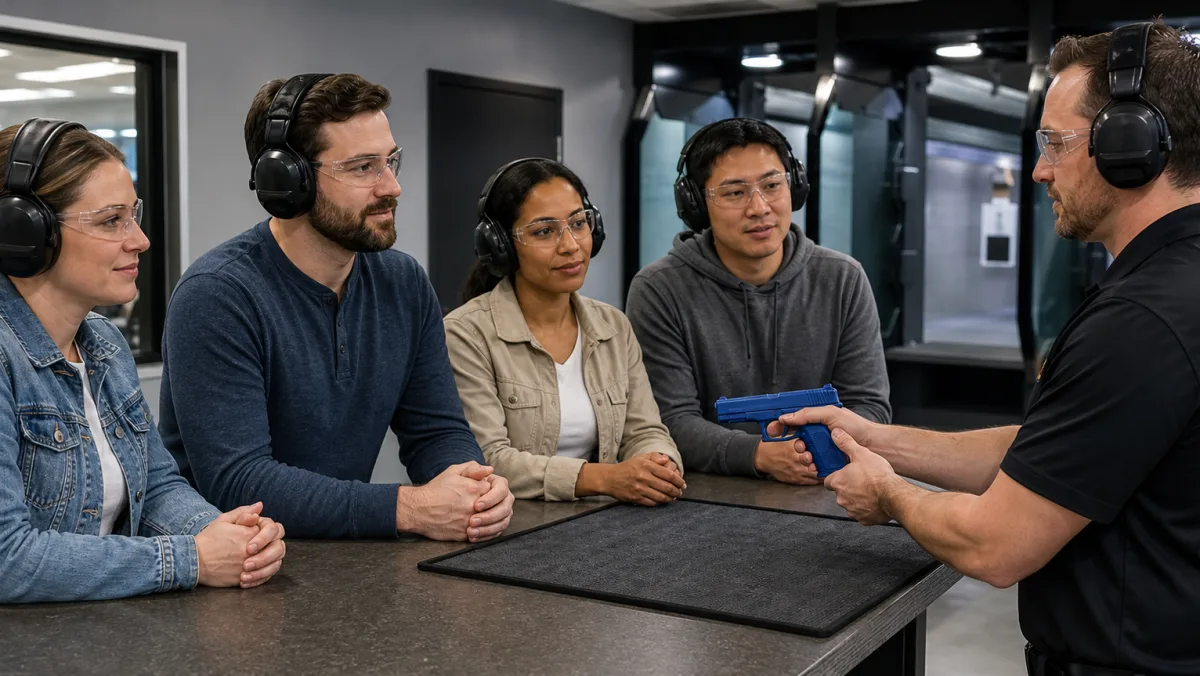
First-time shooters should say so directly. Basic safety assistance can help you understand the facility, but a counter explanation is not automatically a substitute for a structured lesson. If you cannot independently maintain muzzle direction, trigger-finger discipline, and control of the firearm, arrange appropriate instruction.
Review the first-time shooting range checklist before departure and the Michigan gun range safety rules guide before entering a live-fire area.
Dress and pack for a safer indoor range visit
Wear closed-toe shoes and a shirt with a close-fitting neckline. Hot cartridge cases can move unpredictably, and low-cut tops or open footwear can trap them against skin. Avoid loose scarves, dangling jewelry, or anything that can interfere with eye and hearing protection.
Bring only ordinary travel items:
- Valid border documents and range identification
- A payment method accepted in the United States
- Prescription glasses or necessary medication
- A simple hair tie for long hair
- Clean clothing for the rest of the day, if desired
- Written confirmation of any special arrangement
Do not pack alcohol, cannabis, CBD products, or impairing substances for a firearms outing. Canadian legalization does not make cannabis lawful to carry across the international border. CBSA’s border reminder checklist specifically warns travelers about cannabis and regulated goods.
Leave firearm cleaning until after you are home and following a lawful, controlled plan. Wash your hands and face with cool water and soap after the session, and keep food and drinks out of the live-fire area.
Rental equipment keeps the visit focused
An eligible visitor who does not bring a firearm can ask about on-premises rentals. Availability varies, and not every model or caliber will suit a beginner. Choose equipment based on manageable operation, fit, current range approval, and staff guidance—not appearance or social-media familiarity.
Before the first live round, learn how the specific rental’s controls operate. Confirm the ammunition, target distance, loading procedure, malfunction response, and method for requesting staff assistance. Keep the muzzle pointed downrange and your finger indexed outside the trigger guard while listening.
If several friends are participating, do not let the most confident person become an unofficial instructor unless that person is qualified and the range permits it. Each shooter should hear the rules directly and work within a pace they can control.
Our guide to visiting a Michigan shooting range without owning a gun explains rentals, costs, orientation, and beginner expectations in more detail.
Build a realistic budget in U.S. dollars
The final cost may include lane time, a rental, approved ammunition, targets, eye protection, hearing protection, instruction, taxes, food, tolls, parking, fuel, and currency conversion. Ask for the current range prices before leaving Canada and check how your card issuer handles foreign transactions.
Avoid planning around the lowest possible number. A beginner may need more staff time or formal instruction, while a group may need additional lanes. Ammunition use also varies by equipment and pace. A smaller, deliberate session is often more useful than buying the largest package available.
Do not take leftover ammunition, magazines, firearm components, or a firearm purchase back to Canada on impulse. Retail availability does not establish that an item can lawfully leave the United States or enter Canada. Ask qualified authorities before any cross-border purchase involving a regulated item.
Make the first trip about the experience, not performance
A cross-border outing can create pressure to make every minute count. That is exactly when people rush. Use the first visit to learn the facility, understand the safety system, experience one suitable rental, and finish with attention intact.
Set a modest goal: complete orientation, fire a few controlled groups, learn how to load and unload under supervision, or decide whether a future class would be useful. Take breaks when concentration drops. Stop if anyone is uncomfortable, fatigued, emotionally upset, or unable to follow instructions.
The loudest or fastest shooter is not necessarily the most skilled. A successful visit is one in which every participant returns the equipment as directed, leaves the lane safely, and understands the next responsible step.
Return to Canada with a clean inventory
Before leaving Range 313, account for your passport, wallet, phone, personal protective equipment, and ordinary belongings. Return every rental item and confirm that no ammunition, casing, magazine, firearm part, knife, spray, or other regulated item has entered a pocket or bag.
Keep receipts for ordinary purchases and declare goods accurately when required. CBSA directs returning residents to make a full and accurate declaration. If you are uncertain about an item, ask a border services officer rather than guessing.
Never agree to carry a package or equipment for another person. A friendly request does not transfer the legal responsibility away from the traveler whose vehicle or bag contains the item.
Gun range near Canada trip checklist
Use this final sequence before a Windsor-to-Lincoln Park visit:
- Confirm that every participant may legally enter the United States and possess or use a firearm.
- Review current CBP travel-document requirements for each person.
- Call Range 313 and accurately explain the group’s citizenship, status, age, and experience.
- Confirm hours, last check-in, lane access, rentals, protective gear, pricing, and training needs.
- Leave personal firearms, ammunition, magazines, parts, and defensive weapons at home unless fully authorized in advance.
- Check live border and road conditions in both directions.
- Bring a passport or valid government-issued photo ID, suitable clothing, and a U.S.-compatible payment method.
- Arrive early, disclose that you are an international visitor, and follow all staff directions.
- Use only approved equipment and ammunition at the range.
- Check bags and pockets before returning to Canada, then declare goods truthfully.
A search for a gun range near Canada can lead to a memorable Detroit-area experience, but proximity never replaces preparation. Range 313 gives eligible Canadian visitors access to indoor lanes, rentals, protective equipment, and staff support in Lincoln Park. The best plan is simple: verify first, travel with clean documentation, rent on site when approved, practice deliberately, and cross home with no surprises.
Sources
- Range 313 contact, hours, identification, and visitor information
- U.S. Customs and Border Protection: Documents for Canadian visitors
- ATF: Firearms questions and answers for nonimmigrant visitors
- ATF Form 6NIA and temporary import instructions
- Canada Border Services Agency: Firearms and weapons requirements
- Canada Border Services Agency: Border reminder checklist