Your first CPL class near Detroit may feel like several new experiences packed into one day: a legal seminar, a pistol-safety course, a range orientation, a shooting lesson, and the beginning of a government application process. Feeling uncertain before that day is normal. Good preparation turns uncertainty into useful questions instead of rushed decisions.
Range 313 is located in Lincoln Park, just south of Detroit, and offers CPL classes every Saturday at 10am for $79.99. A firearm rental and ammunition are included with no hidden class fees. No advance sign-up is required, and walk-ins are welcome.
This guide is written for adults in Detroit, Dearborn, Allen Park, Lincoln Park, Taylor, Southgate, Wyandotte, and throughout Metro Detroit who are considering their first class. It explains readiness, the classroom and range experience, common beginner concerns, and what happens afterward. It does not determine legal eligibility or replace current official instructions.
First, understand what the class is for
A Michigan CPL class provides the training required before an eligible person applies for a concealed pistol license. It does not issue the license. It does not guarantee government approval. It does not authorize a student to carry concealed after class.
Michigan’s current law requires a qualifying pistol training program to include at least eight hours of instruction completed within the five years before application. The program includes five hours of specified instruction, at least three hours on a firing range, and at least 30 rounds fired. The required topics include safe storage and handling, ammunition knowledge, shooting fundamentals, pistol positions, firearms law, civil liability, use of deadly force, conflict avoidance, and Michigan carry law.
Read the complete requirements in MCL 28.425j through the official Firearms Laws of Michigan . Knowing the structure helps a beginner understand why the day is substantial and why every portion deserves attention.
Decide whether you need a fundamentals lesson first
A complete beginner can learn a great deal in a CPL course, but there is a difference between being legally permitted to enroll and being positioned to learn comfortably. If every pistol control, range command, and sound is new, the student may spend so much attention managing the immediate experience that little remains for legal concepts and judgment.
Ask yourself:
- Have I handled a pistol under qualified supervision?
- Can I consistently keep the muzzle in a safe direction?
- Do I understand keeping my finger outside the trigger guard?
- Have I worn eye and hearing protection on an indoor lane?
- Do I know how to stop and ask for help during a malfunction?
- Can I follow multi-step range commands without rushing?
You do not need to arrive as an expert. The questions identify whether a short introductory lesson would help. A separate fundamentals session can make the CPL class less stressful and allow more productive participation.
Contact Range 313 about its course options and explain your experience honestly. “I have never touched a pistol” gives the team useful information. “I am probably fine” does not.
Review eligibility before registering
Training is only one part of Michigan’s CPL process. Michigan State Police publishes a detailed CPL requirements page . It currently addresses age, citizenship or lawful admission, residency, identification, training, criminal history, court orders, mental-health-related provisions, firearm-possession restrictions, and other conditions.
Read the official page before paying for class. Do not ask an instructor to guarantee eligibility or make a government decision. If a conviction, pending case, immigration question, protection order, commitment, or another personal circumstance may matter, contact the appropriate authority or a qualified Michigan attorney.
Completing class does not cure a disqualification. Honest review before registration protects your time and money.
What the classroom portion feels like
Expect sustained attention. The classroom is not filler before shooting; it contains much of the information that defines responsible concealed carry. Topics move from concrete skills, such as safe storage and ammunition knowledge, into legal and judgment questions with serious consequences.
Take notes in plain language. Instead of trying to transcribe every sentence, write:
- The rule or principle.
- The official source connected to it.
- A question you still need to resolve.
- A real situation in which the principle matters.
For example, prohibited premises should lead you to the current Michigan State Police prohibited-premises page , not a memory of someone’s old list. Interstate travel should lead to official sources for the destination state, not an assumption that reciprocity makes every rule identical.
Ask questions without turning the class into a debate built from online hypotheticals. A useful question clarifies a concept. An individualized legal scenario may require private advice from an attorney.
The legal portion is about judgment, not clever phrases
First-time students sometimes expect the legal section to provide simple sentences that answer every possible encounter. Real legal analysis depends on facts, and responsible behavior often begins long before a use-of-force question.
Pay close attention to conflict avoidance, de-escalation, prohibited places, impairment, storage, and the duties associated with carrying. A CPL does not transform a person into law enforcement or create authority over strangers. It adds responsibilities to ordinary daily decisions.
Michigan State Police maintains a CPL and firearms resource hub with current pages on requirements, application, renewal, prohibited premises, reciprocity, and carrying under the influence. Bookmark it during class.
Preparing for the indoor range environment
An indoor range is controlled, but it is still loud and unfamiliar. Gunfire produces a sharp pressure wave, target carriers move, ventilation creates background noise, and several people may be following commands at once.
Properly fitted hearing protection reduces sound exposure but does not make the range silent. Ask whether double protection—earplugs beneath over-ear muffs—is appropriate and compatible with the instructor’s communication system. Eye protection should stay in place wherever required.
Before live fire:
- Secure long hair.
- Remove loose objects that could interfere with movement.
- Check that eye protection does not shift.
- Confirm hearing protection seals properly.
- Listen to the complete command before moving.
- Know how to signal that you need help.
Tell the instructor if loud noise causes panic, if you have difficulty hearing commands, or if protective equipment conflicts with prescription glasses or hearing aids. Quietly struggling is not safer than asking for an adjustment.
What happens on the firing line
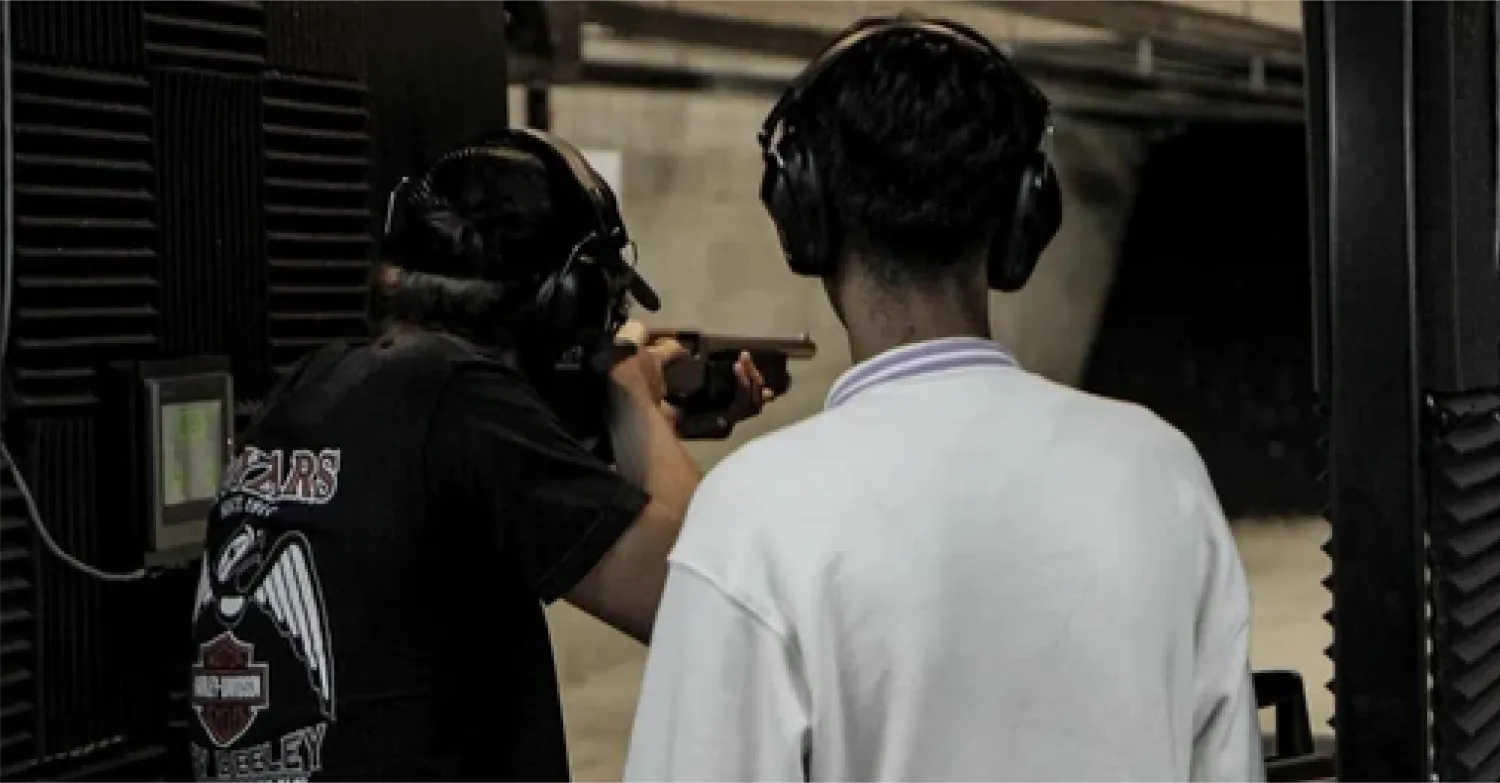
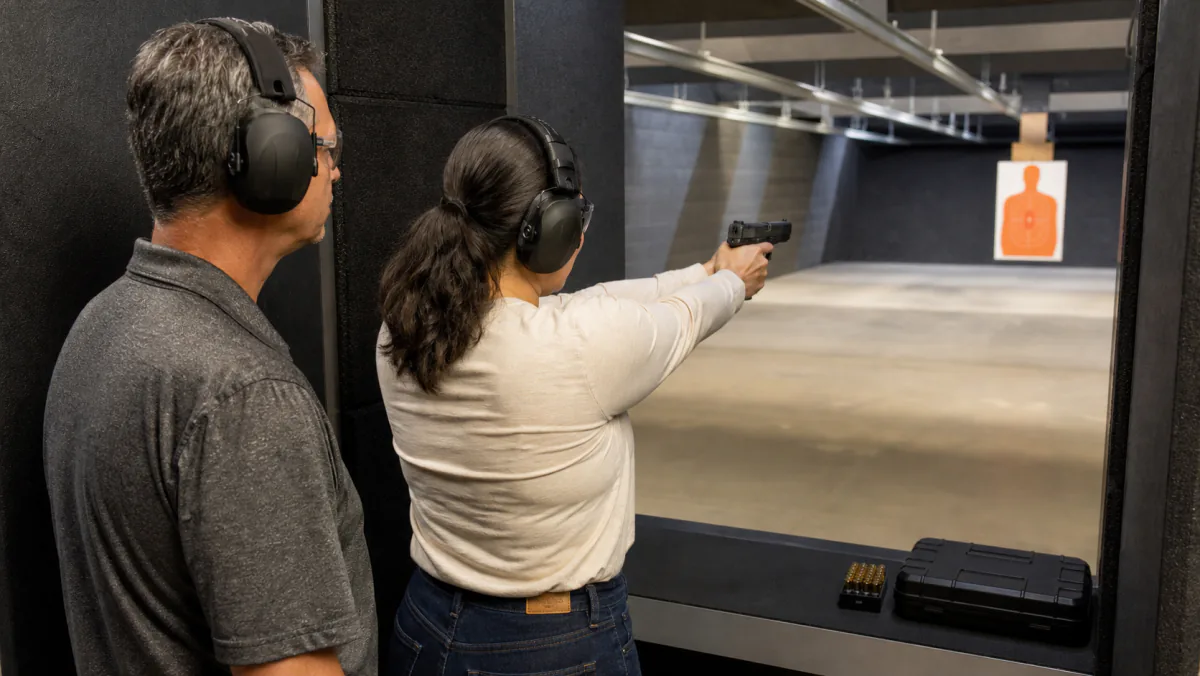
Procedures vary by curriculum and facility, but students can expect a safety briefing, range commands, a supervised process for loading, shooting fundamentals, and controlled firing. The instructor may demonstrate grip, stance, sight alignment or sight picture, trigger control, and recovery between shots.
Your job is not to impress the class. Your job is to handle the pistol safely, follow commands, and apply feedback. Speed is not the measure of maturity.
Keep the muzzle in the designated safe direction. Keep your trigger finger visibly indexed outside the trigger guard until instructed and ready to fire. If something is wrong, stop. Do not rotate toward the instructor with the pistol. Maintain safe orientation and ask for help.
If your shots do not land where expected, do not chase the target by changing everything at once. Listen to the instructor’s correction. A small adjustment to grip or trigger press is more useful than firing faster.
Managing first-shot nerves
The first live round can create anticipation. Students may tense their shoulders, hold their breath, close their eyes, or press the trigger abruptly. None of this makes someone a bad student; it provides information for the instructor.
Use a simple process:
- Establish the instructed stance.
- Confirm a stable grip.
- Keep attention on the relevant sighting method.
- Breathe normally.
- Press the trigger smoothly when directed.
- Recover and listen before the next repetition.
If anxiety grows instead of settling, say so. A pause may be appropriate. The course is not improved by hiding dizziness, confusion, numbness from poor equipment fit, or a loss of concentration.
Rental or personal pistol?
Many first-time students do not own a pistol. Range 313 includes a firearm rental and ammunition in its CPL class price, which can remove pressure to buy before receiving training.
At Range 313, no registration or rental reservation is needed for the Saturday 10am class. The firearm rental and ammunition are included. Let the instructor explain every control; a rental should never be operated from assumptions based on another model.
If you own a pistol, ask whether the provider approves it for class. Confirm the exact ammunition and bring the firearm unloaded in a secure case, following current law and facility instructions. Keep it cased until staff direct you to an authorized handling area.
Do not choose your first pistol solely to meet an approaching class date. Fit, controls, intended use, reliability, storage, practice cost, and your ability to operate the firearm safely matter more than completing a purchase quickly.
Clothing for a CPL class near Detroit
Choose practical clothing for a full classroom day and an indoor range. Closed-toe shoes with stable soles support balance. A close-fitting crew-neck shirt helps prevent hot brass from entering the neckline. Comfortable pants should allow a normal stance without loose fabric around equipment.
Avoid:
- Sandals or open shoes.
- Low necklines.
- Loose scarves, dangling jewelry, or bulky accessories.
- Clothing that interferes with hearing protection.
- Hats or eyewear that prevent protective equipment from fitting.
- Any garment you have never tested for comfortable movement.
Detroit weather may be cold outside and warm inside. Wear simple layers that can be removed before entering the range. Do not let a heavy coat create loose bulk around the firing line.
What to bring
The provider’s checklist controls. Confirm it directly rather than relying on a generic internet list. Common items may include:
- Current government-issued photo identification.
- Registration confirmation.
- Notebook and pen.
- Water and permitted food.
- Eye and hearing protection, if not provided.
- Approved pistol in a secure case, or a confirmed rental.
- The exact approved ammunition quantity.
- Any accessibility or medical item discussed with the provider.
Do not bring alcohol, cannabis, controlled substances without lawful medical need, or anything that impairs attention. If a prescribed or over-the-counter medication affects alertness, contact the provider about safe rescheduling rather than guessing.
The night before class
Confirm the address, start time, expected end time, parking, and check-in instructions. Range 313 is at 1125 Fort Street in Lincoln Park. Check traffic from Detroit or your suburb and leave a buffer.
Pack ordinary non-firearm items first. If bringing a firearm, follow the provider’s case and transport instructions carefully. Keep ammunition and equipment organized as directed. Do not handle or demonstrate the firearm to friends the night before.
Eat normally, hydrate, and sleep. An eight-hour minimum program demands attention. Late-night entertainment, alcohol, or an exhausting work shift can make the range portion less safe.
Common beginner mistakes—and better choices
Pretending to understand: Ask the instructor to repeat the step.
Watching the next lane instead of the instructor: Follow your assigned commands and target.
Rushing because others finish first: Work at the controlled pace permitted by staff.
Bringing unconfirmed ammunition: Obtain the exact requirement before class.
Buying unnecessary equipment: Wait until training clarifies what fits your needs.
Treating the certificate as a license: Follow the separate county-clerk process and wait for issuance.
Assuming one day creates mastery: Schedule continued practice with specific goals.
What happens after successful completion
Review your completion certificate before leaving. Confirm your name and required instructor information are accurate. Store it securely and follow the provider’s guidance for the application.
Eligible applicants file with the county clerk in the county where they reside, include the training certificate, pay current government fees, and complete required fingerprinting steps. Requirements can change, so read the official Michigan CPL application instructions .
Do not carry concealed under CPL authority until a valid license has actually been issued. Training completion and an application receipt are not interchangeable with a license except where current law explicitly provides a narrow rule; never assume it applies without verifying the exact official instruction.
Build confidence after your first class
Confidence should mean knowing and following a safe process, not feeling fearless. Write down three skills that need work, then plan short, purposeful sessions. Safe loading procedures, consistent grip, sight use, trigger control, and accurate shooting at a manageable distance are reasonable early goals under appropriate supervision.
Review Michigan legal resources regularly. Build a secure storage plan before bringing a firearm into a home or vehicle. The Michigan secure-storage resource explains current requirements when a minor is or is likely to be present.
If you practice at the same facility where you trained, the environment and procedures may feel more familiar. Review Range 313 range options and ask staff what next step matches your experience.
A first class should create better questions
You do not need to arrive at a Detroit-area CPL class with expert skill. You need to arrive eligible to participate, rested, honest about your experience, and willing to follow instructions. A good class should replace vague assumptions with safer habits and more precise questions.
For a local option, review CPL Classes at Range 313 . The Lincoln Park course is $79.99 every Saturday at 10am, including a firearm rental and ammunition. Walk-ins are welcome, and successful students receive their certificate in hand the same day.