Choosing firearm training Michigan beginners can trust is less about finding the fastest course and more about building the right sequence. A new shooter needs safety habits before speed, supervised fundamentals before independent practice, and a clear reason for every drill. When training follows that order, confidence grows from competence rather than pressure.
This roadmap shows how to move from no experience to a sustainable range routine. It applies whether your goal is recreational target shooting, responsible ownership, a future CPL class, or simply understanding equipment already present in your household.
Start by defining your purpose
“Learn to shoot” is broad. Ask what you actually want to accomplish in the next three months. You may want to become comfortable in a range environment, learn safe pistol handling, improve target accuracy, prepare for a Michigan CPL class, or understand how to store a firearm responsibly.
Your purpose determines the right course. A class built for experienced competitors may overwhelm a first-time visitor. A licensing course may assume basic familiarity that you do not yet have. A short orientation may explain facility rules without teaching firearm operation.
Write one sentence describing your goal and share it with the training provider. At Range 313, our course options address different experience levels, and the team can help you identify a suitable starting point.
Choose qualified, transparent instruction
Good firearm training Michigan providers should explain prerequisites, instructor qualifications, class size, equipment requirements, live-fire supervision, and what students should be able to do afterward. Avoid vague promises that a single session will make you “advanced.”
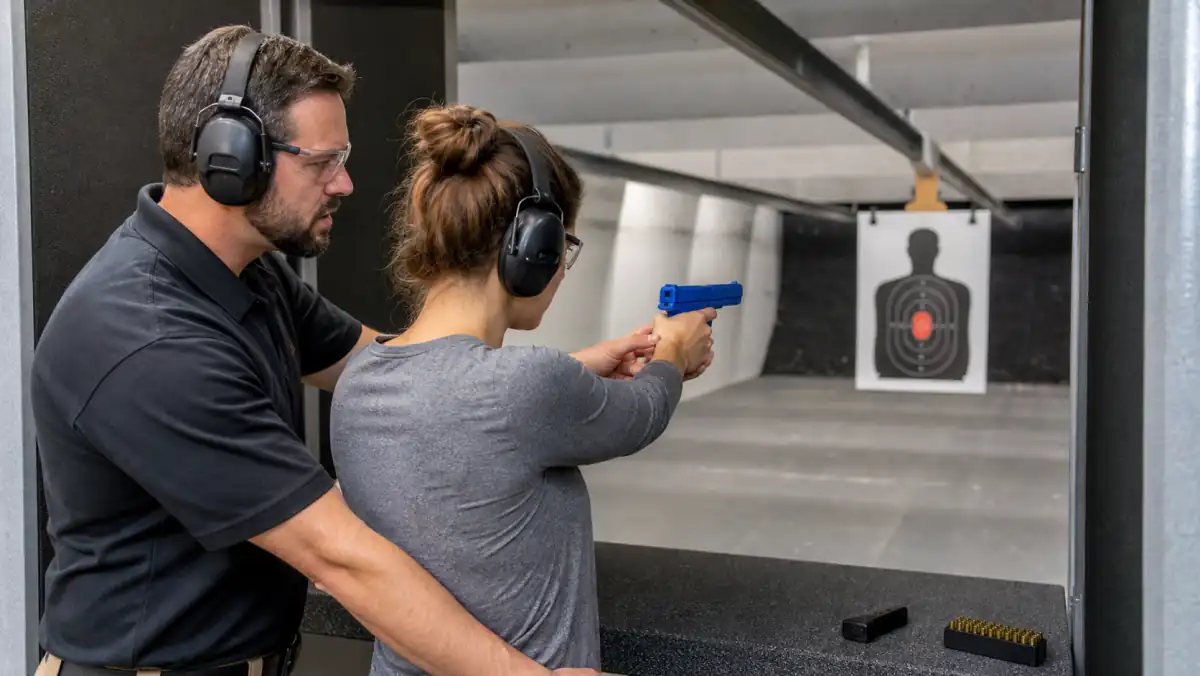
Ask how the instructor supports nervous beginners and what happens if a student needs extra help. Training should permit questions without sacrificing control of the firing line. A clear safety brief, manageable student-to-instructor ratio, and defined emergency process are positive signs.
The Michigan DNR shooting resources describe a statewide range culture serving varied ages, abilities, and experience levels. Individual instructors and facilities still differ, so evaluate the actual program rather than relying only on a recognizable course name.
Take an introductory safety course first
A true beginner course should explain firearm condition, safe direction, trigger-finger discipline, range commands, protective equipment, basic loading and unloading under supervision, and what to do when something unexpected occurs. It should not rush into high round counts.
Look for demonstrations using inert training tools before live fire. The instructor should confirm understanding rather than merely asking whether everyone is ready. Students need enough time to practice a safe sequence with close supervision.
If you feel lost, say so. Firearm training Michigan courses work best when instructors know what a student does not understand. Pretending familiarity creates unnecessary risk.
Learn range procedure as a separate skill
Operating a firearm is only part of a range visit. You must also know how to check in, transport a case to the lane, position it, respond to cease-fire commands, use a target carrier, request help, and leave the bench in a safe condition.
Review our first-time range checklist before your first independent visit. Arrive during a time when you can ask questions without rushing.
The Michigan DNR range rules demonstrate formal commands and behaviors at state facilities. Your indoor range will have its own posted rules, and those requirements govern your session.
Build fundamentals in a logical order
Once safety behavior is consistent, work on a stable shooting position, a repeatable grip, sight alignment, visual focus, controlled trigger movement, and follow-through. Instructors may describe these concepts differently, but the goal is a process you can repeat without unnecessary tension.
Change one variable at a time. If you alter stance, grip, target distance, and equipment together, you cannot tell what affected the result. Fire small groups, pause, and compare observations with the target.
Accuracy should be evaluated in context. A beginner who keeps shots in a consistent area while maintaining safe handling is building a base. Chasing speed too soon usually creates tension and hides errors.
Use a practice journal
After each firearm training Michigan session, record the date, equipment, target distance, primary goal, what improved, and one question for next time. A simple notebook is enough.
The journal prevents random practice. It also helps an instructor see patterns that may not appear during one lesson. If groups consistently move in one direction, or fatigue appears after a certain period, the record gives you useful evidence.
Avoid recording only scores. Include comfort, equipment fit, and safety observations. A session where you recognized fatigue early and stopped is a successful decision even if the target was not impressive.
Practice consistently, not excessively
Short, focused sessions often produce better learning than long sessions dominated by fatigue. Begin with a warm-up that reinforces safe handling and a familiar fundamental. Spend the middle of the session on one improvement area, then finish with several calm repetitions of something you can perform correctly.
Your schedule should fit your life and budget. Practicing every two or three weeks with a plan may be more useful than an unsustainable weekly promise. Shooters who train regularly can compare Range 313 membership plans to determine whether recurring access makes financial sense.
More ammunition is not automatically better. Stop when concentration, grip quality, or rule compliance begins to decline.
Choose equipment after gaining context
Beginners are often encouraged to buy immediately. Training first can make the purchase more informed. Rentals or instructor-provided equipment may help you compare size, control placement, recoil comfort, and visibility of sights.
Do not choose solely from online popularity or another person’s preference. Hand size, strength, intended use, maintenance willingness, and training access all matter. Ask whether replacement parts, magazines, and professional service are readily available.
If you decide to buy, use a licensed dealer and confirm current legal requirements. The ATF firearms Q&A explains federal background-check obligations for licensed dealers. Michigan rules may add requirements, so consult current state sources as well.
Add intermediate skills only when the foundation holds
Intermediate training may introduce movement, time pressure, varied distances, low-light considerations, or equipment transitions. These activities should occur only in a class and facility that expressly allow them, with instruction appropriate to the student.
Do not attempt a drill because it looks exciting online. Ask what skill it develops, what prerequisite it assumes, and how success is measured. If the answer is vague, the drill may be entertainment rather than education.
Firearm training Michigan students should be able to maintain muzzle and trigger-finger discipline even when a task becomes difficult. Complexity never excuses a safety lapse.
Include secure storage in the training plan
Responsible ownership extends beyond the range. Learn how your storage device operates, how keys or combinations are controlled, and how the firearm is secured when not under immediate control.
Michigan’s secure-storage requirements apply in circumstances involving minors. The MDHHS secure storage law page summarizes the law and links to current resources. Read the official material rather than relying on a product advertisement.
Practice the administrative process of returning from the range: verify condition in an appropriate setting, secure equipment, separate contaminated range gear from household areas, and wash thoroughly before eating.
Protect hearing and reduce lead exposure
Training frequency increases the importance of health controls. Wear well-fitted eye protection and strong hearing protection. Many indoor shooters use earplugs and earmuffs together. Never remove protection inside an active range.
Do not eat, drink, or smoke on the firing line. Wash hands and face after shooting, keep range bags away from kitchens and children, and change clothing after prolonged sessions.
CDC/NIOSH offers detailed lead and noise guidance for indoor firing ranges . Ask facilities about ventilation and cleaning practices. A professional provider should treat the question seriously.
Know when to return to an instructor
Schedule follow-up coaching when a technique problem persists, when you change equipment substantially, when you want to attempt a more complex activity, or when confidence exceeds recent practice. A short diagnostic lesson can prevent months of reinforcing an error.
Return to basics after a long break. Skills are perishable, and there is no shame in reviewing foundational material. Experienced shooters often benefit from a second observer precisely because familiar habits are difficult to assess alone.
If a firearm develops a mechanical concern, stop training with it and seek qualified firearm service rather than adjusting parts without the necessary knowledge.
Evaluate progress responsibly
Useful progress includes smaller groups, more consistent safe handling, clearer self-correction, better equipment organization, and improved judgment about when to stop. Speed is only one measurement and often an inappropriate early priority.
Set goals you can observe: “I will keep my trigger finger indexed during every administrative action,” or “I will fire five deliberate groups and record the results.” These are better than “get good.”
Compare your performance with your previous sessions, not a stranger’s edited video. Firearm training Michigan should create durable personal competence, not online validation.
A 90-day beginner roadmap
During the first month, complete an introductory course and one supervised practice session. Focus on safety rules, range commands, protective equipment, and a consistent handling sequence.
In the second month, schedule two focused sessions or one session plus coaching. Work on stable fundamentals and begin a journal. If ownership is a goal, compare suitable equipment with professional help rather than purchasing impulsively.
In the third month, reassess your original purpose. Choose the next appropriate class, create a realistic practice schedule, and confirm your storage and transportation plan. If CPL training is a goal, verify prerequisites and current official requirements before enrolling.
This timeline is flexible. Progress depends on the individual, and taking longer is better than skipping a foundation.
Final firearm training Michigan principles
Start with purpose, choose transparent instruction, build safety before speed, and practice with one goal at a time. Keep written notes, protect your hearing and health, store equipment responsibly, and return to an instructor whenever uncertainty appears.
The best firearm training Michigan program does not promise instant mastery. It gives you a structure for making responsible decisions long after class ends.