There is no single profile of an older adult interested in firearm education. One person may be starting a new recreational activity after retirement. Another may be returning after years away. Someone else may want to understand equipment already present in the household without making any decision about ownership or licensing.
Good firearm training for older adults in Michigan begins with those individual goals. Age provides context, but it does not tell an instructor everything about experience, comfort, learning style, or physical needs. The right lesson should make room for a specific person rather than rely on assumptions about an age group.
This guide offers practical questions for choosing instruction, discussing equipment, and arranging a manageable visit. It focuses on education and planning. If a health condition or medication creates uncertainty about safe participation, ask a qualified clinician for advice before attending; that assessment is separate from a range’s explanation of its facilities and rules.
Decide what you want the lesson to accomplish
Begin with a goal that is more specific than “learn about guns.” You might want a first introduction to safe handling, help understanding a firearm’s controls under supervision, or a refresher before returning to recreational range visits. A clear goal gives the provider a basis for recommending a format.
You may also want education without immediate live fire. Ask what introductory options are available and what each includes. Do not assume every conversation must lead directly to a purchase, a license application, or a long course. Learning enough to make an informed next decision is a legitimate objective.
If another person suggested the lesson, consider whether the goal is yours. A family member’s enthusiasm can be helpful, but you should be comfortable with the activity and the pace. You can ask questions, choose a different format, or decline without having to prove anything about independence or confidence.
Describe your experience accurately
Tell the instructor whether you are entirely new, have occasional past experience, or once practiced regularly. Include the approximate length of any break. Experience with one type of firearm or one setting does not automatically translate to familiarity with another.
Avoid discounting your background, but also avoid letting an old description of your abilities set expectations for the present. “I used to visit an outdoor range, but I have never trained indoors” is useful information. It helps the instructor identify what should be explained rather than repeated unnecessarily.
For a return after a long absence, our returning to the range guide offers additional planning questions. The first lesson can establish what remains familiar and what needs review without turning that review into a judgment about your previous experience.
Choose the pace and format deliberately
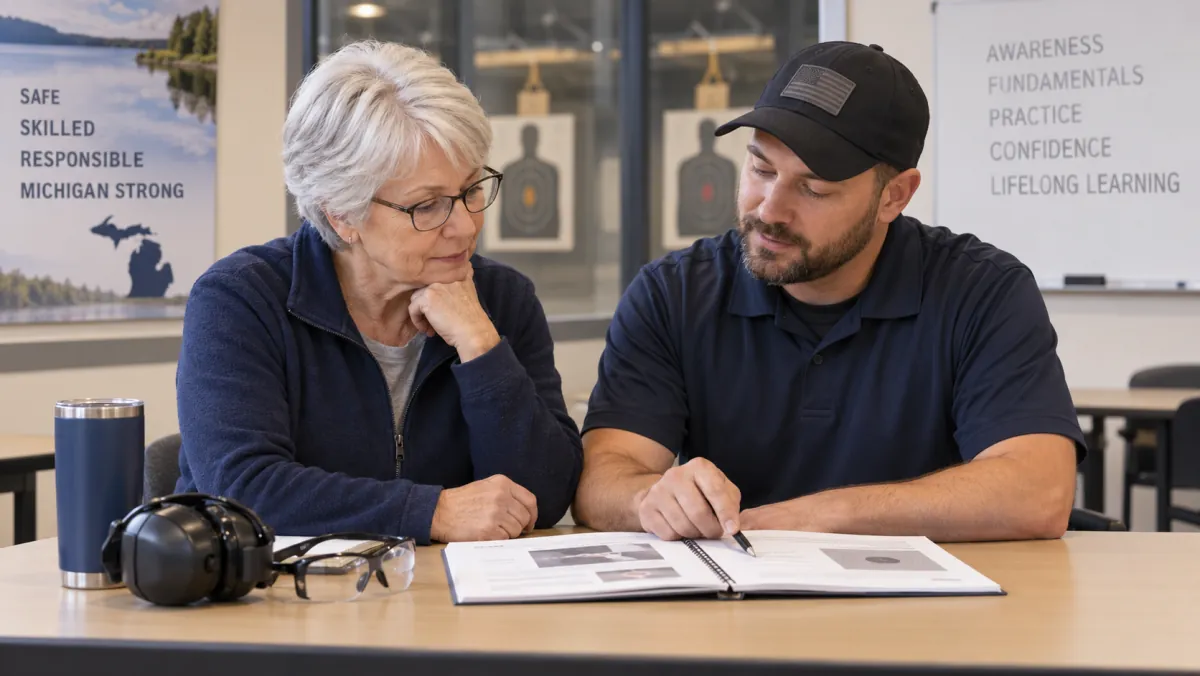
A private lesson may provide time for questions, repeated explanations, and an individually planned sequence. A group class may offer a useful structure and the chance to hear other students’ questions. Neither format is automatically right for every older adult.
Ask about group size, the instructor’s approach to beginners, the length of the session, and the balance between explanation and activity. If you prefer written notes or demonstrations before attempting a supervised task, say so. A provider can give a better answer when the request is concrete.
Do not confuse a slower explanation with lower expectations for safety. The goal is enough time to understand and apply the instructions correctly. A suitable instructor should welcome clarification while maintaining the same clear standards for everyone in the training environment.
Discuss practical comfort before booking
Think through the whole visit: walking from the vehicle, checking in, sitting in a classroom, standing where required, and returning to the car. If you need seating, shorter periods of standing, a particular route, or planned breaks, ask about those features in advance.
The provider should confirm what can be accommodated rather than expecting you to discover the answer on arrival. A generic statement that a facility is accessible may not address bench height, lane space, restroom access, or the location of seating. Ask for the information relevant to your own situation.
Our accessible range visit guide explains how to make those questions specific. It does not certify features at Range 313 or another facility. Direct confirmation with staff is the step that turns a general possibility into an actual plan.
Evaluate equipment with qualified help
Equipment advice aimed at older adults often starts with an assumption: choose the smallest option, use what a relative already owns, or buy whatever is described as easy. Those shortcuts can miss the person’s actual needs. Size alone does not tell you whether equipment will be comfortable or manageable.
Ask an instructor to assess appropriate fit and operation in a supervised setting. Explain any difficulty you experience with reach, comfort, or a control. Do not force a task to avoid appearing inexperienced, and do not make your own modifications to solve an unfamiliar problem.
If rentals are available and appropriate, they may help you learn before making a purchase. Confirm the rental arrangement and provider requirements first. If you bring personal equipment, follow staff instructions for arrival and keep cases closed until directed. The lobby is not a place to demonstrate a handling concern.
Make vision and hearing questions concrete
Tell the instructor how you normally read materials and receive spoken information. You may need time to review a page, a clearer view of a demonstration, or an explanation delivered before entering the noisy firing area. These are useful instructional details, not reasons to assume that someone cannot learn.
Required eye and hearing protection must work with your personal setup. Ask staff about fit and consult the relevant manufacturer or qualified professional for questions involving prescription lenses, hearing devices, or individual health needs. Do not remove required protection in the firing area to solve a communication difficulty.
Agree on how to ask for help when you cannot hear or understand an instruction. The plan should be clear before any live activity. Guessing, nodding to move the lesson along, or waiting for a companion to interpret after the fact can leave an important misunderstanding unresolved.
Use notes to support learning between visits
A small notebook can help preserve the instructor’s language and recommendations. Record unfamiliar terms, questions to revisit, and the purpose of a follow-up session. Ask whether any written material is available in a format you can use comfortably.
Keep the notes short enough to review. A few clear sentences about what the instructor wants you to remember are often more useful than trying to capture every word. If a note involves a procedure you do not yet understand, mark it as a question for supervised review rather than using it as a substitute for instruction.
After the lesson, separate training questions from legal or administrative questions. The instructor can help with course content and safe practice expectations. Official sources and qualified legal professionals are the appropriate route for personal legal issues. A notebook is most useful when it helps you find the right person for the next answer.
Set a companion’s role according to your preference
You may want a spouse, adult child, or friend to help with travel or sit in on permitted parts of the lesson. Ask the facility about that arrangement before arriving. Clarify where a companion can wait and whether their presence affects the lesson format.
The instructor should speak directly to you. A companion can help communicate with your permission, but should not answer every question or choose equipment on your behalf. You are the student, and your own account of comfort and understanding matters.
If you prefer to attend alone, that is useful information too. Some learners ask more freely without a family member watching. You can share what you learned afterward without having someone present throughout the session. Choose the arrangement that supports your attention rather than the one others assume is necessary.
Keep the first session within a reasonable scope
An introductory lesson does not need to settle every question about ownership, storage, recreational practice, and licensing. Choose one main purpose and allow the instructor to assess how much can be covered appropriately. There is value in ending with a clear next step rather than a large amount of partially understood material.
Notice attention and comfort during the session. If you need a pause or do not understand what comes next, tell the instructor. An honest request gives them information they can use. Continuing silently to avoid inconveniencing someone can make the lesson less effective.
Do not measure success against another student’s pace. Useful outcomes include understanding the range’s procedures, knowing how to ask for assistance, and identifying a suitable training format. Those outcomes can support future learning even if the first visit includes less activity than you originally imagined.
Connect education with the household routine
If firearms are present in your home, use the lesson as a reason to review storage and access arrangements. Consider who is authorized to access equipment, how keys or codes are controlled, and what happens when guests or grandchildren visit.
Michigan’s secure-storage guidance addresses situations where a minor is or is likely to be present. Review the official requirements and ask appropriate questions about your circumstances. Do not assume that occasional visitors are irrelevant simply because children do not live in the home.
A storage system also needs to be usable by authorized adults. If a lock or container becomes difficult to operate, seek a suitable solution through the manufacturer or a qualified professional while preserving security. Leaving equipment unsecured is not a workable substitute for addressing the actual problem.
Revisit the plan as your needs change
The arrangement that suits you today may need adjustment later. Changes in schedule, equipment, comfort, or interests are reasons to talk with the provider again. You do not have to maintain a particular routine just because it was once a good fit.
If continued recreational visits are appropriate, choose a schedule you can manage and give each visit a purpose. If you prefer occasional guided lessons, explain that. If you decide the activity is not for you, the education may still have helped you make a well-informed decision.
Range 313 in Lincoln Park can discuss its current instruction options and facility arrangements with you. Contact the team with your goals, experience, and practical questions before booking. The best starting point is a conversation that treats you as an individual learner and turns those details into a clear, manageable plan.