

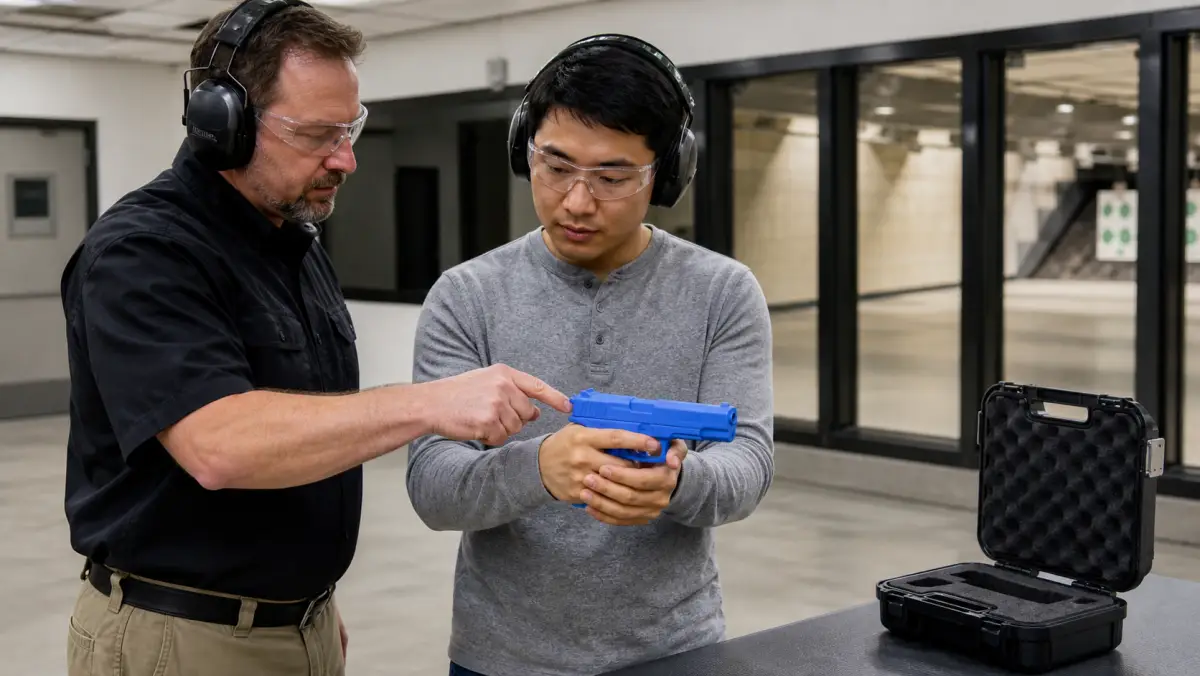
Firearm safety basics begin before the first range trip and continue through every moment of ownership. Safe handling matters, but so do secure storage, lawful transportation, model-specific training, maintenance, household planning, and knowing when not to handle a firearm. A new owner needs a repeatable system—not a few rules remembered only when ammunition is present.
This guide is written for new firearm owners in Detroit, Lincoln Park, Dearborn, Allen Park, Southgate, Taylor, and throughout Michigan. It explains the habits Range 313 staff want beginners to establish early, connects them with current official resources, and identifies the situations that require qualified instruction or legal advice.
Firearm safety basics at a glance
Use this table as a planning reference, not as a substitute for hands-on training or the manufacturer’s manual.
| Responsibility | Safe default | Next step for a new owner |
|---|---|---|
| Handling | Assume the firearm is loaded and keep it pointed safely | Learn the exact model with a qualified instructor |
| Trigger discipline | Keep the finger outside the trigger guard unless you intend to fire | Practice the indexed position during supervised handling |
| Target awareness | Know the target and what is around and beyond it | Use only approved targets and backstops |
| Storage | Prevent access by minors and other unauthorized people | Choose and install storage before bringing the firearm home |
| Ammunition | Store and use only compatible, manufacturer-approved ammunition | Read the manual and confirm markings with qualified staff |
| Transportation | Plan the lawful route and storage method before leaving | Check current Michigan law and destination policies |
| Training | Match instruction to present experience | Begin with safety and fundamentals, then practice deliberately |
| Maintenance | Follow the exact manufacturer procedure | Stop and seek service when damage or abnormal behavior appears |
| Household safety | Make access controls and emergency plans explicit | Review the plan whenever people, risks, or living arrangements change |
| Records | Secure model, serial, receipt, and service information | Keep records separate from the firearm and update them after service |
The central safety lesson is consistency. The rules do not become optional because a firearm is believed to be unloaded, because the owner is at home, or because handling will last only a few seconds.
1. Treat every firearm as if it is loaded
The first core rule removes dangerous assumptions. Someone may have checked a firearm earlier, another person may have handled it, or a step may have been forgotten. The safe response is not to trust memory; it is to maintain safe direction and trigger discipline while the firearm’s condition is verified using the correct model-specific procedure.
The ATF’s current firearms safety and security guidance begins with treating every firearm as if it were loaded. It also emphasizes safe muzzle direction, keeping the finger outside the trigger guard unless intending to fire, using protection, secure storage, and following applicable law.
For a beginner, “treat it as loaded” should influence every handoff and every inspection. Do not accept a firearm with the muzzle pointed at you. Do not point it at another person while asking whether it is unloaded. Do not relax the other rules after seeing an empty chamber.
These safety principles overlap intentionally. If one layer fails, safe direction and trigger discipline still reduce risk.
2. Keep the muzzle pointed in the safest available direction
Safe direction is one of the firearm safety basics that changes with the environment. It means a direction in which an unintended discharge would be least likely to injure someone or cause unacceptable damage. The designated direction at an indoor range is generally downrange toward the approved backstop; the appropriate direction in another setting depends on the surroundings and must never be assumed casually.
Walls, floors, ceilings, doors, vehicles, and furniture should not automatically be treated as safe backstops. People may be on the other side, and common building materials may not reliably stop a projectile.
When moving through an approved handling process, keep awareness on the muzzle rather than letting it follow your eyes or conversation. If someone calls your name, do not turn your body and the firearm together. Secure or safely place the firearm according to instruction before redirecting attention.
Safe direction is continuous. It applies while presenting a cased firearm to staff, receiving a rental, cleaning, checking condition, and responding to an equipment problem.
3. Keep your finger outside the trigger guard
Trigger discipline is one of the firearm safety basics that must be visible. The trigger finger should remain straight and indexed along the frame or another model-appropriate location until the firearm is safely oriented, the decision to fire has been made, and the rules of the activity permit firing. It should return outside the trigger guard as soon as that decision changes.
Do not rest the finger on the trigger because the firearm is unloaded. Do not place it inside the guard while moving, turning, loading, unloading, clearing, handing off, or diagnosing a problem. Startle responses, loss of balance, and sympathetic hand movement can occur without warning.
A proper indexed position must be visible and repeatable. A qualified instructor can help a shooter find a location that keeps the finger unmistakably outside the trigger guard without interfering with controls.
These principles become useful habits only when practiced during low-pressure supervised handling, not merely recited at check-in.
4. Know the target, surroundings, and backstop
Target awareness turns the safety rules into an environmental decision. Before any shot, identify the intended target and understand what is in front of, beside, and beyond it. A target does not stop a projectile; the approved backstop does. A shooter remains responsible for every shot.
Use only targets, distances, firearms, calibers, and ammunition allowed by the facility. Do not fire at objects found on private land without confirming that shooting is lawful, the target is appropriate, and a suitable backstop exists. Water, hard surfaces, rocks, and metal not designed for the activity can create unpredictable hazards.
At an indoor range, position the target according to staff directions so shots enter the backstop correctly. Do not aim at carrier hardware, walls, ceilings, floors, lights, or lane dividers. Stop if the target turns, falls, or becomes difficult to identify.
Target awareness cannot be delegated to a companion. Each shooter must personally confirm the target and environment before firing.
5. Learn the exact firearm—not just its category
Model-specific knowledge anchors firearm safety basics in the equipment actually being handled. Two pistols, rifles, or shotguns may look similar while having different controls, safeties, loading indicators, field-stripping procedures, ammunition requirements, and inspection points. Familiarity with one model does not prove competence with another.
Read the current manual for the exact manufacturer, model, generation, and configuration. If the original manual is missing, obtain it from the manufacturer rather than relying on a random diagram or video. Confirm any modification with a qualified professional because aftermarket parts may change operation or maintenance.
Before live fire, a new owner should be able to identify:
- The model and caliber or gauge markings.
- The manufacturer-specified ammunition requirements.
- The controls and their function.
- The correct status-checking procedure.
- How the firearm should be safely stored and transported.
- The manufacturer’s inspection and maintenance schedule.
- Warning signs that require professional service.
Do not improvise loading, unloading, disassembly, or reassembly. Ask a qualified instructor to demonstrate the procedure and supervise your first repetitions.
The strongest safety framework is model-specific where the equipment demands it and universal where human behavior is concerned.
6. Build secure storage before bringing a firearm home
Secure storage is one of the firearm safety basics that must be planned before ownership. The safe, lockbox, locking cabinet, or other selected system should be installed, tested, and ready before the firearm enters the home.
Michigan’s secure-storage law guidance from MDHHS explains state requirements when a firearm is unattended on premises where a minor is, or is likely to be, present. The current statute, definitions, exceptions, and penalties control; an online summary cannot resolve every household situation.
A responsible storage plan considers more than minimum compliance:
- Children who live in or visit the home.
- Adults who are not authorized or trained to access the firearm.
- People who are legally prohibited from possessing firearms.
- Theft, fire, flood, and removal of portable containers.
- Who controls keys, combinations, biometric backups, and emergency access.
- Whether the firearm fits without pressure on controls.
- How ammunition and magazines are secured.
- How the plan changes during travel, moving, repairs, or household crisis.
Hiding is not locking. A high shelf, vehicle console, nightstand, closet, or drawer does not prevent access simply because another person is not expected to look there.
Range 313’s retail firearm and safety products include secure-storage options subject to current inventory. Staff can discuss product features, but legal compliance and household risk assessment remain the owner’s responsibility.
Safe ownership requires confirming the storage system every time, not assuming the last user locked it correctly.
7. Control keys, codes, and access information
Access control keeps the storage plan working after the container is closed. A strong container can fail as a safety system when its key is easy to find, its combination is shared casually, or a default code remains unchanged. Access information should be limited to authorized adults who understand the storage plan and can legally possess the firearm.
Do not keep the backup key beside the safe. Do not write the combination on the container, share it by unsecured message, or enter it where a child can watch repeatedly. Change access credentials when a key is lost, a relationship changes, a household member should no longer have access, or the owner suspects the code has been observed.
Test mechanical and electronic locks according to manufacturer instructions. Replace batteries on a planned schedule where applicable, understand the low-power signal, and know how emergency override features affect security. Anchor portable storage when appropriate so the entire container cannot be removed easily.
Strong safety planning treats access control as an ongoing process rather than a one-time purchase.
8. Make a household communication plan
Household communication makes the rules clear to people who should never have access. Every person in the home does not need access, but everyone should know the safety boundaries that apply to them. Children should be taught not to touch an unattended firearm and to leave the area and tell a trusted adult. Education does not replace secure storage.
Adults should know that no one handles a firearm without authorization, training, and a safe setting. Guests should not be shown a firearm casually. If a visitor brings a firearm, the owner should establish storage and handling expectations before it enters the home.
Ask parents or guardians about secure firearm storage before a child visits another home. That conversation may feel uncomfortable, but it is a practical part of protecting children.
Review the complete safety plan whenever:
- A child begins walking, climbing, or exploring new areas.
- Teenagers or guests will be present.
- A person moves into or out of the home.
- A key, code, or access device is lost.
- Someone experiences a behavioral-health or substance-use crisis.
- The owner purchases a different firearm or storage system.
The storage plan should change when the people or risks change.
9. Never handle firearms while impaired or distracted
Sobriety and attention are firearm safety basics, not personal preferences. Alcohol, cannabis, illegal drugs, and medications that impair judgment, balance, coordination, vision, or alertness are incompatible with firearm handling. Fatigue, intense anger, panic, and emotional crisis can also make it unsafe to access a firearm.
Separate firearm activity completely from alcohol and impairing substances. “Only one drink” is not a safety standard. If medication labeling warns against driving or operating machinery, ask a qualified medical professional how it affects activities requiring judgment and coordination.
Distraction matters too. Do not handle a firearm while arguing, filming content, responding to messages, supervising unrelated activity, or trying to impress another person. Create a quiet, controlled environment and stop if attention is divided.
These rules apply at home, in a vehicle, at a range, during cleaning, and while showing equipment to another person.
10. Plan transportation before leaving
Transportation planning extends safe ownership beyond the home. Rules can depend on firearm type, licensing, route, destination, storage method, and other facts. Do not assume that advice for hunting, CPL holders, or another state applies to your trip.
The Michigan DNR’s current firearms and bows information provides general state transportation information in hunting and target-shooting contexts and directs handgun-law questions to Michigan State Police or local authorities. Review the law that applies to your situation and obtain qualified legal advice when uncertain.
Before traveling:
- Confirm that possession and the destination are lawful.
- Review the destination’s case, ammunition, and check-in rules.
- Use an appropriate closed case and prevent unauthorized access.
- Plan direct travel and avoid unnecessary stops.
- Never leave a firearm visible or unsecured in an unattended vehicle.
- Know what to do if the vehicle breaks down or the route crosses a restricted location.
At Range 313, keep personal firearms secured and cased until staff direct you to the approved handling area. Do not uncase in the parking lot, lobby, restroom, or seating area.
Transportation belongs in the safety system because risk begins before the owner reaches the firing line.
11. Follow every range rule and command immediately
Range discipline applies firearm safety basics in a shared live-fire environment. A private range establishes rules based on its backstop, lanes, ventilation, equipment, insurance, and staffing. Those rules may be stricter than a visitor expects, and they apply even if another facility permits the activity.
Read our Michigan gun range safety rules before visiting. At check-in, disclose your experience honestly and ask about unfamiliar language. Keep protection on in the live-fire area and stop immediately when staff issue a cease-fire or direct command.
If something feels or sounds wrong, keep the firearm pointed downrange, keep your finger outside the trigger guard, and request assistance. Do not turn around with it, look into the muzzle, or continue firing to see whether a suspected problem repeats.
Range-specific procedures protect neighboring shooters as well as the person handling the firearm.
12. Use correct eye and hearing protection
Protective equipment is part of firearm safety basics wherever live fire occurs. Firearm discharge can cause immediate and cumulative hearing damage, while fragments, debris, gas, and ejected cases can threaten the eyes. Use appropriate impact-rated eye protection and properly fitted hearing protection throughout the live-fire area.
Many indoor shooters use correctly inserted earplugs beneath earmuffs because of impulse noise. Glasses, hats, hair, and jewelry can interfere with an earmuff seal. Ordinary music headphones and unlabeled active-noise-canceling devices are not substitutes for rated hearing protection.
Wear clothing that reduces predictable distractions. Closed-toe shoes and a crew-neck shirt help limit contact with hot brass. Avoid loose scarves, low necklines, dangling jewelry, and anything that interferes with protection or safe movement.
Safe handling includes stopping calmly if hot brass enters clothing. Keep the firearm pointed safely, remove the trigger finger, set it down according to range instruction, and then address the distraction.
13. Practice indoor-range hygiene
Indoor hygiene broadens the safety plan beyond immediate handling. Indoor shooting can create lead and other residue from primers, projectiles, and surfaces. Do not eat, drink, smoke, apply cosmetics, or touch the face on the firing line. Wash hands, forearms, and face before eating after a session.
Keep range bags and footwear away from kitchens, children’s areas, and clean clothing. After frequent or extended shooting, change clothes and follow appropriate laundering practices. Pregnant people and households with small children may wish to discuss exposure concerns with a qualified health professional.
Choose a range that takes ventilation, housekeeping, and hygiene questions seriously. Visitors cannot evaluate every engineering detail, but they can notice whether common surfaces are maintained and whether staff reinforce appropriate practices.
Hygiene is often omitted from informal safety lists, but it is part of responsible indoor-range use.
14. Maintain the firearm without improvising
Maintenance keeps firearm safety basics connected to known equipment condition. Follow the exact manufacturer’s manual for inspection, cleaning, lubrication, parts replacement, and service intervals. More lubricant is not always better, and a generic online procedure may not apply to the model in front of you.
Before maintenance, remove ammunition from the work area, eliminate distractions, maintain safe direction, and follow the manufacturer’s status-checking process. Never look into the muzzle. Do not force a part, alter a safety device, or continue when the procedure differs from the manual.
Stop using the firearm if you notice cracks, corrosion, a damaged magazine, loose sights, abnormal sound or recoil, recurring malfunctions, a suspected obstruction, or controls that do not operate normally. Secure it and arrange professional evaluation.
Our Michigan firearm cleaning and maintenance guide explains how to create a model-specific service plan. Range 313 also provides inspection, cleaning, repair, parts, and optic services based on current capabilities.
Maintenance supports safe ownership when it preserves known condition; improvised modification creates new uncertainty.
15. Use only correct, serviceable ammunition
The markings on ammunition, the box, the magazine, and the firearm must be understood and compatible. Similar names or dimensions do not prove interchangeability. Confirm the exact specification in the firearm manual and ask qualified staff when uncertain.
Keep ammunition in labeled packaging where possible. Do not use cartridges that are corroded, heavily damaged, exposed to unknown conditions, or mixed in an unidentified container. Do not attempt to fire ammunition that the range prohibits, even if the firearm manufacturer otherwise lists it.
If a shot sounds or feels abnormal, stop. Maintain safe direction and ask range staff or a qualified professional to inspect the firearm. Continuing to fire after a suspected obstruction can cause catastrophic damage.
One of the simplest firearm safety basics is also one of the easiest to neglect: never guess about ammunition compatibility.
16. Keep secure records for loss, theft, and service
Maintain the manufacturer, model, caliber or gauge, and serial number in a secure record separate from the firearm. Keep purchase documents, photographs, warranty information, manuals, and service history where they can be accessed if the firearm is lost, stolen, damaged, or sent for repair.
Do not publish serial numbers or storage details online. Do not leave the only record inside the case that may be stolen with the firearm. Review insurance coverage and documentation requirements before a loss occurs.
If a firearm is missing or stolen, contact local law enforcement promptly and follow current reporting requirements. Do not attempt to recover it personally or confront a suspected thief.
Documentation is part of the safety plan because fast, accurate reporting can assist identification and recovery while reducing confusion.
17. Prepare for emotional or behavioral-health crises
Access plans should change when a person with access expresses suicidal thoughts, threatens harm, experiences a severe crisis, or becomes unable to handle firearms safely. Do not wait for the situation to resolve itself.
Create a lawful temporary-storage plan before a crisis. Options and transfer requirements vary, so ask local law enforcement, a qualified attorney, or an FFL about what is permitted before moving or transferring a firearm. Do not casually hand it to another person or place them in unlawful possession.
If there is an immediate threat, call 911. The 988 Suicide & Crisis Lifeline is available by call, text, or chat for people experiencing emotional distress and those concerned about someone else. Move away from the firearm and seek help rather than trying to manage the crisis while armed.
Responsible ownership includes recognizing when distance, time, and outside support are necessary.
18. Take qualified training and practice deliberately
Reading can establish vocabulary, but it cannot observe your muzzle direction, trigger finger, grip, attention, or response to a command. Qualified instruction provides immediate feedback and a controlled place to build habits.
Choose a course that matches your experience. A new owner usually benefits more from introductory safety and fundamentals than from a licensing course or advanced class chosen for prestige. Ask about prerequisites, instructor qualifications, class size, live-fire expectations, required equipment, and what students should be able to do after completion.
Range 313 offers firearms training courses in Lincoln Park for different experience levels. Contact the team to identify the appropriate starting point; registration in a class does not replace honest disclosure about current ability.
After instruction, practice one or two defined skills at a time on an indoor range with staff support . Stop before fatigue or frustration degrades attention. Keep a simple log of training dates, topics, instructor feedback, and the next safe practice goal.
Firearm safety basics become dependable through correct repetitions, not high round counts.
Common new-owner mistakes
Avoid these patterns:
- Buying before storage and training are planned.
- Treating “unloaded” as permission to ignore safe direction.
- Allowing the trigger finger to drift inside the guard during handling.
- Assuming one firearm operates like another.
- Learning disassembly from an unverified video instead of the exact manual.
- Leaving a firearm in a vehicle while completing unrelated errands.
- Hiding access keys or codes where unauthorized people can find them.
- Handling while tired, angry, impaired, or distracted.
- Continuing to fire after an unusual sound or repeated malfunction.
- Treating a friend’s experience as a substitute for qualified instruction.
- Posting storage details or serial numbers online.
- Waiting for a household crisis before planning temporary storage.
These mistakes often arise from convenience and overconfidence rather than a lack of concern. A written plan makes the rules easier to follow when attention is divided.
A 30-day firearm safety basics plan
Before pickup or the first home visit
Install and test secure storage. Read the exact manufacturer manual. Confirm lawful transportation, verify the current household access plan, and schedule suitable beginner instruction.
During the first week
Complete supervised orientation on the exact firearm. Practice safe direction, trigger discipline, status checks, and storage transitions without rushing. Record the model, serial number, purchase information, and manufacturer contacts securely.
During the first month
Attend a structured class, complete a short supervised range session, and establish a cleaning and inspection plan. Review whether the storage system actually fits the household rather than assuming the purchase solved every risk.
Every few months
Recheck storage hardware, access credentials, protective equipment, records, household circumstances, and training goals. Review the manual after service or configuration changes. Replace damaged protection and schedule professional maintenance when needed.
This plan turns firearm safety basics into observable actions instead of good intentions.
How Range 313 supports new Michigan owners
Range 313 combines indoor pistol and rifle lanes, first-time support, rentals, training, retail products, secure-storage options, FFL transfers, cleaning, inspection, repair, and gunsmithing services at 1125 Fort Street in Lincoln Park.
That connected setting helps Metro Detroit owners move from purchase planning to appropriate instruction, supervised practice, equipment maintenance, and continued education. It also gives beginners a place to ask questions before an unsafe assumption becomes a habit.
For a new owner, safe habits are easier to retain when training, practice, storage, and service are part of one coherent plan.
Range staff cannot determine legal eligibility or replace individualized legal, medical, or crisis advice. They can explain facility rules, current services, and appropriate training options. Call (313) 436-0197 before visiting when a specific course, rental, product, or service matters.
Make safety a system
Firearm safety basics are not slogans reserved for the range. They form a system: safe direction, trigger discipline, target awareness, model-specific knowledge, secure storage, controlled access, lawful transportation, proper protection, careful maintenance, household planning, and qualified training.
Build that system before convenience and familiarity create shortcuts. Review it when equipment, people, laws, or risks change. A responsible owner does not aim to “graduate” from firearm safety basics; the goal is to apply them consistently for as long as the firearm remains in their care.