

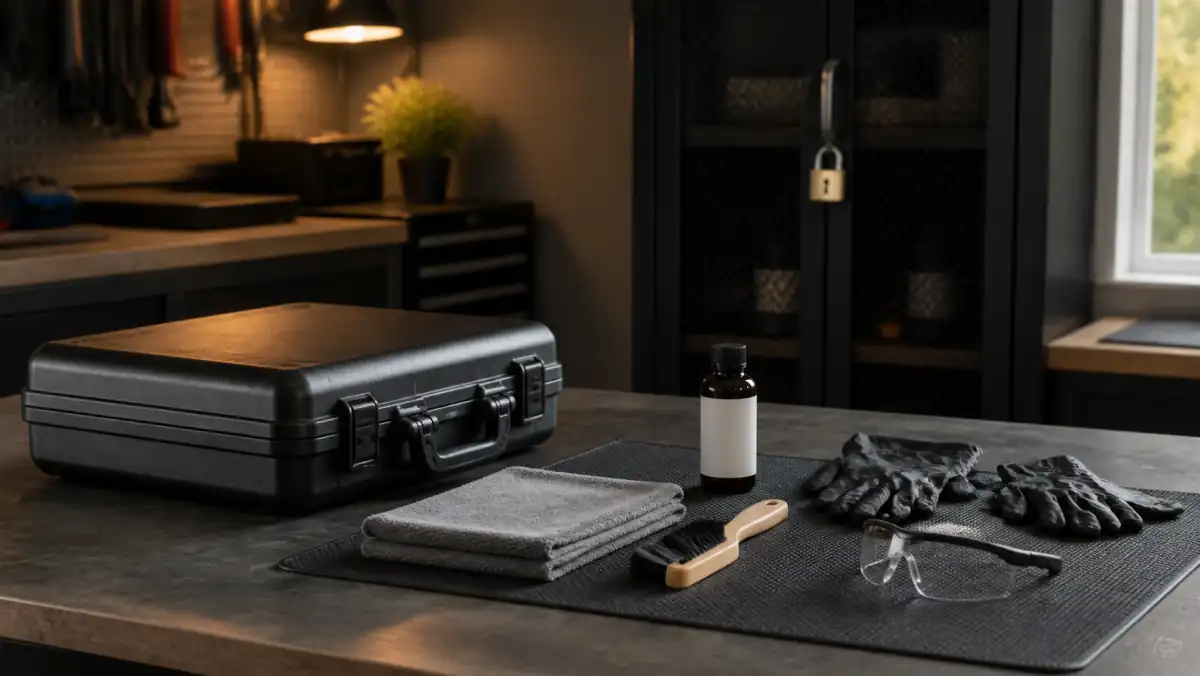
Responsible firearm cleaning Michigan owners perform is less about making metal look polished and more about inspection, reliability, corrosion prevention, and safe storage. Maintenance begins with an intentional workspace where live ammunition is absent, distractions are controlled, and the manufacturer’s instructions are available. It ends with the firearm reassembled correctly, function checked only as instructed, and secured against unauthorized access.
This guide stays at a general safety and planning level. Firearms differ, so the owner’s manual and qualified professional support must control the exact procedure.
Why cleaning is part of ownership
Firing leaves combustion residue, metal fouling, lubricant, and environmental debris. Carry, storage, humidity, and handling can add lint, moisture, dust, or corrosion. Maintenance removes harmful buildup and creates an opportunity to notice changes.
Cleaning does not fix every issue. A damaged spring, loose sight, cracked component, obstructed bore, or repeated reliability concern may require a gunsmith. Treat inspection findings honestly instead of assuming more solvent is the answer.
Range 313 offers firearm cleaning and maintenance services for owners who lack the equipment, time, or expertise to perform a task safely.
Start with the manufacturer’s manual
Locate the manual for the exact make and model. It identifies the approved field-stripping process, lubrication points, product warnings, maintenance intervals, and reassembly checks. Do not substitute a video for current manufacturer instructions.
If the manual is missing, obtain a replacement from the manufacturer’s official website or support department. Confirm model and generation, because designs can change.
A firearm cleaning Michigan routine should be documented and repeatable. Improvising from memory increases the chance of damaging a part or assembling it incorrectly.
Create a dedicated workspace
Choose a well-lit, ventilated area with a stable surface and a safe direction. Remove all live ammunition from the room before bringing the firearm to the bench. Keep children, guests, pets, phones, and food away.
Use a mat or tray to contain small parts and residue. Wear appropriate disposable gloves if recommended for the products and residue involved. Read solvent and lubricant safety data, provide ventilation, and keep ignition sources away.
Never clean at the kitchen table while food is present. Range residue can contain lead, and solvents may be hazardous.
Verify condition deliberately
Before disassembly, follow the manufacturer’s process to verify that the firearm is unloaded. Keep it pointed in the chosen safe direction and keep your finger outside the trigger guard. Remove the ammunition source and inspect as instructed.
Do not let familiarity turn the verification into a quick gesture. Many preventable incidents occur when someone “knows” a firearm is unloaded and skips an observable check.
If you are interrupted, restart the verification sequence when you return. A consistent process is more reliable than memory.
Use compatible products and tools
Select cleaners, lubricants, brushes, patches, and tools recommended for the firearm’s materials and finish. A product safe for one surface may damage another. Avoid excessive force and tools that can slip or scratch.
More lubricant is not always better. Excess can attract debris or migrate where it does not belong. Follow the amount and location described by the manufacturer.
Do not mix chemicals unless the manufacturers explicitly state compatibility. Store products in labeled original containers away from heat, children, and unauthorized users.
Field-strip only to your level of training
Routine field stripping is different from complete disassembly. Stop at the level the owner’s manual defines for ordinary user maintenance. Springs and small parts can be damaged or installed incorrectly when disassembly goes beyond training.
Photographing parts is not a substitute for technical knowledge. If a step requires specialized fixtures, torque values, fitting, or safety checks, use a qualified gunsmith.
The goal of firearm cleaning Michigan owners do themselves is safe routine care, not proving mechanical ability.
Inspect while you clean
Look for unusual wear, cracks, deformation, corrosion, loose fasteners, damaged magazines, and anything different from previous sessions. Compare observations with manufacturer documentation.
Check whether sights or optic mounts appear loose. Observe the condition of accessible springs and contact surfaces without stretching, bending, or altering them.
If something is questionable, set the firearm aside, label the concern, and avoid live fire until a professional evaluates it. A maintenance record helps explain when the change appeared.
Treat the bore carefully
The bore must be unobstructed and maintained using the method and direction recommended by the manufacturer. Use correctly sized tools and avoid damaging the crown or chamber.
Never look down the muzzle. Use safe inspection tools and orientation. Do not force a stuck patch or brush; a lodged cleaning tool creates a new obstruction.
Suspected barrel damage, squib obstruction, bulging, or heavy corrosion requires professional assessment. Do not attempt to “shoot it clear.”
Pay attention to magazines
Magazines can collect lint, dust, residue, and damaged parts. Follow manufacturer instructions for inspection and cleaning. Do not add lubricant where it may contaminate ammunition or attract debris unless specifically directed.
Mark magazines discreetly so repeated problems can be tracked to one item. If a magazine is bent, cracked, or unreliable, remove it from use.
A firearm cleaning Michigan plan that ignores magazines misses a major part of the operating system.
Reassemble and verify correctly
Follow the manual in order. Do not force parts. If reassembly requires unusual pressure, stop and check orientation rather than striking or prying.
Perform only the manufacturer-recommended function check in a safe direction with ammunition still outside the room. If the controls do not behave exactly as expected, do not load the firearm.
When uncertainty remains, keep it secured and arrange professional firearm service . A live-fire test is not the correct way to resolve unknown assembly.
Keep a maintenance log
Record the date, approximate use since last cleaning, products used, parts inspected or replaced, and any observation. Include professional service invoices and warranty work.
A log reveals patterns. If the same issue appears after a predictable number of rounds or under certain conditions, a gunsmith has better information to diagnose it.
Keep the record separate from sensitive access information. It should support maintenance without exposing safe combinations or storage details.
Decide how often to clean
There is no single schedule for every firearm. Manufacturer guidance comes first. Frequency also depends on ammunition, round count, environment, carry exposure, storage humidity, and the firearm’s role.
Inspect after each range session even when a full cleaning is not needed. Moisture or unusual residue deserves prompt attention. A firearm exposed to rain, snow, sweat, or condensation may need care sooner.
Avoid both extremes: neglecting maintenance indefinitely and over-cleaning with aggressive methods that cause wear.
Manage lead and chemical exposure
Residue can contain lead. Do not eat, drink, smoke, or touch your face during maintenance. Wash hands and exposed skin with cold water and soap afterward. Clean the work surface using an appropriate method rather than dry sweeping.
Keep contaminated patches and disposable materials away from children and dispose of them according to product and local guidance. Do not wash residue into food-preparation sinks without understanding safe cleanup practices.
CDC/NIOSH explains lead pathways in its indoor firing range guidance , and OSHA maintains a broader lead resource .
Prepare for Michigan humidity and winter
Seasonal temperature change can create condensation. A firearm moved from a cold vehicle into a warm room may develop moisture. Inspect and dry it according to manufacturer guidance before storage.
Michigan summer humidity can also contribute to corrosion. Monitor the storage environment and use an appropriate humidity-control strategy without allowing devices or chemicals to contact the firearm improperly.
After a winter indoor range session , do not put a cold, damp case directly into long-term storage.
Know when professional service is necessary
Use a qualified gunsmith for repeated malfunctions, broken or missing parts, rust or pitting, suspected obstruction, sight installation, trigger work, parts fitting, warranty concerns, or disassembly beyond the manual.
Also seek help if you simply do not feel confident. Professional cleaning can be a learning opportunity when staff explain what was found and how to recognize future issues.
Do not modify safety mechanisms or critical parts based on anonymous online advice.
Store the firearm securely
Once maintenance is complete, return the firearm to secure storage immediately. Keep ammunition controlled according to your storage plan. Prevent access by unauthorized people.
Michigan’s secure-storage law includes requirements in circumstances where a minor is present or likely to be present. Review current MDHHS secure-storage guidance .
Cleaning does not justify leaving a firearm unattended on the bench. Complete storage before moving on.
Firearm cleaning Michigan checklist
Obtain the exact manual, remove ammunition from the workspace, establish a safe direction, verify condition, and use compatible products. Stay within user-level disassembly, inspect as you clean, reassemble without force, and perform only approved checks. Log the work, wash thoroughly, and store securely.
Firearm cleaning Michigan owners handle well is a controlled maintenance process. The strongest habit is knowing when routine care ends and professional service should begin.