Dry practice vs live-fire practice is not an either-or decision. Dry practice can create frequent, low-cost opportunities to rehearse safe handling, visual consistency, control familiarity, and deliberate movement without live ammunition. Live fire adds the conditions dry work cannot reproduce: recoil, sound, firearm cycling, ammunition behavior, target feedback, and the shared range environment.
The methods work best when each has a defined purpose and its own safety controls. Dry practice without a controlled environment can be dangerous. Live fire without a focused plan can become expensive repetition that reinforces the wrong habits.
This Michigan guide explains what each method can teach, what it cannot, how beginners should approach both, and when Metro Detroit shooters should seek professional coaching.
Dry practice vs live-fire practice at a glance
| Comparison | Dry practice | Live-fire practice |
|---|---|---|
| Live ammunition | Removed from the controlled practice environment | Present and managed under range rules |
| Recoil and report | Not reproduced | Present |
| Firearm cycling | May be absent or simulated by an approved device | Occurs according to the firearm and ammunition |
| Target feedback | Visual movement or training-device feedback only | Actual impacts when the shot and target are properly observed |
| Cost per repetition | Usually low after appropriate equipment and instruction | Includes ammunition, targets, lane time, travel, and protection |
| Location | Only in a controlled, lawful area with safe direction and backstop | Approved range or other lawful shooting location |
| Supervision | Strongly recommended for beginners and new skills | Range staff or instructor support may be available |
| Health exposure | No discharge-related impulse noise or lead from firing | Requires hearing, eye, ventilation, and hygiene controls |
| Best use | Rehearsing known safe processes and observing unwanted movement | Validating skills under recoil, sound, cycling, and range conditions |
| Main limitation | Cannot prove live-fire performance | Cost and noise can reduce repetition or hide small technique issues |
The practical answer to dry practice vs live-fire practice is balance. Dry repetitions should support skills that have already been taught correctly, while live fire should test whether those skills transfer.
What dry practice means
In dry practice vs live-fire practice, dry practice means structured firearm-related practice without live ammunition in the practice environment. It may involve an unloaded firearm that the manufacturer permits to be dry fired, a dedicated inert training device, or another instructor-approved system.
“Dry” does not mean casual. The firearm safety rules still apply. NSSF’s four primary firearm safety rules specifically note that even an unloaded firearm used for dry firing must never be pointed at an unsafe target. The organization also emphasizes checking the action, chamber, receiver, and magazine whenever handling or receiving a firearm.
A shooter comparing these training methods should not begin by copying an online routine. The first questions are:
- Has a qualified instructor taught this process?
- Does the exact manufacturer manual permit dry firing?
- Is a model-specific training aid required or recommended?
- Can all live ammunition be removed from the practice environment?
- Is there a safe direction and suitable backstop?
- Can other people, pets, and distractions be controlled?
- Is the planned behavior allowed by law and safe for the location?
If any answer is unclear, stop and obtain qualified guidance.
What live-fire practice means
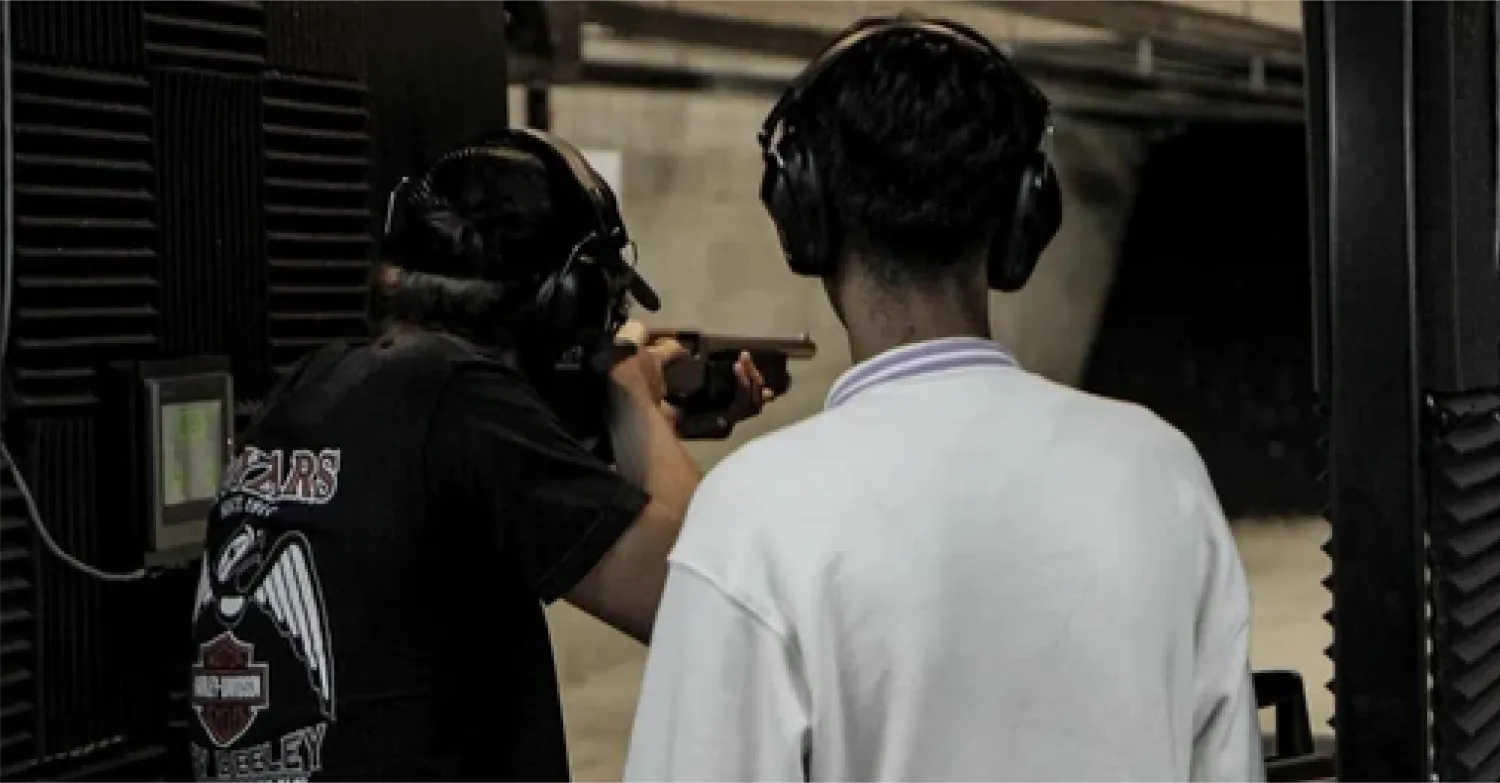
In dry practice vs live-fire practice, live fire uses live ammunition at an approved range or another lawful location designed for shooting. It introduces physical and environmental conditions absent from dry work.
Those conditions include recoil, muzzle report, firearm cycling, ammunition performance, target impacts, protective equipment, lane boundaries, range commands, neighboring shooters, and indoor-range ventilation. They are not minor details; they affect whether a skill remains safe and repeatable.
When assessing dry practice vs live-fire practice, live fire is the validation environment. It reveals whether visual alignment, trigger control, grip consistency, safe handling, and attention remain stable when the firearm actually discharges.
Live fire should follow the facility’s rules rather than a routine created for another range. Michigan DNR’s shooting range rules provide a public example of formal discipline: firearms enter cased and unloaded, handling occurs at established stations, eye and ear protection are required, and range commands must be followed. Private ranges establish their own rules, which control the visit.
What dry practice can develop
The dry side of the comparison can provide many correct repetitions without ammunition cost or recoil. That makes small inconsistencies easier to observe—provided the shooter already knows what correct behavior looks like.
Safety routines
An instructor may assign dry work to reinforce safe direction, trigger-finger placement, status-checking procedures, or deliberate transitions between ready and stored conditions. These behaviors must remain controlled throughout the session.
Dry practice vs live-fire practice should never mean “safety rules only matter on the range.” Dry work is firearm handling, and the same rules remain active.
Visual consistency
Without recoil and report, a shooter may find it easier to observe whether the sights or optic move during a carefully supervised trigger press. The purpose is not to predict a perfect live shot; it is to collect information about unwanted movement.
Control familiarity
Model-specific instruction can help a shooter locate and operate controls safely without the pressure of a live firing line. Familiarity must be limited to the exact firearm or training device being used. Similar-looking models may function differently.
Deliberate setup and attention
Dry work can rehearse preparing protection, checking the practice area, following a written objective, and stopping when distracted. These administrative habits are valuable because they shape the safety of the session before physical practice begins.
Frequent short sessions
Once the process has been taught and the environment can be controlled, dry practice may fit into a schedule more easily than a range trip. Five careful minutes can be more useful than a long unfocused session.
Dry work is best at refining a known process—not inventing a new one alone.
What dry practice cannot teach
The comparison exposes real limitations in simulation. Treating dry work as a complete substitute creates false confidence.
Recoil management
No dry repetition reproduces the forces, movement, and recovery demands of an actual discharge. Some training devices provide movement or feedback, but they are not identical to the firearm-ammunition combination used at the range.
Report and concussion
Firearm discharge creates intense impulse noise and physical sensation. A shooter may perform calmly in a quiet room and tense, blink, rush, or lose visual focus during live fire.
Firearm and ammunition function
Dry work does not prove that a firearm cycles, magazines feed, ammunition performs, or a particular configuration functions safely. Live-fire evaluation must still occur under approved conditions.
Actual target impacts
Laser and visual training aids can indicate movement, but they do not create bullet impacts. Alignment between an accessory and the firearm may differ, and a displayed point should not be treated as proof of where live ammunition will strike.
Shared range behavior
Dry practice does not reproduce neighboring shooters, commands, lane equipment, protection, check-in, or the pressure of being observed. A student must learn those procedures at the actual facility.
The central limitation of dry rehearsal is transfer. A dry skill has not been validated until the shooter performs it safely under appropriate live conditions.
What live-fire practice develops
The live-fire side tests the complete system: shooter, firearm, ammunition, protection, target, range, and environment.
Response to recoil and sound
The shooter learns whether their stance, grip, attention, and visual process remain stable through actual discharge. An instructor can identify flinching, anticipation, inconsistent recovery, or unsafe reactions that never appear during dry work.
Equipment function
Approved live fire can reveal sight issues, magazine problems, ammunition incompatibility, loose components, or recurring malfunctions. Any abnormal sound, recoil, damage, or function is a reason to stop and seek qualified help.
Real target feedback
Targets show the combined result of alignment, control, ammunition, distance, and equipment. A single group is not a complete diagnosis, but repeated observations under the same conditions can reveal patterns.
Range procedure
Visitors practice checking in, keeping firearms cased until the approved area, managing protection, using target carriers, responding to commands, and requesting assistance.
Decision-making under realistic sensory conditions
Noise, recoil, time pressure from a lane rental, and neighboring shooters can reduce attention. A well-designed live session teaches the student to slow down and preserve the process.
Live fire tests whether a skill survives conditions that simulation omits.
What live fire cannot fix by itself
Comparing the two methods also reveals why more ammunition is not the same as more learning. Live fire can repeat an error so quickly that it becomes harder to correct.
A high round count cannot compensate for:
- Unclear safety procedures.
- Equipment that does not fit or function correctly.
- Poorly fitted hearing or eye protection.
- A target distance that hides useful feedback.
- Fatigue, frustration, or divided attention.
- A drill that exceeds the shooter’s current ability.
- Lack of instructor observation.
- Failure to record what happened.
If several groups show the same problem, pause. The answer may be coaching, equipment inspection, a simpler objective, or a supervised dry exercise—not another box of ammunition.
Dry practice vs live-fire practice should create a feedback loop. Live fire identifies a specific issue; qualified instruction clarifies it; controlled dry work rehearses the correction; later live fire tests transfer.
The safety protocol for dry practice
The dry-practice protocol must remain separate from cleaning, storage, daily carry, and casual handling.
1. Get instruction first
Have a qualified instructor teach the exact process. Beginners should not design their own dry routines from short videos or social posts. Ask the instructor to identify the objective, correct behavior, common errors, stop conditions, and how the skill will later be validated.
2. Confirm manufacturer guidance
Read the current manual for the exact firearm and generation. Some designs may be damaged by dry firing, may require a manufacturer-approved device, or may have model-specific restrictions. Do not assume advice for a similar firearm applies.
3. Establish a dedicated area
Use a lawful, controlled location with a safe direction and appropriate backstop. Remember that ordinary walls, windows, floors, and furniture may not stop a projectile or protect people on the other side.
4. Remove live ammunition from the environment
Move live ammunition, loaded magazines, and carry equipment out of the practice space before the firearm enters. Do not place live and inert cartridges together. Verify the firearm’s condition using the manufacturer procedure while maintaining safe direction and trigger discipline.
5. Control access and interruptions
Prevent children, visitors, pets, phone calls, video recording, and unrelated activity from interrupting the session. If interrupted, stop and secure the firearm. Do not resume from the middle of the routine based on memory.
6. Use a written objective
Practice only the behavior assigned. Avoid adding movement, speed, holster work, or unfamiliar manipulations because the session feels easy. Complexity should come from qualified instruction.
7. End clearly
Finish the session, remove any training devices as directed, and return the firearm to secure storage. Do not immediately transition into loading or another firearm activity while mentally remaining in “dry” mode. Change the environment and follow the normal storage or use procedure deliberately.
ATF’s current firearm handling and storage guidance reinforces treating every firearm as loaded, maintaining safe direction, keeping the finger outside the trigger guard, and using secure storage.
These controls make the dry portion a planned training event rather than casual trigger pulling.
Training aids and inert equipment
Training aids can support dry rehearsal. Commercially manufactured inert cartridges, dedicated training pistols, laser devices, reset systems, and simulator tools may support instruction, but none eliminates the need for safe direction, ammunition separation, and careful identification.
Before using a training aid:
- Confirm it is intended for the exact model and purpose.
- Read the manufacturer instructions and warnings.
- Ask a qualified instructor how it changes the training process.
- Inspect it for damage or wear.
- Keep it physically and visually separated from live ammunition.
- Never rely only on color to distinguish it.
- Remove and account for it when the session ends.
Some devices alter trigger feel, sight picture, balance, or cycling. Feedback may be useful without being identical to live fire.
When comparing training methods, treat the aid as a measurement or rehearsal tool—not proof of live performance.
The safety protocol for live fire
The live protocol in dry practice vs live-fire practice begins before the lane.
- Confirm the range’s hours, identification, equipment, ammunition, and reservation policies.
- Transport the firearm lawfully and keep it secured and cased.
- Arrive rested and completely unimpaired.
- Read the waiver and range rules.
- Tell staff your experience and planned objective.
- Put on properly fitted eye and hearing protection before entering the live-fire area.
- Keep the firearm cased until staff direct handling at the approved bench.
- Follow every command immediately.
- Stop when equipment behaves abnormally or attention declines.
- Wash hands, forearms, and face before eating after the session.
CDC/NIOSH explains that indoor firing ranges can expose users and workers to lead and hazardous impulse noise . Ventilation, housekeeping, protective equipment, and hygiene all matter.
Live-fire safety makes the two methods unequal in one important respect: live discharge adds exposure and environmental demands that require facility controls.
Which method fits each training goal?
Dry practice vs live-fire practice becomes clearer when each method is tied to a specific goal.
| Goal | Dry practice role | Live-fire role |
|---|---|---|
| Safety-rule consistency | Rehearse known safe processes in a controlled setting | Confirm behavior under actual range conditions |
| Trigger-control observation | Make unwanted movement easier to see | Test whether control remains consistent through discharge |
| Sight or optic familiarity | Rehearse obtaining a repeatable visual reference | Confirm visibility and actual point of impact |
| Recoil management | Cannot reproduce it | Required for meaningful evaluation |
| Equipment reliability | Cannot prove it | Reveals cycling and configuration issues |
| Range commands | Can review vocabulary | Must be practiced under facility supervision |
| Ammunition comparison | No useful functional result | Required under safe, controlled conditions |
| Beginner confidence | Builds familiarity after instruction | Builds experience when support and pacing are appropriate |
| Cost control | Allows low-cost repetition | Uses limited ammunition for planned validation |
The correct training method depends on the question being asked. If the skill depends on recoil or firearm cycling, dry work cannot answer it.
A safe beginner progression
A beginner approaching dry practice vs live-fire practice should not start alone at home. The first stage is qualified instruction in universal safety, the exact firearm, storage, transportation planning, and range procedure.
Stage 1: instruction
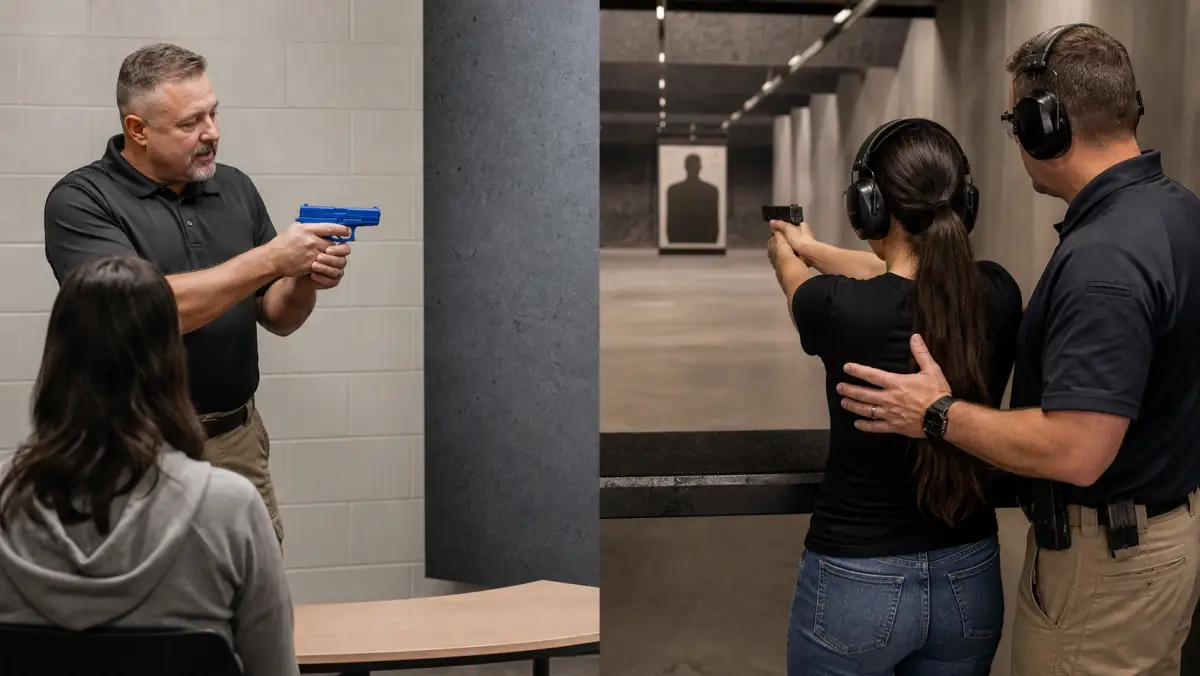
Learn the behavior and demonstrate it under supervision. The instructor decides whether dry practice is appropriate and specifies the setup.
Stage 2: supervised dry repetitions
Use a controlled setting to repeat only the assigned process. The instructor corrects unsafe direction, trigger-finger placement, visual inconsistency, or unnecessary movement.
Stage 3: limited live validation
Move to an approved range and test the skill with small, deliberate live-fire groups. Stop before fatigue or noise reduces attention.
Stage 4: review
Compare the live result with the dry observation. Choose one correction and confirm it with the instructor rather than making several simultaneous changes.
Stage 5: repeat deliberately
Use short dry sessions to reinforce the corrected behavior and return to live fire on a realistic schedule.
Range 313’s firearms training courses can help Metro Detroit students identify the right starting point before practicing independently.
This progression keeps rehearsal and validation connected through feedback instead of treating them as unrelated activities.
How to structure a combined week or month
There is no universal dry practice vs live-fire practice ratio. A safe schedule depends on experience, coaching, goal, equipment, budget, health, and access to a controlled dry environment.
A simple cycle might include:
- One instructor-defined objective.
- Several short dry sessions that end before attention fades.
- A live-fire session using limited ammunition to validate that objective.
- Notes on what transferred and what changed under recoil.
- A coaching check when the error persists.
Do not chase a high number of repetitions. Ten correct, attentive repetitions may be more valuable than one hundred rushed ones. Stop dry practice when distracted; stop live fire when fatigued, frustrated, or physically uncomfortable.
Our guide to how often you should practice at the range provides schedules for beginners and experienced recreational shooters without pretending one frequency fits everyone.
The best practice ratio is the one that preserves quality and produces measurable transfer.
Costs to compare
The cost comparison is broader than ammunition. Dry practice is often described as free, but a safe setup may involve qualified instruction, a dedicated training device, a manufacturer-approved accessory, a suitable backstop, and secure storage.
Live fire commonly includes:
- Lane fees.
- Ammunition.
- Targets.
- Eye and hearing protection.
- Rental firearm charges.
- Instructor time.
- Travel and parking.
- Cleaning and maintenance.
Do not calculate value only by cost per trigger press. A coached live session may correct an issue that hundreds of unsupervised dry repetitions would reinforce. A short dry session may preserve a correction between range visits without using ammunition.
The balance between dry and live work is a resource decision as well as a training decision. Spend where feedback is most useful.
Common mistakes
Dry and live practice can fail in different ways, but both usually suffer when purpose and controls disappear.
Dry-practice mistakes
- Beginning without qualified instruction.
- Leaving live ammunition in the room.
- Assuming the firearm permits dry firing.
- Using an unsafe direction or unverified backstop.
- Allowing interruptions or recording content while handling.
- Mixing live and inert cartridges.
- Adding speed or complexity without supervision.
- Loading immediately after the session while still in a dry-practice mindset.
- Treating a laser point as proof of live impact.
Live-fire mistakes
- Arriving without one defined objective.
- Using ammunition volume as the measure of success.
- Ignoring protection fit.
- Practicing a drill the range does not allow.
- Continuing after abnormal sound, recoil, or function.
- Changing equipment and technique simultaneously.
- Staying after fatigue reduces attention.
- Repeating the same error without coaching.
The common failure across both methods is lack of purpose. A written objective and stop condition make each safer and more useful.
When to stop and seek coaching
The combined training plan requires qualified coaching when:
- You cannot establish a safe dry-practice environment.
- You are unsure how to verify the firearm’s status.
- The manufacturer’s dry-fire guidance is unclear.
- Safe direction or trigger discipline is inconsistent.
- You tense, close your eyes, or react unpredictably during live fire.
- Target results remain inconsistent after several deliberate groups.
- A new holster, optic, modification, or firearm changes the process.
- A malfunction repeats.
- Pain, vision, hearing, mobility, or anxiety affects safety.
- You are tempted to add speed before control is stable.
Coaching is not a last resort. It keeps rehearsal and validation aligned with correct technique instead of reinforcing mistakes.
Use Range 313’s pistol training fundamentals guide to identify common areas for instructor feedback, then choose a course or private session that matches your experience.
Dry practice and household responsibility
Household responsibility shapes any dry-and-live training plan. Dry work changes the normal storage state of a firearm and may reveal equipment or routines to other people, making access planning essential.
Do not practice where children, guests, or unauthorized people can enter unexpectedly. Do not leave training aids, inert cartridges, or firearms unattended. Keep keys, codes, and storage details private. When the session ends, account for equipment and return it to secure storage.
If the household includes a person who is prohibited from possessing firearms or is experiencing an emotional or behavioral-health crisis, do not rely on a closed door as access control. Obtain qualified legal and safety guidance about secure or temporary storage.
Review our firearm safety basics for Michigan owners for storage, access control, household communication, transportation, maintenance, and crisis planning.
Responsible practice begins with protecting people who are not participating.
How Range 313 supports a balanced plan
Range 313 combines instructor-led courses, indoor pistol and rifle lanes, rentals, retail equipment, secure-storage options, and firearm services in Lincoln Park. That gives Detroit and Downriver shooters a place to learn a process, validate it under live conditions, and address equipment concerns.
The Range 313 indoor range supports deliberate practice with staff nearby. Call (313) 436-0197 about current lane, rental, course, and service availability before making a special trip.
Students from Detroit, Dearborn, Allen Park, Southgate, Taylor, Wyandotte, and neighboring communities should describe their experience honestly. Ask an instructor which behaviors are appropriate for dry practice, what safety setup is required, and how those behaviors will be checked during live fire.
Range 313 does not recommend treating dry work as a substitute for professional instruction or live validation. The aim is a training loop in which each method has a clear job.
Use each method for what it can prove
Dry practice vs live-fire practice is a comparison between rehearsal and validation. Dry work can make correct processes easier and less expensive to repeat. Live fire reveals whether they survive recoil, sound, cycling, actual target feedback, and the range environment.
Neither method is automatically productive. Dry practice requires ammunition separation, safe direction, a suitable backstop, model compatibility, controlled access, and a defined objective. Live fire requires lawful range access, protection, facility rules, environmental controls, and careful pacing.
Learn first, rehearse deliberately, validate under supervision, record the result, and return to coaching when needed. That cycle makes dry practice vs live-fire practice a responsible training strategy instead of a debate about which method is “better.”