People searching for CPL classes for women in Michigan are not all looking for the same thing. One student may want a women-only group because she feels more comfortable asking beginner questions there. Another may prefer a mixed class but wants an instructor who takes equipment fit seriously. A third may already be an experienced target shooter and simply needs qualifying Michigan training on a workable date.
The label on the class matters less than the experience it delivers. A strong course provides respectful instruction, a compliant curriculum, careful live-fire supervision, realistic equipment options, and room for every student to learn without being patronized or rushed.
Range 313 offers Michigan CPL classes at its indoor facility in Lincoln Park. Classes are not automatically women-only, so call (313) 436-0197 to ask about upcoming formats, instructors, dates, beginner support, rentals, and accommodations.
This article explains what women can look for when comparing CPL training. It does not assume that women share one body type, experience level, reason for training, or equipment preference. It is general education rather than legal advice.
The legal requirements are the same
Michigan does not establish a separate CPL curriculum based on gender. MCL 28.425j currently requires a qualifying initial program to contain at least eight hours of instruction, including at least five hours on required subjects and at least three hours of firing-range instruction. The student must fire at least 30 rounds.
Required subjects include safe storage, use and handling, ammunition knowledge, shooting fundamentals, pistol positions, firearms law, civil liability, use of deadly force, avoiding criminal attack, controlling a violent confrontation, and Michigan concealed-carry law.
A women-focused class must still meet that complete structure. It should not replace required substance with product demonstrations, fear-based marketing, or simplified slogans. Read the statute through the official Firearms Laws of Michigan and ask the provider to confirm compliance.
Women-only, women-focused, or mixed class?
Each format can work well.
A women-only class may help a student who feels hesitant in a male-dominated setting or who wants to meet other women pursuing similar training. It may also encourage discussion about clothing, equipment fit, family routines, and day-to-day carry considerations.
A women-focused class may use examples and equipment options selected with a wider range of students in mind while allowing any eligible adult to attend. The important question is how “focused” changes the teaching—not merely the title.
A mixed class can be equally effective when the instructor establishes a respectful culture, addresses individuals rather than stereotypes, and offers equipment that fits different hands and experience levels.
Choose the environment in which you can participate fully. Do not assume a women-only room guarantees better instruction, and do not assume a mixed room will be unwelcoming. Speak with the provider and evaluate the answers.
Look for respect without condescension
Good instruction is calm, direct, and specific. It corrects unsafe behavior immediately without humiliating the student. It also avoids talking to adult women as though they are fragile, automatically fearful, or interested only because a partner encouraged them.
Positive signs include:
- The provider asks about your actual experience.
- Beginner questions receive complete answers.
- The instructor explains the reason behind procedures.
- Corrections focus on observable technique.
- Students are not pressured to handle equipment before they understand the process.
- No one uses jokes, flirtation, or embarrassment as a teaching method.
- Experienced students are allowed to progress without dominating beginners.
You should be able to say “I do not understand,” “this does not fit,” or “I need help” and receive a useful response.
Avoid equipment stereotypes
Women are often steered automatically toward the smallest pistol, the lightest pistol, or a product with gendered colors. Size alone does not determine suitability.
A compact pistol may be easy to conceal but harder to control comfortably. A small grip may help one person reach the trigger while giving another too little surface area. A stiff slide, strong recoil impulse, small controls, or limited sight radius may create unnecessary difficulty. Hand strength, reach, previous injury, vision, training goals, and technique all matter.
The right question is: Can this individual operate this specific pistol safely, consistently, and independently?
A good provider can help a student evaluate:
- Trigger reach without distorting grip.
- Access to the magazine release and other controls.
- Ability to rack and lock the slide using sound technique.
- Grip circumference and texture.
- Weight and balance.
- Perceived recoil.
- Sight visibility.
- Reliability and maintenance needs.
None of these measurements has one answer for all women.
Rentals can prevent an expensive mistake
Range 313 says rentals are available for its CPL classes. A rental can let a student complete training or gain supervised experience before buying.
Ask the provider whether more than one suitable option is available and whether a rental must be reserved. Confirm approved ammunition, identification, rental charges, and what happens if the first model is difficult to operate.
Do not use class day as an uncontrolled shopping comparison. The instructor may need everyone to follow one course plan. If you want to compare multiple pistols, a separate supervised rental session or private lesson may be more productive.
Training before purchasing replaces marketing assumptions with personal evidence. It can also reveal that technique—not a different product—is the main issue.
Instructor gender is a preference, not a quality guarantee
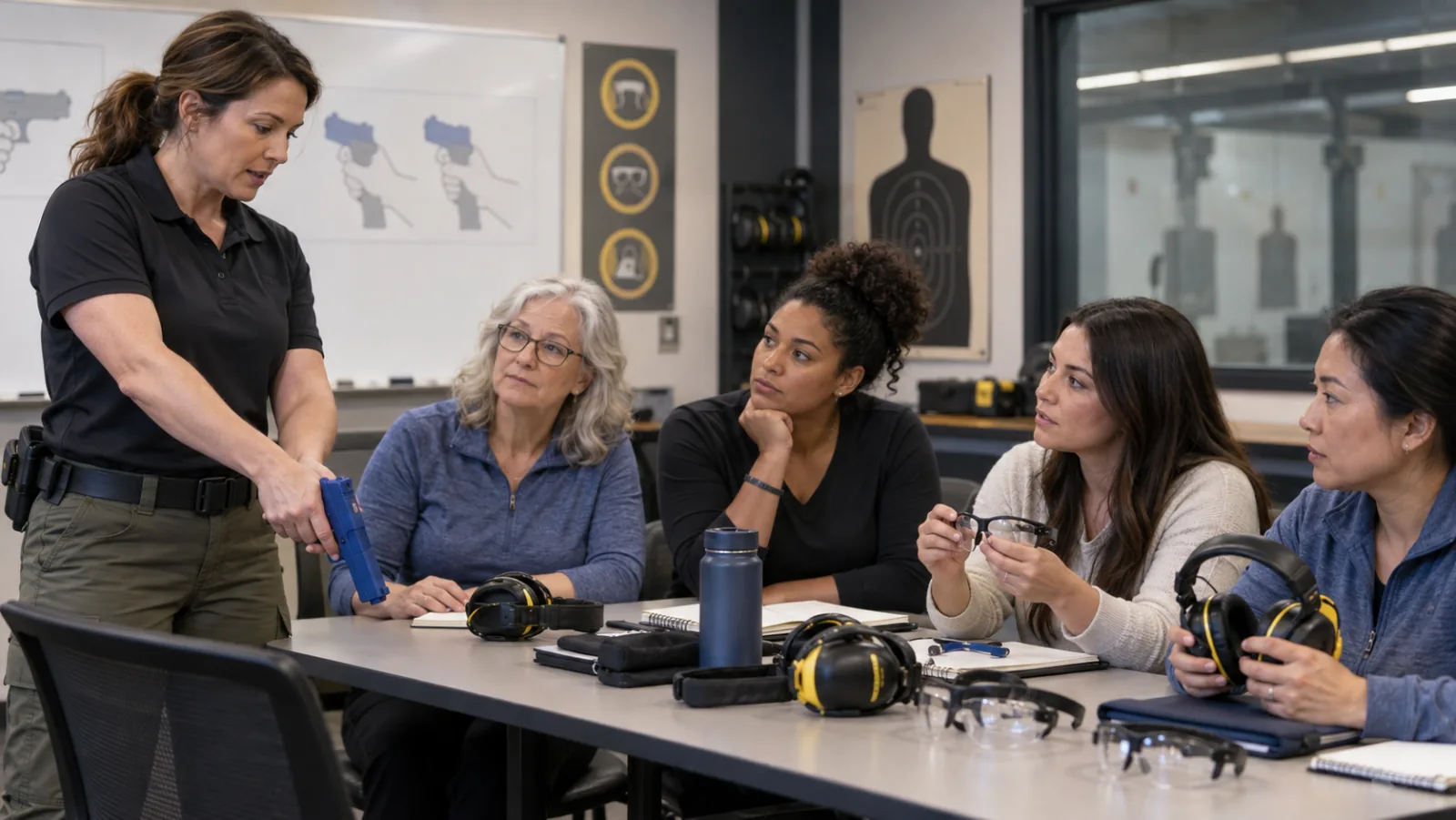
Some women specifically want a female instructor. That preference can be reasonable, especially after an uncomfortable past experience or when it makes communication easier. Ask whether a female instructor is scheduled rather than assuming from a stock photo or class title.
Instructor gender alone does not prove teaching quality. Evaluate certification, course compliance, live-fire supervision, communication, and experience working with students at your level. A skilled instructor of any gender should listen, adapt explanations, maintain professional boundaries, and avoid stereotypes.
If the course uses more than one instructor, ask who teaches the classroom, legal, and range portions. Michigan law contains qualification requirements that providers should be able to explain.
Beginner support should be concrete
“Beginners welcome” is useful only when the schedule and staffing support it. Ask what the phrase means.
- Does the instructor explain basic pistol parts and controls?
- Are range commands reviewed before live fire?
- Is there a safe method for practicing grip and stance before entering the lane?
- How many students share each instructor or range officer?
- What happens if a student cannot operate the planned rental?
- Can the student stop and ask for help without holding up the group?
Someone with no experience may benefit from beginner firearm training before the CPL day. A preliminary lesson is not a failure. It can reduce cognitive overload and create more attention for legal concepts, decision-making, and supervised live fire.
Ask about class culture before registering
The provider’s first phone conversation often reveals the culture. Describe your experience, ask specific questions, and notice whether the answers are patient and clear.
Ask:
- Do you regularly teach women and first-time shooters?
- Is the upcoming class women-only, women-focused, or mixed?
- Who is the instructor?
- How large is the group?
- How is live fire supervised?
- Are rentals available for different hand sizes and operating needs?
- Can you accommodate a prior injury, hearing concern, or limited mobility?
- What behavior is expected from every student?
A professional provider will not promise that training will remove every concern in one day. It should describe the process honestly.
Clothing should solve range problems
Range clothing is about coverage, footing, movement, and hot-brass protection—not about looking tactical.
Common choices include:
- Closed-toe shoes with stable soles.
- A high neckline.
- Comfortable pants that allow normal movement.
- Layers for different classroom and range temperatures.
- A brimmed cap if allowed.
- Hair secured when it could interfere with protection or vision.
Avoid low or loose necklines, open footwear, dangling jewelry, and garments that interfere with safety equipment. A hot casing caught against skin can trigger an instinctive movement, so clothing should reduce that possibility.
Ask about holsters before buying or wearing one. Many introductory or CPL course formats do not require students to draw from a holster. Bringing unrequested equipment can complicate check-in rather than improve the experience.
Fit eye and hearing protection early
Protective equipment is not one-size-fits-all. Oversized safety glasses can slide, interfere with earmuff seals, or leave gaps. Earmuffs can press uncomfortably against glasses, hair accessories, or earrings.
Try the full combination before class. Make sure the glasses stay in place when you look down and move naturally. Confirm hearing protection seals correctly and still allows you to understand commands. Some students use properly inserted plugs under earmuffs at an indoor range.
If you wear prescription lenses or hearing aids, contact the provider in advance. Do not wait until the firing line to discover that two devices conflict.
Consider physical differences individually
Pregnancy, recent surgery, arthritis, prior injury, limited hand strength, mobility differences, and sensory concerns deserve individual planning. They should not be met with generic advice.
Firearm discharge creates noise and other exposures. A person who is pregnant or has a medical concern should consult an appropriate healthcare professional and the range before participating. The provider can explain facility conditions and course demands but should not replace medical advice.
For a hand or shoulder limitation, a private session may help identify safer technique or suitable equipment. For limited mobility, ask about entrances, classroom seating, lane design, and whether the required firing positions can be addressed appropriately.
The goal is meaningful access without improvising away a safety control or legal course requirement.
The legal portion should not use fear as a sales tool
A CPL class should discuss avoidance, de-escalation, legal boundaries, civil liability, secure storage, prohibited premises, impairment, and the consequences of poor decisions. It should not imply that danger is everywhere or that licensing turns the student into a protector of strangers.
Students should leave with a clearer understanding of responsibility, not a heightened appetite for confrontation. Ask which official sources support the legal material and how the provider handles questions that depend on individual facts.
Michigan State Police maintains a CPL and firearms resource hub covering requirements, applications, renewal, prohibited premises, reciprocity, and impairment. Bookmark it and revisit it after class.
Personal safety involves more than shooting
Many students pursue a CPL because personal safety matters to them. A complete plan extends beyond marksmanship.
Consider education in:
- Awareness and avoidance.
- Verbal boundary setting.
- De-escalation.
- Secure home storage.
- Emergency communication.
- Trauma first aid.
- Legal updates.
- Safe behavior around children and visitors.
- Realistic plans for prohibited locations.
A firearm is not a substitute for planning, relationships, lighting, locks, communication, or leaving a dangerous situation. Good training places pistol skills inside a larger decision system.
Secure storage must fit the household
Before bringing a firearm home, identify who lives in and visits the residence. Children, teenagers, roommates, relatives, service workers, and guests can change the storage risk.
A responsible system should prevent unauthorized access, protect against theft, and remain usable by the authorized owner. Hiding a firearm is not the same as locking it. Keys and combinations also require control.
Michigan’s secure-storage law and guidance should be reviewed directly. Household circumstances differ, and minimum legal compliance may not be the strongest option for a particular home.
Continued training matters after class
One qualifying class cannot create complete skill. Plan a gradual progression:
- Reinforce safe handling and accurate fundamentals.
- Learn the specific pistol’s controls and maintenance.
- Obtain qualified feedback on recurring problems.
- Learn secure storage and lawful transportation.
- Study avoidance, judgment, and current law.
- Practice at a sustainable interval.
A women-only practice group may provide community, but the same quality standards apply. Group confidence should not replace qualified supervision or facility rules.
Range 313 offers indoor lanes and multiple training courses . Ask which next step matches your actual experience rather than jumping from a first class into an advanced format.
Red flags in a women-focused CPL class
Pause when a provider:
- Uses fear or victim imagery as the main sales strategy.
- Treats all women as complete beginners.
- Pushes one small pistol for every student.
- Uses appearance or gendered colors as proof of suitability.
- Dismisses questions about recoil, controls, injury, or fit.
- Guarantees license approval.
- Avoids explaining instructor qualifications.
- Offers a schedule that appears shorter than Michigan’s requirements.
- Tolerates jokes, flirting, intimidation, or humiliation.
- Emphasizes merchandise more than curriculum and supervision.
A respectful tone is not an optional extra. It affects whether students ask the questions that prevent mistakes.
A practical comparison checklist
Compare providers using the same fields:
| Question | What a useful answer includes |
|---|---|
| Is the class compliant? | Complete schedule, classroom and range structure |
| Is the environment respectful? | Clear behavior expectations and professional teaching |
| Are beginners supported? | Specific instruction and staffing, not a slogan |
| Are rentals available? | Fit options, reservation, ammunition, and cost |
| Who teaches? | Names, roles, and relevant qualifications |
| Is live fire well supervised? | Commands, lane process, and help procedure |
| Are accommodations possible? | Early, individual planning without unsafe shortcuts |
| What does it cost? | Tuition plus every required item |
| What comes next? | Official application resources and continued training |
Our 15-question CPL class guide provides an expanded provider comparison.
Choosing a CPL class at Range 313
Range 313’s Lincoln Park course combines classroom and live-fire instruction. The current listed price is $100, and firearm rentals are available. Upcoming class format, instructor, dates, seats, rental details, ammunition, and accommodations should be confirmed directly.
Call (313) 436-0197 and explain what you need: a first-time-friendly class, information about the instructor, a rental, equipment-fit support, or an accessibility conversation. The most useful class is the one where you can learn seriously and participate safely.
Women do not need diminished standards or stereotyped equipment. They need complete information, competent instruction, suitable choices, and the freedom to build skill at an honest pace.