
Buying your first handgun Michigan residents can own lawfully requires more planning than choosing a model from a display case. The purchase should follow a clear purpose, honest assessment of fit, qualified training, current legal requirements, a complete budget, and secure storage prepared before the firearm enters the home. A good dealer will slow the process down enough for you to ask questions.
This guide is general education, not legal advice or a product recommendation. Confirm current federal and Michigan requirements with licensed dealers, official agencies, and qualified counsel.
Define the lawful purpose first
Start with why you are considering ownership. Recreational target shooting, collecting, home storage, and preparation for licensed carry involve different priorities. A vague goal leads shoppers to focus on appearance or popularity instead of suitability.
Write down where the handgun will be used, who will have lawful access, how often you will train, and how it will be secured. If you cannot answer the storage question, pause the purchase.
Visit Range 313’s product department to discuss current options and support, but treat the conversation as research rather than an obligation to buy.
Take introductory training early
Training provides context for every later decision. A beginner course can explain safe direction, trigger-finger discipline, range procedure, basic operating systems, loading and unloading under supervision, and what to do when something unexpected occurs.
Without this foundation, a shopper may mistake small size for easy control or assume every pistol operates alike. Qualified Range 313 courses let students learn in a structured setting.
If rentals are available, supervised comparison can reveal grip, control reach, sight visibility, and recoil comfort before you commit.
Evaluate fit, not just dimensions
The handgun should allow you to establish a secure grip and reach controls without unsafe repositioning. You should be able to operate it with appropriate instruction and without relying on excessive force.
Very compact handguns can be harder to grip and may feel sharper in recoil. Larger models can be easier to control but less suited to other purposes. No category is automatically right.
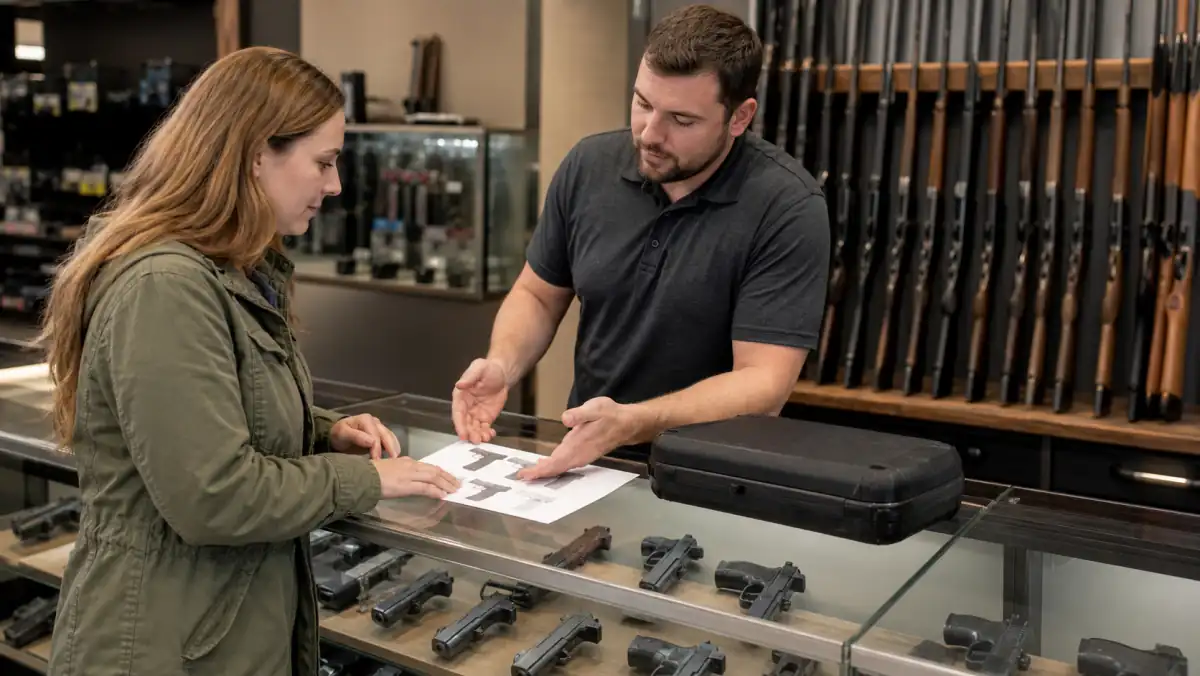
Ask the dealer for permission before handling any display firearm. Keep it pointed in the designated safe direction, maintain trigger-finger discipline, and do not manipulate controls you do not understand.
Compare operating systems carefully
Handguns use different safeties, trigger systems, magazine releases, slide stops, sights, and disassembly methods. Similar appearance does not guarantee identical operation.
Ask the dealer to explain the controls and manufacturer documentation. Consider whether you can practice the same safe sequence consistently. Do not select a feature because an online personality declares it essential.
The best choice supports responsible operation and regular training. Complexity you do not understand is not an advantage.
Consider ammunition availability and comfort
Caliber affects ammunition cost, availability, recoil sensation, and the handgun’s size. Avoid choosing based on reputation alone. The ability to practice consistently with approved ammunition matters.
Ask what the manufacturer specifies, what the range permits, and what products are regularly available. Do not fire unknown, damaged, or incompatible ammunition.
Include realistic annual practice cost in the decision. A handgun you cannot afford to train with may not meet your goal.
Build the complete budget
The displayed price is only one cost. Plan for:
- Applicable taxes and transfer costs.
- Secure storage or a locking device.
- A protective transport case.
- Impact-rated eye protection.
- Proper hearing protection.
- Introductory and follow-up training.
- Range fees or membership.
- Practice ammunition and targets.
- Cleaning and maintenance supplies.
- Additional magazines if appropriate.
Buying your first handgun Michigan shoppers can support responsibly means budgeting for ownership, not merely acquisition.
Understand the licensed dealer process
Federal firearms licensees must follow identification, recordkeeping, and background-check requirements. The transferee completes ATF Form 4473 and the dealer contacts or uses the applicable NICS process unless a legal exception applies.
The ATF firearms Q&A explains federal dealer obligations, while the FBI NICS overview describes proceed, delay, and denial responses.
Bring current identification and answer every form question truthfully. Do not let another person complete the form for you.
Review Michigan requirements directly
Michigan law includes requirements beyond the federal process. Firearm purchase, licensing, records, transport, concealed carry, prohibited possession, and storage rules may apply depending on the facts.
Michigan State Police maintains firearms information and forms . Read current official materials before shopping. A dealer can explain its process but may not determine your legal eligibility in advance.
If your background includes any circumstance that may affect possession or purchase, consult an appropriate attorney or agency before attempting the transaction.
Never misrepresent the actual buyer
The actual purchaser must be accurately identified. Do not complete a transaction for someone who is prohibited or to conceal the true recipient. Questions about lawful gifts or shared finances should be resolved with the dealer or qualified counsel before forms are signed.
ATF instructions use specific definitions. Guessing is unnecessary when the dealer can pause the process.
Buying your first handgun Michigan residents undertake should be transparent from selection through transfer.
Prepare secure storage before pickup
Do not take the handgun home first and shop for a safe later. Choose a storage method based on unauthorized-access prevention, household members, theft resistance, lawful access needs, and manufacturer guidance.
Michigan’s secure-storage law requires specified measures when a minor is present or likely to be present. The MDHHS secure-storage resource summarizes current requirements and links to additional material.
Control keys, combinations, and biometric access. Test the storage device without live ammunition present.
Plan lawful transportation
Bring an appropriate case to pickup. Learn the current transportation rules applicable to your firearm, licensing status, and route. The Michigan DNR firearms page provides general guidance.
Do not leave the handgun unattended in a vehicle while completing errands. Go directly to the planned secure destination when practical.
A CPL is a separate licensing matter and should not be assumed from ownership. Review official MSP information if concealed carry is a future goal.
Inspect before accepting transfer
Confirm the make, model, caliber, visible condition, and included items. Ask permission before manipulating the handgun. If ordering through an FFL, understand the seller’s return policy before transfer completion.
New does not mean no inspection is needed. Used firearms may deserve a qualified mechanical assessment. Range 313 provides gunsmithing and maintenance services when professional evaluation is appropriate.
Do not accept pressure to complete a transaction you do not understand.
Schedule the first range session responsibly
Do not load the handgun at home simply to “try it.” Read the manufacturer’s manual, arrange qualified instruction, transport it secured, and use it at an appropriate range.
Tell the instructor the handgun is new to you. Begin with operation and safety rather than speed. Bring manufacturer-approved ammunition and proper protection.
Our first-time Michigan shooting range checklist explains clothing, check-in, lane behavior, and hygiene.
Create a maintenance routine
Follow manufacturer guidance for inspection, cleaning, lubrication, and parts replacement. Use a dedicated workspace with no live ammunition present and confirm firearm condition before beginning.
Do not over-lubricate or alter components without understanding the consequences. Preserve warranty information and service records.
If operation changes, visible damage appears, or repeated failures occur, stop use and seek professional assistance.
Avoid common first-purchase mistakes
Common mistakes include buying solely on price, choosing the smallest model, skipping training, ignoring storage cost, relying on a friend’s preference, and purchasing accessories before identifying a need.
Another mistake is treating ownership as the end of learning. Safe competence requires recurring practice and legal awareness.
Wait when uncertain. A product can be reconsidered; a rushed legal or safety decision can have lasting consequences.
Questions to ask the dealer
Ask what identification is required, what the total out-the-door cost is, which storage device fits the handgun, what ammunition the manufacturer specifies, whether magazines and service are available, how warranty work is handled, and what training supports the model.
Ask the dealer to explain any form or process you do not understand. A reputable business values accurate paperwork and informed customers.
Document the exact model and compare options at home before purchasing.
Buying your first handgun Michigan checklist
Define the purpose, take introductory training, compare fit under supervision, calculate the full budget, review current law, and prepare secure storage. At the dealer, bring accurate identification, complete forms truthfully, inspect the product, and ask questions. Afterward, transport lawfully and schedule supervised practice.
Buying your first handgun Michigan residents can manage responsibly is a process rather than an impulse. The right outcome is not simply owning a handgun; it is having the knowledge, storage, training, and ongoing plan to control it safely.
Use a 48-hour decision worksheet
After comparing options, leave the store with written notes rather than making an automatic same-day choice. Record the exact model, operating system, fit observations, total price, included magazines, warranty, storage device, ammunition cost, training plan, and any control you did not understand.
During the next 48 hours, read the manufacturer’s official manual and current Michigan and federal resources. Confirm that the storage solution is available and suitable for your household. Calculate the first-year cost using realistic training and range visits. Discuss legal or eligibility uncertainty with the appropriate authority—not a social media group.
Return only when the original purpose still matches the product and every unresolved question has an answer. If another model now appears more suitable, repeat the process. If the purchase no longer makes sense, walking away is a successful outcome.
The worksheet introduces a pause between product enthusiasm and ownership responsibility. Buying your first handgun Michigan residents can support safely should survive that pause. A suitable choice will remain suitable after the marketing language, counter conversation, and novelty have faded.