Good shooting habits are safe, repeatable behaviors that remain consistent when the range is busy, a target is disappointing, equipment feels unfamiliar, or attention begins to fade. They are not a lucky target, a fast string of fire, or a large ammunition receipt. The goal is to make the responsible process easier to repeat and an unsafe shortcut easier to notice.
This guide gives Michigan shooters a 30-day framework for building good shooting habits through qualified instruction, short practice sessions, simple measurement, and honest review. It is designed for adults in Lincoln Park, Detroit, Dearborn, Allen Park, Southgate, Taylor, Wyandotte, and the wider Downriver area who want a practical system rather than a collection of random drills.
Thirty days is a planning window, not a biological promise. Research on real-world habit formation found wide variation in how quickly behavior became more automatic. The useful lesson is that repetition in a stable context matters; the misleading lesson would be that every person masters every habit on the same calendar day.
Good shooting habits at a glance
| Part of the process | What to repeat | What to avoid |
|---|---|---|
| Before the visit | Confirm rules, equipment, objective, and stop conditions | Arriving rushed with a vague plan |
| At check-in | Disclose experience and ask about anything unclear | Pretending to know a command or firearm |
| At the lane | Maintain safe direction, trigger discipline, and range awareness | Letting target results override safe handling |
| During practice | Work on one observable behavior in short sets | Changing several variables at once |
| Between sets | Pause, inspect the process, and reset attention | Shooting continuously through fatigue |
| After practice | Record one measure, one correction, and one next step | Judging the session only by the best group |
| At home | Follow secure storage, hygiene, and manufacturer guidance | Leaving equipment care and access control for later |
Why habits matter more than a perfect target
A target records where projectiles arrived. It does not tell the entire story of how they got there. A tight group can occur during a session that included poor muzzle awareness, rushed loading, unsuitable hearing protection, or uncertainty that the shooter did not disclose. A wider group can occur while a beginner correctly follows commands and learns a new process under supervision.
Good shooting habits prioritize the process that makes improvement sustainable:
- Treat every firearm as loaded.
- Keep it pointed in the safest available direction.
- Keep the finger outside the trigger guard until the decision and instruction to fire are clear.
- Know the target, the approved backstop, and the range boundary.
- Stop when a command, condition, or equipment response is unclear.
- Use eye and hearing protection correctly.
- Secure firearms against unauthorized access after the session.
ATF’s current firearms handling and storage guidance reinforces these handling rules and the responsibility to use secure storage. Michigan DNR’s shooting range rules provide a public example of structured range behavior: firearms enter cased and unloaded, handling occurs at established stations, protection is required, and range officer commands control the line. Range 313 has its own current facility rules, which govern a visit here.
Accuracy still matters in target practice, but accuracy should be built on behaviors that can survive distraction and pressure. That is why good shooting habits begin with safety and decision-making rather than speed.
The cue, behavior, and review loop
Habits become easier to repeat when they have a consistent cue. For range practice, a cue might be arriving at the lane, hearing a command, placing a case on the bench, or completing a small group. The cue should trigger a known response rather than improvisation.
A useful loop has three parts:
- Cue: a specific event begins the routine.
- Behavior: the shooter performs the same safe, instructor-approved sequence.
- Review: the shooter pauses to confirm whether the sequence actually happened.
For example, “case reaches the approved bench” can cue a deliberate pause to confirm the facility’s uncasing instructions. “Small group complete” can cue the finger away from the trigger, the firearm secured as instructed, and a short observation. “Session ends” can cue safe casing, handwashing, notes, and secure storage.
The peer-reviewed study How are habits formed: Modelling habit formation in the real world found that repeated behavior in a consistent context was associated with increasing automaticity, although the time course varied widely. It was not a shooting study, so it does not prove a firearm-training schedule. It does support a careful general principle: attach one appropriate behavior to one stable cue and repeat it consistently.
The review step remains important because automatic does not always mean correct. Repetition makes a behavior familiar; qualified feedback helps ensure the behavior deserves to become familiar.
The 30-day plan for good shooting habits
This framework uses ten steps across four weeks. It is not a replacement for a course, range supervision, the firearm’s manual, or legal advice. A complete beginner should start with professional firearms training in Lincoln Park rather than trying to design a self-directed curriculum.
1. Define one safe, observable behavior
Begin with one behavior that another person could see and evaluate. “Be safer” is too vague. “Keep the muzzle in the designated safe direction during every lane transition” is observable. “Improve accuracy” is broad. “Use the same instructor-approved preparation sequence before each deliberate shot” is specific.
Examples of suitable first objectives include:
- Following every range command without delay.
- Keeping the trigger finger visibly indexed during non-firing tasks.
- Maintaining the designated safe direction during setup and pauses.
- Pausing immediately when a condition is uncertain.
- Checking that eye and hearing protection remain correctly fitted.
- Completing the same written pre-session checklist.
Do not choose a behavior simply because it looks advanced. Good shooting habits address the highest-consequence uncertainty first. If safe direction or trigger discipline is inconsistent, those issues take priority over group size, target distance, speed, or accessories.
Write the objective in one sentence before the session. If the objective cannot be explained clearly, it will be difficult to evaluate honestly.
2. Get a qualified baseline assessment
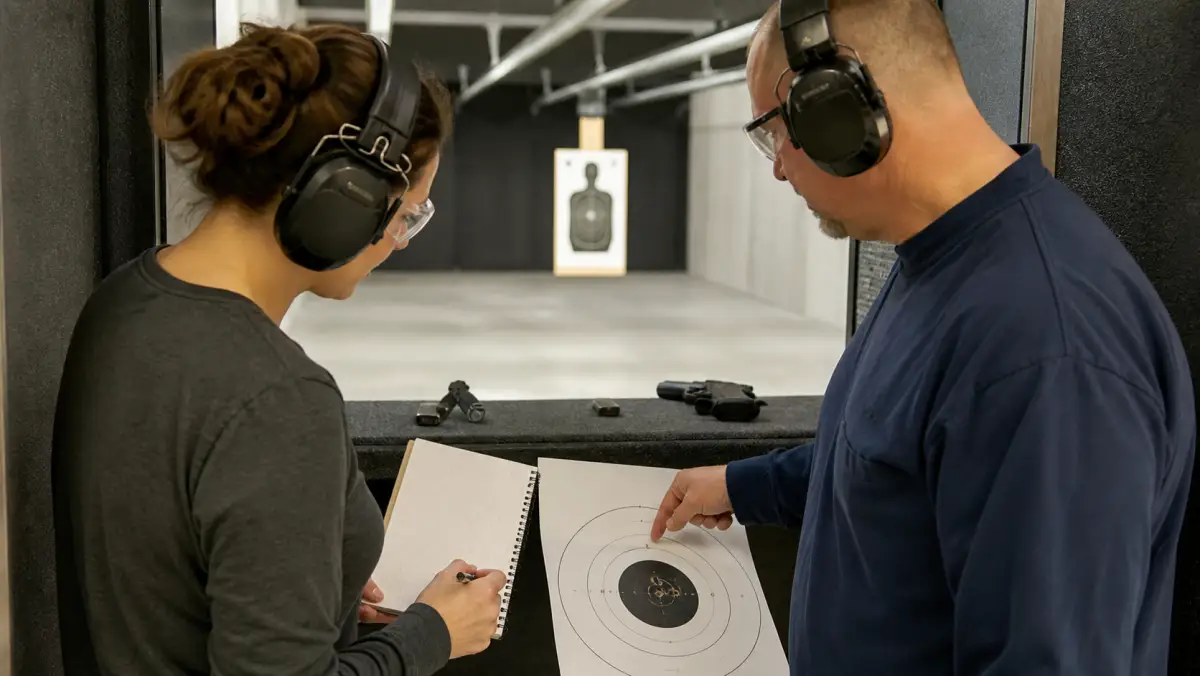
Repetition should begin after the process has been checked, not before. Ask a qualified instructor to observe the selected behavior and identify the most important correction. A friend may have useful experience, but informal experience is not the same as professional observation, current facility authority, or responsibility for the lesson.
A baseline does not need to be dramatic. It might record:
- Whether the behavior remained consistent during five controlled repetitions.
- Which cue caused hesitation.
- Whether equipment fit created a distraction.
- Which instruction the student misunderstood.
- When attention began to decline.
- Whether the original objective was appropriate for the student’s current level.
The instructor may decide the student needs a more foundational objective or direct supervision. That is useful information, not failure. Good shooting habits develop faster when uncertainty is exposed early.
Range 313’s Michigan firearm safety basics guide explains the overlapping safety layers that should remain active before, during, and after a range visit.
3. Build a pre-session checklist
A checklist moves essential decisions to a calm moment. Keep it short enough to use every time. The exact content should match current range rules, the specific firearm, and instructor guidance.
A practical checklist can cover:
- Current range hours, reservation, and facility rules.
- Identification and required documents.
- Firearm case and secure transportation plan.
- Manufacturer-approved equipment condition check.
- Correct ammunition confirmation by qualified staff or documentation.
- Properly fitted eye and hearing protection.
- Closed-toe shoes and practical clothing.
- One written practice objective.
- Planned duration and spending limit.
- Stop conditions: confusion, fatigue, pain, damaged equipment, emotional distress, or any unsafe behavior.
- Secure storage readiness for the trip home.
Do not use a generic internet checklist to replace model-specific instructions. If the firearm’s status, ammunition compatibility, or condition is uncertain, keep it secured and ask qualified staff.
Good shooting habits often look ordinary. The same ten-item checklist used before every visit can prevent more problems than an elaborate plan that stays in a notebook.
4. Use short, spaced practice sessions
One long, exhausting visit is not the only way to practice. Shorter sessions spaced across time can make it easier to protect attention and identify the moment performance changes.
A controlled study of a general motor-sequence task found better acquisition with distributed practice than massed practice . This research did not involve firearms, so it should not be used to prescribe a universal shooting schedule. It does support a modest training principle: more concentrated volume is not automatically better learning.
For good shooting habits, session quality matters more than raw duration. A student and instructor may choose several short blocks with clear pauses. Stop while the safe process is still reliable. Do not continue merely to finish a box of ammunition or justify the drive.
Our guide to how often you should practice at the range explains how to choose a sustainable cadence around experience, goals, budget, recovery, and coaching needs.
5. Use only instructor-approved dry practice
Dry practice can remove live-fire noise and recoil from a learning task, but it requires serious controls. A beginner should receive qualified instruction before attempting it and should practice only assigned behaviors using the exact model-specific procedure.
At minimum, the plan should address:
- A controlled location that can be secured from interruption.
- A verified safe direction and suitable backstop.
- Removal of all live ammunition from the practice environment.
- A deliberate start and stop ritual.
- Manufacturer guidance for the exact firearm and any training device.
- A short duration that preserves attention.
- An immediate stop when uncertainty appears.
- Secure storage when practice ends.
Never combine dry practice with television, alcohol, cannabis, fatigue, emotional conflict, or casual handling. Do not use a real person, pet, mirror image, window, door, or ordinary interior wall as an aiming reference. If the environment cannot be controlled, do not practice there.
The full dry practice versus live-fire practice guide explains the different feedback each method provides and the safety boundaries beginners need.
Good shooting habits do not depend on doing more at home. They depend on refusing to practice when the conditions are wrong.
6. Validate the process with limited live fire
Live fire adds noise, recoil, equipment cycling, range commands, and neighboring activity. It reveals whether an apparently stable process remains stable under real conditions.
Use small, instructor-approved groups and pause between them. Ask one question: did the selected behavior remain consistent? If not, reduce complexity or stop. Do not conceal a safety lapse because the target looked good.
A useful live-fire review may include:
- Did the student follow every command promptly?
- Did safe direction remain controlled during setup, firing, pauses, and casing?
- Did the trigger finger remain in the correct place outside the firing decision?
- Did the shooter notice and report uncertainty?
- Did protection remain fitted?
- Did attention change after noise, recoil, a poor target, or a neighboring distraction?
- Did the shooter stop at the planned limit?
CDC/NIOSH warns that indoor firing ranges can involve hazardous noise and lead exposure. Its indoor firing range guidance emphasizes engineering controls, protective measures, and work practices. Follow facility requirements, keep protection on in live-fire areas, avoid eating or drinking there, and wash hands, forearms, and face before eating or close contact after shooting.
7. Record one measure and one correction
A good practice log is short enough to complete in the parking area after equipment is secured. Record one objective measure, one observation, and one next action.
For example:
- Measure: five out of five planned repetitions completed without a safety correction.
- Observation: attention dropped after the third small group.
- Next action: shorten the next session and ask the instructor to review the transition.
Other useful measures include time spent before fatigue, number of staff interventions, equipment issues, protection fit, and whether the planned checklist was completed. A target photo may be included, but it should not erase the process record.
Avoid writing “good day” or “bad day” without evidence. Good shooting habits become easier to manage when the notes distinguish feelings from observable behavior.
Keep records private and practical. Do not post targets, firearm details, schedules, serial numbers, storage information, or household routines publicly. A training log should help the next responsible decision, not create an unnecessary security risk.
8. Add complexity only after consistency
Change one variable at a time. A new firearm, ammunition type, target distance, visual setup, accessory, pace, or range environment can change the task. If several change together, the shooter cannot tell which one helped or harmed the process.
Before adding complexity, ask:
- Has the foundational behavior remained reliable across several supervised checks?
- Can the student explain the cue and sequence clearly?
- Does the instructor agree the next step is appropriate?
- Is the equipment correctly fitted and understood?
- Can the shooter stop immediately when something changes?
- Is the new activity permitted by the facility?
There is no prize for reaching an advanced label quickly. Good shooting habits grow through dependable layers. A student who pauses and asks for help is demonstrating better judgment than one who attempts an unfamiliar task to avoid appearing inexperienced.
9. Complete the after-range routine
The session does not end when the target returns. After-range behavior protects health, equipment, and the household.
Follow the facility’s casing and checkout procedure. Secure firearms for lawful transportation and direct travel. Wash exposed skin before eating, drinking, smoking, or close contact. Consider keeping range shoes and clothing separate, particularly after frequent indoor-range use, and follow CDC/NIOSH guidance for reducing take-home lead contamination.
At home:
- Secure the firearm against unauthorized access immediately.
- Keep keys, combinations, and access devices controlled.
- Store ammunition according to the household plan and applicable law.
- Inspect equipment for damage without improvising repairs.
- Follow the manufacturer’s cleaning and maintenance instructions.
- Record any suspected problem and seek a qualified gunsmith when needed.
- Replace damaged eye or hearing protection.
- Update the practice log while details are fresh.
Good shooting habits include what happens when no instructor is watching. Safe storage, household access control, hygiene, and maintenance are not optional administrative tasks; they are part of responsible ownership.
10. Reassess after 30 days
At the end of the month, compare the selected behavior with the baseline. Do not ask only whether it feels easier. Ask whether it is more consistent and whether another qualified observer agrees.
Use four questions:
- What specific behavior improved?
- Under what conditions did it fail or become uncertain?
- Which cue made the correct response easier?
- What is the smallest responsible next objective?
Thirty days may produce a useful routine without producing mastery. If the behavior still requires reminders, continue working on it. If it becomes unreliable with a new firearm or environment, return to the simpler condition. If a serious safety issue appeared, schedule instruction before further independent practice.
The best outcome is not a claim that the habit is “done.” It is a more accurate understanding of what the shooter can repeat safely and what still needs help.
A week-by-week Michigan practice calendar
The calendar below is an example planning framework. The number and type of sessions should be adjusted by a qualified instructor for the student’s experience, equipment, and objective.
| Week | Primary purpose | Suggested actions | Evidence to collect |
|---|---|---|---|
| Week 1 | Establish the baseline | Choose one behavior, review safety rules, schedule instruction, prepare the checklist | Instructor observation and one clear correction |
| Week 2 | Repeat the process | Use short assigned practice, stable cues, and the same checklist | Log entries showing whether the behavior stayed consistent |
| Week 3 | Validate carefully | Use limited live fire under range rules; change no more than one variable | Notes on attention, equipment, and any needed intervention |
| Week 4 | Review and decide | Repeat the baseline condition, compare records, and request follow-up feedback | A specific conclusion and one responsible next objective |
Metro Detroit schedules can be disrupted by work, weather, traffic, and family responsibilities. Missing one planned day does not erase progress. Habit research suggests that consistency matters, but one missed opportunity is not a reason to cram several sessions together. Resume the planned cue at the next safe opportunity.
How to recognize a bad habit early
An error becomes more difficult to correct when it is repeated without feedback. Watch for patterns rather than isolated imperfections.
Warning signs include:
- The shooter speeds up after one successful target.
- Safe direction changes when conversation begins.
- The trigger finger moves early during setup or late during a pause.
- The student repeats a task they do not understand rather than asking.
- A poor result leads to immediate equipment adjustments.
- Fatigue is acknowledged but ignored.
- Every range visit uses a different firearm, distance, or goal.
- The shooter relies on an accessory to solve an unexamined process problem.
- Notes focus only on group size or praise.
- Secure storage and after-range hygiene happen inconsistently.
The correction loop is simple: stop, make the firearm and environment safe under facility procedure, name the exact problem, ask for qualified feedback, reduce the task, and retry only when authorized. If the error returns, end the exercise and schedule more instruction.
Good shooting habits require enough humility to interrupt a repetition. Continuing through confusion does not prove confidence.
What to measure besides accuracy
Accuracy is an outcome. Process measures reveal whether performance is dependable.
Consider tracking:
- Safety consistency: Were any corrections required?
- Decision quality: Did the shooter stop when uncertain?
- Checklist completion: Were rules, equipment, protection, and objective confirmed?
- Attention span: When did concentration begin to change?
- Equipment reliability: Did a fit or maintenance issue interfere?
- Instruction transfer: Did the assigned correction appear in the next session?
- Session discipline: Did practice stop at the planned limit?
- After-range completion: Were hygiene, storage, and notes handled immediately?
Do not turn the log into a competition. The purpose is to make good shooting habits visible enough to improve.
Common reasons good shooting habits fail
The objective is too broad
“Become a better shooter” cannot guide one session. Reduce it to an observable behavior with a clear cue.
The shooter practices errors alone
Repetition does not determine whether a movement is correct. Periodic coaching provides an external check and can prevent confident mistakes from becoming familiar.
Volume replaces attention
More ammunition can produce more tired repetitions. Use only the amount that supports the day’s goal and stop when the process changes.
Equipment changes constantly
New gear can be enjoyable, but frequent changes obscure learning. Keep equipment stable long enough to understand the effect of one correction.
The plan ignores range rules
An online exercise may be unsafe, prohibited, or unsuitable for a facility. The range officer and posted policies govern the lane. Ask before attempting anything unfamiliar.
The plan has no stop condition
Every session should define when it ends. Pain, fatigue, emotional distress, repeated confusion, damaged equipment, or unsafe behavior are reasons to stop—not challenges to push through.
Progress is measured by the best moment
One excellent group is not the same as repeatability. Compare the ordinary process across sessions, including the least successful repetitions.
When coaching should interrupt the plan
Professional help belongs throughout the process, not only at the beginning. Schedule instruction when:
- You are new to firearms or to a specific model.
- Safe direction or trigger discipline is inconsistent.
- A firearm’s condition or operation is unclear.
- A recurring target problem survives one simple correction.
- You return after a long break or health change.
- You want to add unfamiliar equipment or a new training objective.
- Anxiety, startle response, or physical discomfort affects control.
- You cannot distinguish an equipment issue from a technique issue.
- You are preparing for a course with prerequisites.
- You need legal guidance beyond a trainer’s scope.
A competent instructor should explain the objective, observe the student, provide a limited correction, and describe the next safe step. They should also be willing to say when a different professional—such as a gunsmith, physician, attorney, or hearing specialist—is needed.
Build good shooting habits at Range 313
Range 313 combines indoor pistol and rifle lanes , training, rentals, retail support, and firearm services at 1125 Fort Street in Lincoln Park. That makes it possible for Metro Detroit shooters to connect instruction, controlled practice, equipment questions, and responsible follow-up in one location.
Call (313) 436-0197 before traveling to confirm current classes, lane availability, rental policies, and the right starting option for your experience. Tell the team whether you are a complete beginner, returning after a break, working with a new firearm, or trying to correct a repeated issue.
Visitors come from Detroit, Dearborn, Allen Park, Southgate, Taylor, Wyandotte, Riverview, Trenton, and throughout Downriver. The most useful visit is not necessarily the longest. It is the one with a clear objective, honest communication, safe repetitions, and a next step that fits real life.
About the author
The Range 313 Team works with first-time visitors, firearm owners, students, rental customers, and experienced target shooters at an indoor range, training facility, retail showroom, and service counter in Lincoln Park, Michigan. This guide reflects day-to-day experience helping people replace rushed assumptions with structured preparation, direct questions, and safer practice decisions.
This article provides general educational information, not individualized instruction, medical advice, or legal advice. Range policies, laws, manufacturer guidance, and personal circumstances can change. Verify current requirements and use qualified professionals for decisions beyond your training.
The lasting lesson
Good shooting habits are built when the same responsible response follows the same cue: pause before handling, keep the safety rules active, ask when uncertain, practice one objective, stop before attention collapses, record what happened, and secure everything afterward.
The 30-day framework gives that process a beginning and a review date. It does not create a shortcut. Start with qualified feedback, repeat only what deserves to become familiar, and let consistent behavior—not speed, volume, or appearance—define progress.