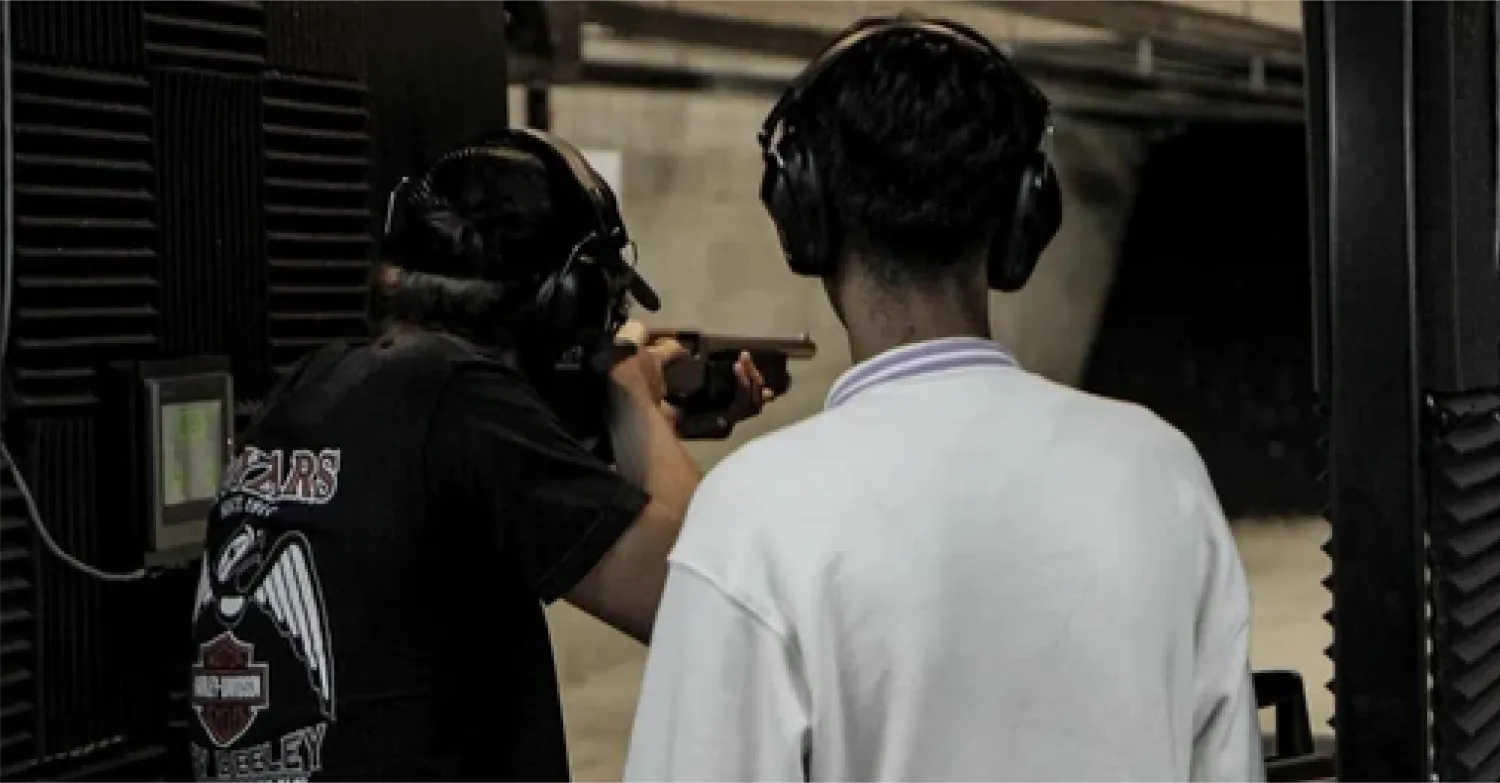
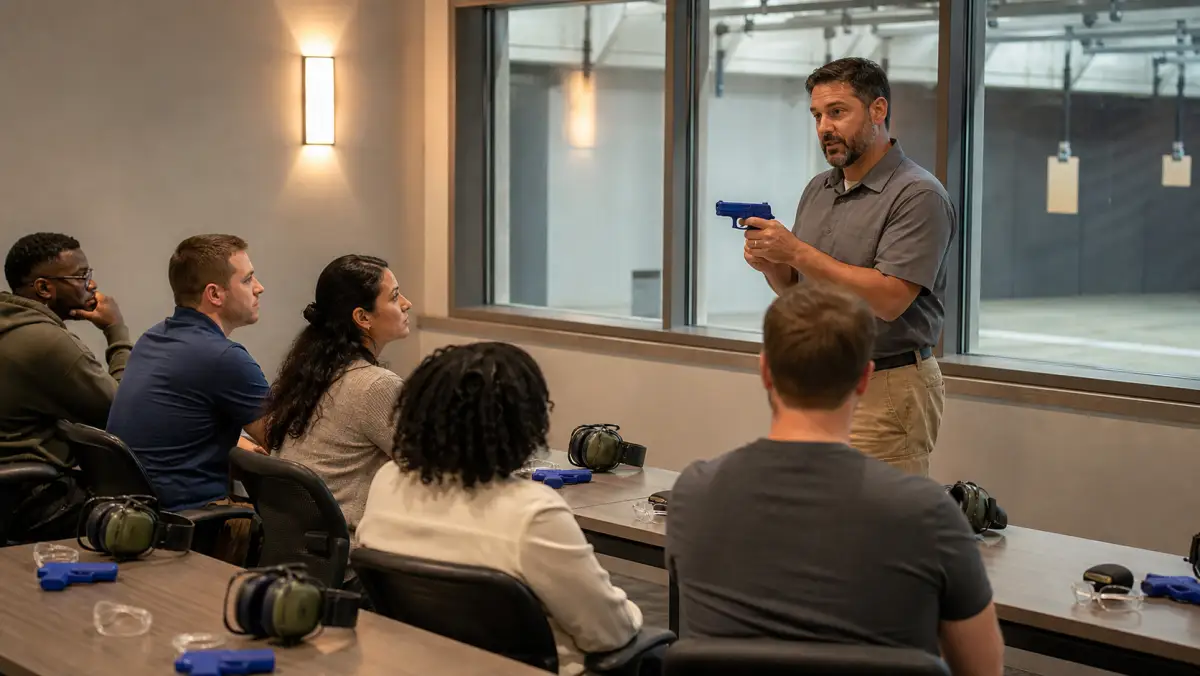
A beginner firearms safety class should replace uncertainty with a clear, supervised process. Students learn the safety rules, understand how a well-run range operates, become familiar with model-specific controls, discuss secure storage, and practice responding calmly to instructor commands. Depending on the course, the day may include classroom discussion, inert training equipment, supervised handling, and live fire.
For students in Detroit, Lincoln Park, Dearborn, Allen Park, Southgate, Taylor, and throughout Metro Detroit, the right class is not necessarily the fastest or the one with the most dramatic advertising. It is the course designed for your current experience, with transparent objectives, qualified instruction, a manageable student-to-instructor ratio, and a safe next step after completion.
This guide explains what to expect before, during, and after a beginner firearms safety class in Michigan.
Beginner firearms safety class: the day at a glance
Course formats vary, but this sequence is common.
| Stage | What may happen | What the student should verify |
|---|---|---|
| Registration | Experience, goals, eligibility, and accessibility questions | Course level, prerequisites, cancellation terms, total price |
| Preparation | Equipment list, clothing guidance, waiver, and arrival instructions | Whether firearms, ammunition, protection, or rentals are provided |
| Classroom | Safety rules, terminology, storage, range commands, and legal-resource overview | Topics, instructor credentials, time for questions |
| Demonstration | Instructor models safe handling and explains equipment | Exact firearm or training device being used |
| Supervised practice | Students rehearse safe behaviors under direct observation | Instructor ratio and correction process |
| Range orientation | Live-fire boundaries, protection, lane rules, and emergency commands | What must be demonstrated before entering the lane |
| Live fire, if included | Deliberate supervised shooting focused on safety and fundamentals | Ammunition, rental, target, and lane policies |
| Assessment | Instructor observes safety knowledge or performance | Passing criteria and remediation options |
| Completion | Certificate or record may be provided | What the document does—and does not—represent |
| Follow-up | Practice plan, next course, or private instruction | Specific skills to reinforce and when to return |
A strong introductory course should make each transition explicit. Students should never wonder whether they are permitted to handle equipment, load, enter the range, or begin an exercise.
What a beginner class is designed to accomplish
The primary goal of a beginner firearms safety class is not speed, accuracy, or a high round count. It is safe, repeatable behavior. A strong course teaches students how to control attention, follow a handling sequence, recognize uncertainty, and request help before a small question becomes a serious problem.
The course may introduce:
- Universal firearm safety rules.
- Safe direction and trigger-finger discipline.
- Common firearm and ammunition terminology.
- The difference between orientation and independent competence.
- Model-specific controls and manufacturer documentation.
- Range check-in, boundaries, commands, and cease-fire procedures.
- Eye and hearing protection.
- Secure storage and prevention of unauthorized access.
- Transportation-planning questions and authoritative resources.
- Basic inspection, maintenance, and conditions that require professional service.
- A deliberate practice plan after class.
One course cannot make a student competent in every firearm, range, legal context, or defensive scenario. The instructor should explain the course boundaries rather than implying that a certificate creates universal expertise.
The strongest beginner course gives the student a safer foundation and an honest understanding of what they still need to learn.
A general safety class is not automatically a Michigan CPL class
Course labels matter when selecting a beginner firearms safety class. “Basic pistol,” “firearm orientation,” “first shots,” “introductory safety,” and “CPL training” may describe different objectives, time commitments, legal content, and qualification requirements.
Michigan State Police explains that a CPL applicant must complete an appropriate pistol safety training course or class and meet other statutory requirements. Review the current Michigan CPL requirements before registering. A provider should state clearly whether a course is intended to satisfy those training requirements.
Do not assume that any introductory safety-course certificate can be submitted with a CPL application. Conversely, do not assume that a licensing-focused course is the ideal first contact with a firearm. A complete beginner may benefit from a foundational class before attempting a longer course with legal education and live-fire expectations.
Ask the provider:
- Is this a general safety class, a fundamentals class, or a Michigan CPL course?
- What prior experience is expected?
- Does the certificate serve a licensing purpose?
- What happens if a student cannot meet a safety requirement?
- Which class should a person with no handling experience take first?
A transparent answer protects the student’s time, money, and confidence.
How to choose the right course level
Choosing a beginner firearms safety class begins with an honest description of your experience. “I have watched others shoot” is different from “I can independently handle this exact firearm safely.” Owning a firearm does not automatically place someone beyond beginner instruction.
A foundational class is usually appropriate when a student:
- Has never handled a firearm.
- Has only informal experience with friends or relatives.
- Purchased or inherited an unfamiliar firearm.
- Has not practiced in many years.
- Feels uncertain about loading status, controls, storage, or range procedure.
- Wants professional feedback before practicing alone.
- Plans to take a Michigan CPL course but wants a foundation first.
Ask whether the provider offers private instruction when a group environment would be difficult because of anxiety, mobility, hearing, vision, language, learning style, or a specific equipment concern. Accessibility is not a reason to skip safety instruction; it is a reason to plan it correctly.
Range 313’s firearms training courses cover different experience levels. Contact the team before registering if you are unsure where to begin.
What to check before registration
A professional course description should answer more than “Beginners welcome.” Look for the learning objectives, duration, location, classroom and range format, prerequisites, age policies, equipment list, ammunition requirements, instructor information, total cost, and cancellation terms.
Before paying for a beginner firearms safety class, ask:
- How many students are permitted?
- How many instructors or range staff will supervise live fire?
- Is the course classroom-only or does it include live fire?
- Are firearms, inert training devices, ammunition, targets, and protection provided?
- May students bring personal firearms, and how must they arrive?
- Are rentals available to students who do not own equipment?
- What physical activities are required?
- Are breaks included?
- What accessibility arrangements can be made?
- What are the passing or completion criteria?
- Can a student repeat or receive remediation if more help is needed?
Get material promises in writing. If live fire, ammunition, or a rental is presented as included, the registration terms should say so.
The right course makes expectations clear before class day.
What a qualified instructor should provide
The instructor in an introductory course should have relevant credentials, but a title alone does not prove teaching quality. They should be able to explain their certification, experience, curriculum, insurance or facility relationship, and the limits of the course.
During class, look for an instructor who:
- Models the same safety behavior expected from students.
- Uses clear language and defines unfamiliar terms.
- Demonstrates one process at a time.
- Watches every student during supervised handling.
- Corrects unsafe behavior immediately and specifically.
- Provides an alternative when a student is not ready to continue.
- Separates legal education from individualized legal advice.
- Refers equipment problems to qualified service.
- Encourages questions without weakening firm safety boundaries.
A foundational safety course should not depend on humiliation, bravado, political commentary, or fear-based sales pressure. Direct corrections are appropriate around firearms; disrespect and distraction are not.
Instructor-to-student ratio matters most during hands-on work and live fire. A large classroom lecture may be manageable, but every student handling equipment needs meaningful observation.
What to do before class day
Before a beginner firearms safety class, read the registration email and course policy completely. Add the start time, arrival time, address, parking instructions, and provider phone number to your calendar. Plan enough travel time that Detroit-area traffic or construction does not turn arrival into a rush.
If the course permits a personal firearm, follow the provider’s exact transportation and check-in instructions. Do not bring a firearm or ammunition merely because you own them. Some courses prohibit personal equipment during the first portion or require all firearms to remain cased until staff accept them at a designated location.
Complete any assigned reading. If you will use a specific firearm, read the current manufacturer manual for that exact model and generation. Write down questions instead of experimenting at home.
Get adequate sleep, eat beforehand, and arrive completely free from alcohol, cannabis, illegal drugs, or impairing medication effects. Contact a qualified medical professional when medication may affect alertness, balance, coordination, or judgment.
A prepared student can focus on learning rather than solving preventable logistical problems.
What to wear and bring
Follow the provider’s equipment list. Common items include:
- Current government-issued photo identification.
- Closed-toe shoes with stable soles.
- A crew-neck or high-neck shirt.
- Comfortable clothing that permits normal movement.
- A billed cap if recommended.
- Prescription glasses or other necessary personal aids.
- Note-taking materials.
- Water and food for designated clean areas.
- Eye and hearing protection when not supplied.
- The exact firearm, case, ammunition, or magazines only when expressly required.
Avoid low necklines, loose scarves, dangling jewelry, open shoes, or clothing that could interfere with protection. Hot brass can create a sudden distraction, and safe clothing reduces the chance that a student reacts unpredictably.
If the course includes live fire, ask whether the range recommends earplugs beneath earmuffs. CDC/NIOSH’s current hearing-protection guidance explains that protection must be selected correctly, fit well, and be used consistently; it also discusses double protection for impulse noise.
Do not assume ordinary headphones or consumer noise-canceling devices qualify as hearing protection.
Check-in and introductions
At a beginner firearms safety class, expect to sign a waiver or acknowledgment, show identification, confirm payment, and review emergency or facility procedures. Read documents rather than treating them as an obstacle between you and the class.
The instructor may ask students to describe their experience and goals. Answer honestly without turning introductions into stories about equipment or past accomplishments. Your response helps the instructor identify who needs additional attention.
Tell the instructor privately about a relevant accessibility concern, previous distressing experience, injury, hearing limitation, visual limitation, or equipment issue. They cannot plan around information they do not have.
At a well-run class, staff should also explain:
- Which areas are classrooms, clean areas, and live-fire spaces.
- Whether personal firearms or ammunition are permitted in the classroom.
- Where personal belongings belong.
- When protective equipment must be worn.
- How breaks and restrooms work.
- What command immediately stops an exercise.
- How to request individual assistance.
These boundaries reduce ambiguity before any equipment appears.
The classroom portion
Classroom time in an introductory course should create the mental framework for supervised practice. Expect explanation, demonstration, questions, and checks for understanding rather than a long sales presentation.
The classroom portion may cover:
Universal safety rules
Students should learn to treat every firearm as loaded, keep it pointed in the safest available direction, keep the finger outside the trigger guard unless intending to fire, and know the target and what is around and beyond it.
ATF’s current firearms handling and storage guidance reinforces treating firearms as loaded, safe muzzle direction, trigger discipline, protection, secure storage, and compliance with applicable law.
The rules work together. Seeing an empty chamber does not make unsafe muzzle direction acceptable.
Terminology and firearm types
The instructor may identify common parts and categories so students can understand directions. The goal is not to memorize every design. It is to use accurate language and recognize that controls and procedures differ by model.
No student should assume that familiarity with one pistol, rifle, or shotgun transfers automatically to another.
Ammunition compatibility
Students should learn to consult the manufacturer manual and markings, keep ammunition identified, and ask qualified staff when uncertain. Similar-looking cartridges are not proof of compatibility.
The class should also explain that range ammunition policies can be stricter than manufacturer allowances because of the facility’s backstop, ventilation, and operating rules.
Secure storage and unauthorized access
Storage belongs in beginner education. The instructor may compare locking devices, lockboxes, safes, cabinets, key control, and household access planning. Legal requirements and risk vary, so the class should direct students to current Michigan sources rather than offer a one-sentence legal conclusion for every home.
Our firearm safety basics for Michigan owners explains secure storage, household planning, transportation, maintenance, crisis preparation, and records in greater depth.
Transportation and legal resources
A general class can identify the questions students must research, but it should not give individualized legal advice unless the instructor is qualified to do so. Firearm type, licensing, route, destination, and other facts can matter.
Good instruction distinguishes “This is our range policy” from “This is Michigan law” and “This is not legal advice.”
Supervised handling before live fire
A foundational class may use inert training aids, unloaded firearms in a controlled environment, or another approved method before live fire. Students may practice safe direction, trigger-finger placement, identifying controls, and responding to commands.
The instructor should control when equipment may be touched. If they say “Do not handle,” leave it alone even if another student begins. If you miss a step, stop and ask instead of copying the person beside you.
The course should not turn supervised practice into a race. Students learn at different speeds. The instructor may pause, reset the exercise, reduce complexity, or provide individual remediation.
Expect correction. A useful correction identifies the behavior, explains the safer action, and confirms that the student can repeat it. Do not argue that a firearm is unloaded or that a different range allows the behavior.
If a student repeatedly cannot maintain safe direction or trigger discipline, the correct outcome may be more instruction before progressing. That is responsible course management, not punishment.
Range orientation before live fire
Before the live-fire portion of a beginner firearms safety class, expect a separate orientation at the range boundary. Protection should be in place before entering the live-fire area and should remain on until staff identify a safe removal point.
The orientation may cover:
- How to enter and leave the lane.
- Where cases and personal items belong.
- Which direction is downrange.
- How the target carrier works.
- Which targets and distances are approved.
- How firearms may arrive at and leave the bench.
- Commands for starting, stopping, and requesting help.
- What to do when equipment behaves unexpectedly.
- Which actions or ammunition are prohibited.
Michigan DNR’s shooting range rules provide a public example of formal range discipline, including cased entry, safe direction, approved firing stations, protection, and immediate compliance with range commands. A private facility has its own rules, and those posted rules control the class visit.
Students should never have to infer range procedure from observation.
What live fire should feel like
Live fire in a beginner firearms safety class should be controlled, deliberate, and limited to what students can perform safely. The objective is not to use as much ammunition as possible or reproduce a fast drill seen online.
The instructor may organize students individually or in small relays. Expect clear commands, close supervision, and pauses for feedback. Students should know who is authorized to handle equipment and when.
You may feel startled by the sound and concussion even with proper hearing protection. That response is not a failure. Maintain safe direction, keep your finger indexed, listen to the instructor, and take a break if attention or physical comfort declines.
During instruction, target results are secondary to safe behavior. A small group is useful only when the process producing it is controlled and repeatable.
If a firearm sounds, feels, or behaves unexpectedly, stop. Keep it oriented safely and request instructor assistance. Do not turn around with it, look into the muzzle, improvise a repair, or fire another round to test the problem.
Eye protection, hearing protection, and hygiene
A live-fire course needs clear eye and hearing protection rules. The instructor should explain fit, range boundaries, and why protection remains on during quiet moments.
Ask for help if earmuffs interfere with glasses or if earplugs do not fit. Protection that is worn incorrectly may provide less benefit than the label suggests. Replace damaged equipment rather than trying to complete the class with a broken seal, lens, or strap.
Indoor-range hygiene also matters. Do not eat, drink, smoke, or touch the face on the firing line. Wash hands, forearms, and face before eating after class. Keep range bags and shoes away from food-preparation and children’s areas when returning home.
Our eye and ear protection guide provides a longer comparison of common protection choices and fit considerations.
A professional program should address both immediate handling risk and the range environment.
How instructors should handle mistakes
Direct correction is normal and necessary. Around firearms, an instructor may use a firm voice because a safety issue must stop immediately. The quality of instruction becomes clear in what happens next.
The instructor should explain the specific behavior, demonstrate the correct alternative when appropriate, observe the student repeating it, and decide whether progression is safe. They should not shame a person for asking a question or use ridicule as the main teaching method.
Students also have responsibilities:
- Stop immediately when directed.
- Keep attention on the equipment and instructor.
- Acknowledge the correction without arguing.
- Ask for clarification before resuming.
- Tell the instructor when fatigue, pain, anxiety, or confusion affects performance.
- Accept a pause or remediation plan.
The class is successful when students learn how to respond to correction calmly—not when no one ever needs correction.
Testing, assessment, and certificates
Some courses use a written quiz, observed handling assessment, live-fire standard, or combination. The provider should explain the criteria before testing and describe what happens if a student does not meet them.
A certificate may document completion of that provider’s course. Its legal or licensing value depends on the curriculum, instructor qualifications, governing requirements, date, and other facts. It does not certify competence with every firearm or remove the need for continued training.
Keep the certificate and course record secure. Record the date, instructor, topics, equipment used, and feedback. If the document is intended for a Michigan process, verify that all required information is present before leaving.
The best beginner firearms safety class makes the meaning and limits of its certificate explicit.
Understanding the complete cost
The advertised tuition may not be the full expense. Before registering, calculate:
- Course tuition and tax.
- Range or lane fees.
- Rental firearm charges.
- Required rental ammunition.
- Targets.
- Eye and hearing protection.
- Classroom materials.
- Certification or administrative fees.
- Parking, food, and travel.
- Rescheduling or cancellation charges.
A higher tuition may be better value when it includes a small class, equipment, protection, range time, and meaningful follow-up. A low tuition may be appropriate when students already own every required item.
Ask for a written total based on your situation. If you do not own a firearm, say so. If you need rental protection, ask. If the class requires ammunition, confirm the quantity, type, source, and price without guessing.
A transparent course helps students budget before the cancellation deadline.
Red flags when evaluating a provider
Pause before registering when:
- The course level and prerequisites are vague.
- Live fire is advertised but instructor ratios are not explained.
- Students are told to bring firearms without clear transport and check-in instructions.
- The provider guarantees a license or legal outcome.
- Instructor credentials cannot be described.
- Safety questions are dismissed as signs of weakness.
- The course promises mastery in a few hours.
- Hidden fees appear after payment.
- Personal equipment is recommended before fit or purpose is discussed.
- Political discussion, intimidation, or sales pressure dominates the curriculum.
- There is no plan for a student who needs more help.
- Range rules or protective-equipment requirements are treated casually.
The right program should welcome scrutiny. A responsible provider wants students to understand what they are buying and whether it matches their current ability.
What to do after the class
Completion should lead to a modest, specific practice plan—not immediate escalation to complex drills or equipment purchases.
Within 24 hours, write down:
- The safety habits the instructor corrected.
- The model or training device used.
- Questions that remain unresolved.
- Storage or protection changes needed at home.
- The next recommended class or supervised practice goal.
Within the next few weeks, review the manual and course notes, improve storage, and schedule a short supervised practice session. Range 313’s indoor pistol and rifle range offers staff support and rentals subject to current policies.
Use our Michigan beginner firearm-training roadmap to organize the next 90 days. Focus on correct repetitions and return to an instructor when the same problem continues.
A beginner firearms safety class is the start of responsible learning, not the final step.
What Range 313 students can expect
Range 313 offers firearms training in Lincoln Park for different experience levels, along with indoor pistol and rifle lanes, rentals, retail equipment, secure-storage options, FFL transfers, cleaning, inspection, repair, and gunsmithing support.
Prospective students from Detroit, Dearborn, Allen Park, Southgate, Taylor, Wyandotte, and throughout Downriver can contact the team to discuss current course schedules, prerequisites, equipment, pricing, and whether a class includes live fire.
Call (313) 436-0197 before registering when you have no prior experience, need a rental, have an accessibility concern, or are uncertain whether a general beginner class or a Michigan CPL course matches your goal.
Range 313’s role is to help students choose an appropriate starting point and build a responsible next step—not to promise that one course completes firearm education.
Arrive ready to learn, not ready to prove yourself
A beginner firearms safety class should feel structured, patient, and serious. Expect clear boundaries, direct correction, questions, supervised practice, and an emphasis on behaviors rather than bravado. If live fire is included, it should reinforce the classroom foundation instead of becoming a race for speed or ammunition count.
Choose a provider that states what the class covers, who teaches it, what it costs, what students must bring, and what the certificate means. Arrive rested, disclose your experience honestly, follow every command, and leave with a specific practice and storage plan.
The most valuable result of a beginner firearms safety class is not a paper certificate. It is a safer decision-making process that continues after class day.