Range practice can help you become a more confident shooter when each visit turns an unknown into something you can safely observe, repeat, and discuss with a qualified instructor. Confidence should not mean feeling fearless, shooting quickly, or filling the center of one target. It should mean knowing the range procedure, operating familiar equipment as taught, recognizing your current limits, responding correctly when uncertain, and using evidence to choose the next step.
That distinction matters for beginners in Lincoln Park, Detroit, Dearborn, Allen Park, Southgate, Taylor, Wyandotte, and across Metro Detroit. A busy indoor range can initially feel unfamiliar: check-in rules, protective equipment, commands, noise, firearm controls, targets, and other shooters all compete for attention. A structured progression makes each part more predictable without pretending that familiarity equals mastery.
This guide explains how supervised range practice can build calibrated confidence, which signs show real progress, why some common approaches create false confidence, and how to plan six weeks of purposeful practice.
Confident shooter versus overconfident shooter
| Situation | Calibrated confidence | Overconfidence |
|---|---|---|
| Range commands | Stops immediately, listens, and follows the facility’s procedure | Assumes experience overrides the current range’s command |
| Unfamiliar firearm | Requests model-specific orientation | Copies another model’s procedure from memory |
| Poor target | Checks conditions and asks for feedback | Blames equipment or adds speed without diagnosis |
| Good target | Records the conditions and tests retention later | Treats one result as proof of permanent skill |
| Stoppage or uncertainty | Maintains safe direction, removes the trigger finger, and signals staff | Experiments with a procedure not taught or authorized |
| Fatigue or distress | Pauses or ends the session | Continues to prove toughness or recover sunk cost |
| Correction | Listens, asks a focused question, and applies one change | Resists feedback because it conflicts with self-image |
| New activity | Verifies training, law, equipment, and facility rules | Assumes one familiar skill transfers automatically |
The most useful confidence statement includes conditions: “I can complete this familiar range procedure safely with this equipment under these rules, and I know when to ask for help.” It does not make a broad claim about every firearm or setting.
Why confidence should be calibrated to performance
Confidence affects attention, decision-making, and willingness to act. Too little can make a beginner hesitant to ask questions, physically tense, or overwhelmed by ordinary procedures. Too much can cause rushing, skipped checks, resistance to correction, or practice beyond the shooter’s current preparation.
The responsible middle is calibrated confidence: the person’s belief about their ability roughly matches what they can demonstrate under defined conditions.
To become a more confident shooter, build that match from documented behavior rather than trying to manufacture a confident feeling before the evidence exists.
Research outside firearm training helps explain the idea, although it should not be converted into a shooting prescription. A randomized study of medical interns found that performance and information feedback improved the relationship between confidence and diagnostic accuracy. The peer-reviewed confidence-calibration study indexed by PubMed involved reading medical images, not operating firearms. Its relevant general lesson is narrower: accurate feedback can help learners compare what they believe with what they actually demonstrate.
At a range, that comparison should rely on observable safety behavior, repeatable conditions, instructor observations, and records across sessions. Emotion is information—anxiety and comfort both matter—but neither is sufficient evidence by itself.
How a controlled range reduces uncertainty
A responsible indoor range organizes live fire around a known direction, assigned lane, target system, protective-equipment requirements, commands, staff oversight, and written rules. For a new shooter, this structure removes many variables.
The first visit may still feel intense. Noise arrives suddenly. Hot cartridge cases, unfamiliar controls, and the presence of other shooters can divide attention. Range practice builds confidence when the environment and procedure become familiar enough that the student can devote more attention to one instructed task while keeping the safety foundation intact.
This is why orientation matters even for visitors who have used another facility. The current range’s rules control the current visit. Michigan DNR’s published shooting range rules , for example, establish specific commands and conduct for DNR ranges; a private indoor range has its own procedures, which may differ or be stricter.
Predictability does not remove risk. It creates a clearer framework for managing it.
Seven ways range practice builds responsible confidence
Each of the following uses observable behavior and qualified feedback to help you become a more confident shooter without confusing familiarity with mastery.
1. Procedures become familiar
Uncertainty consumes attention. During a first visit, a beginner may be trying to remember where equipment belongs, when a target may move, how to respond to a cease-fire, and what to do if the firearm does not operate as expected.
Repeated visits under the same rules can make those procedures easier to recall. The value is not mindless automaticity. It is enough familiarity to respond deliberately without improvising.
ATF’s current firearms handling and storage guidance states core expectations including treating every firearm as loaded, maintaining a safe muzzle direction, keeping the finger outside the trigger guard until intending to fire, and wearing eye and ear protection. A developing shooter should demonstrate those behaviors consistently regardless of the target result.
2. Equipment becomes less mysterious
Model-specific instruction and supervised repetition help a visitor understand the controls, sight system, loading and unloading procedure, and normal operation of one familiar firearm. That knowledge can reduce hesitation without encouraging assumptions about unfamiliar equipment.
The qualification “one familiar firearm” is important. Control location, operating system, chambering, sights, grip dimensions, and maintenance requirements vary. Confidence with one model should make the shooter more willing—not less willing—to request orientation for another.
If equipment is rented, confirm current availability and use only the ammunition supplied or approved by the facility. If anything looks damaged or behaves unexpectedly, stop and notify staff.
3. Qualified feedback separates feeling from behavior
A shooter cannot see every element of their own performance. They may believe the grip changed when the actual issue was visual focus, pace, fatigue, or anticipation. They may feel safe while allowing the trigger finger or muzzle to drift at a transition.
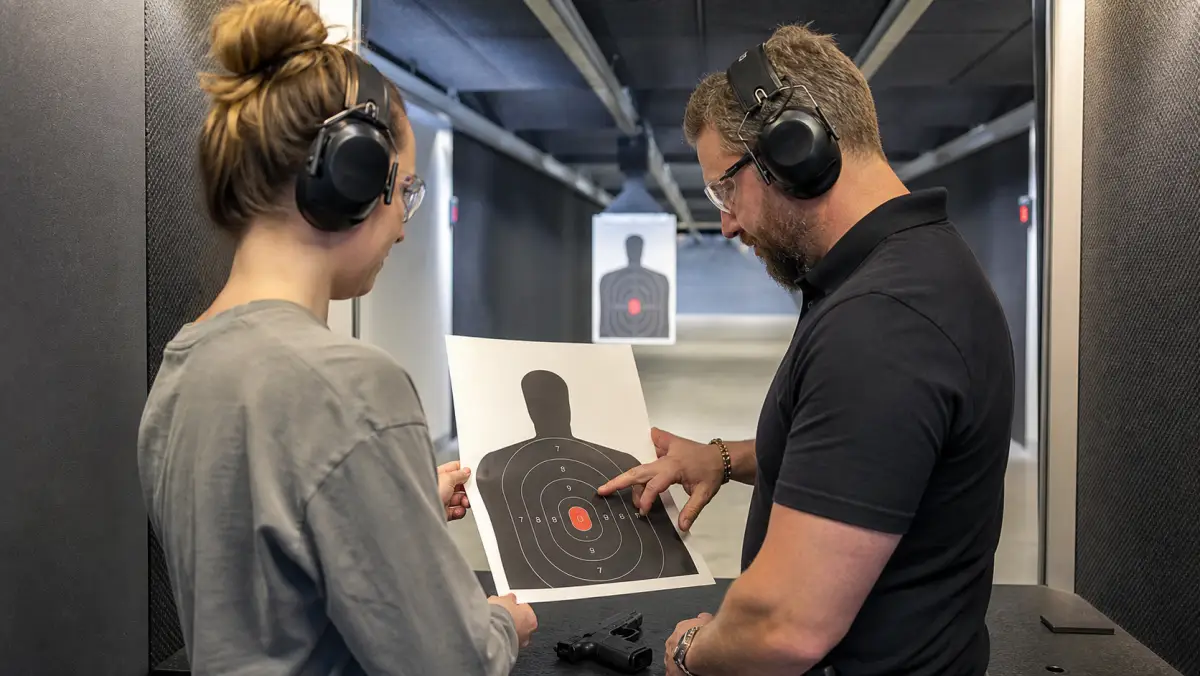
Direct observation from a qualified instructor provides an external check. One clear correction is more useful than a stream of unrelated tips from friends or social media.
A randomized motor-learning study involving an underhand ball toss found better retention for participants who could request performance feedback compared with several other feedback schedules. The study indexed by PubMed was not about shooting and does not establish how often a firearms student should receive feedback. It supports a modest idea: feedback is part of learning, and learners benefit from engaging with it rather than receiving unexplained scores.
At the range, ask specific questions: “Did I follow the loading sequence consistently?” “What changed in my grip?” “Which one issue should I address first?”
4. A baseline turns improvement into evidence
A baseline is a small, repeatable test completed under documented conditions. It might include consistent response to commands, the same approved target and distance, a limited number of deliberate repetitions, and one instructor-observed behavior.
The baseline does not need to be difficult. In fact, an advanced or dramatic task is a poor baseline for a beginner because it mixes too many variables. The purpose is to create a reference that can be repeated after time has passed.
Record:
- Date and facility.
- Firearm and sight configuration.
- Facility-approved ammunition.
- Target and distance.
- Number and pace of repetitions.
- Safety-procedure consistency.
- Instructor cue and observation.
- Fatigue, pain, or attention changes.
- Equipment issues.
- One next action.
If the later result improves under the same conditions while safety behavior remains stable, confidence has evidence behind it. If the result declines, the log helps identify what changed.
5. Small goals make uncertainty manageable
“Get better at shooting” is too broad to guide one session. A focused goal narrows attention and makes success observable.
Beginner goals might include following the range’s bench procedure without missing a step, establishing the same instructor-approved grip before each repetition, seeing the prescribed sight picture, or completing an unloading sequence with direct supervision.
Do not combine safety-critical behaviors with a demand for speed. Speed is not a confidence shortcut. It adds pressure and can hide inconsistency.
The detailed pistol training fundamentals guide explains how to organize a focused practice session around safe handling, grip, sights, controlled trigger movement, notes, and follow-up.
6. Separate sessions show what was retained
Performance often improves during one session simply because the task is fresh and feedback is immediate. Confidence becomes more credible when the person can return after an interval and reproduce the safe process without relearning every step.
That does not require an aggressive schedule. The appropriate frequency depends on experience, purpose, budget, health, coaching, equipment, and results. Our guide to how often you should practice at the range gives planning ranges for beginners, developing recreational shooters, returning shooters, and people learning new equipment.
Retention checks should use ordinary conditions. Do not make every return visit harder just to keep it interesting. First establish that the baseline remains stable.
7. Knowing when to stop becomes a skill
One of the clearest signs of responsible confidence is the ability to interrupt a session. Stop when safe behavior becomes inconsistent, concentration falls, protective equipment shifts, pain develops, emotions escalate, a repeated problem is not understood, or equipment may be damaged.
Maintaining safe direction, removing the finger from the trigger, and signaling staff when something is uncertain is not failure. It is the correct response.
A shooter who knows their limits can make better decisions than someone who continues through confusion. Range practice should make the stop-and-ask response more familiar.
An eight-step plan to become a more confident shooter
This six-week framework is a review cycle, not a promise of mastery. Some people will need more instruction, more rest, or a longer interval. Complete only activities authorized by the facility and appropriate to your experience.
Step 1: Establish a safety and procedure baseline
Begin with a qualified instructor. Ask them to assess response to range commands, safe direction, trigger-finger placement, eye and hearing protection, equipment handling, loading and unloading procedure, and what the student does when uncertain.
The baseline should reveal both strengths and gaps. Do not ask for a flattering score. Ask for an accurate starting point.
Range orientation and a class serve different purposes. Orientation explains facility procedures; instruction teaches and assesses skills. A complete beginner or returning shooter may need both. Range 313 lists firearms courses for multiple experience levels , and staff can explain which current option fits the visitor’s background.
Step 2: Choose one observable goal
Write the goal before purchasing lane time or ammunition:
“During this session, I will ______, and the instructor or my record will show it by ______.”
Good goals describe a behavior or result under set conditions. Weak goals describe an emotion, social comparison, or volume. “I will feel confident,” “I will beat my friend,” and “I will fire 200 rounds” do not define learning.
Step 3: Practice under stable conditions
Keep the firearm, approved ammunition, target, distance, pace, and primary instruction cue consistent enough to interpret the result. Changing equipment may be appropriate later, but it prevents a clean baseline now.
Use short sets with pauses. Check that protective equipment remains correctly fitted and attention remains stable. End before fatigue changes the procedure.
NIOSH’s guidance on lead and noise at indoor firing ranges discusses the hazards of impulse noise and lead exposure, as well as double hearing protection and hygiene. Follow facility requirements, fit protection correctly, keep food and drinks out of prohibited areas, and wash exposed skin after the session.
Step 4: Request qualified feedback
Ask for one correction based on direct observation. Restate it in your own words so the instructor can correct any misunderstanding. Then repeat only when authorized and only if the safe procedure is clear.
Feedback should identify the behavior, not attack the person. “Your finger entered the guard too early” is actionable. “You are bad at this” is not.
If the same issue persists after one correction, reduce the task or stop. Repetition is not automatically improvement.
Step 5: Record evidence after the session
Complete the log while the details are fresh. Record ordinary results, not only the best target. Note uncertainty, corrections, equipment changes, fatigue, and any safety interruption.
End with two statements:
- “Evidence that improved today was ______.”
- “Before I do more, I need ______.”
Those sentences connect confidence to proof and limits.
Step 6: Retest after an interval
During a later visit, repeat the baseline before adding anything new. Use the same conditions when practical and ask whether the safe procedure and measured result were retained.
One lower result is not a crisis. Sleep, health, stress, equipment, ammunition, vision, and normal variation can affect performance. Look for patterns across sessions and ask for qualified interpretation.
Step 7: Add complexity only after consistency
When the baseline is stable, an instructor may change one approved variable: target distance, pacing, equipment, or another element appropriate to the class and facility. The specific progression depends on the lawful purpose and student.
Do not introduce movement, holster work, rapid fire, low-light conditions, or any other specialized activity unless the facility permits it and qualified instruction establishes readiness. Familiarity with basic lane practice is not blanket permission.
The good shooting habits framework explains how to add complexity only after a safe behavior remains consistent and how to interrupt errors before they become familiar.
Step 8: State limits and plan the next step
At the six-week review, write three lists:
- Procedures you can demonstrate safely and consistently under the tested conditions.
- Procedures that still require direct supervision or correction.
- Activities you have not been trained or authorized to perform.
Then choose the next appropriate action: another focused session, a beginner or intermediate class, private coaching, equipment inspection, vision or hearing support, secure-storage review, or a rest period.
A person who can state those limits honestly is closer to the goal than someone who makes a broad claim of mastery.
What to measure besides target accuracy
Paper targets provide useful information, but confidence should also reflect the process that created them.
Track these categories:
| Category | Observable measure |
|---|---|
| Safety | Safe direction and trigger-finger discipline remain consistent throughout handling |
| Commands | Cease-fire and staff instructions receive immediate, correct responses |
| Procedure | Loading, unloading, bench, and departure steps follow the taught sequence |
| Equipment | Protective equipment stays correctly fitted; abnormal behavior is reported |
| Attention | Pace and decision quality remain stable without rushing |
| Accuracy | Group or score is recorded under the same target, distance, and pace |
| Feedback | One correction is understood and applied without creating another safety issue |
| Judgment | The shooter stops when tired, confused, distressed, or uncertain |
| Retention | The safe baseline can be reproduced during a later session |
Accuracy matters for many lawful shooting activities, but it is not permission to ignore process. A tight group produced while breaking a range rule is not a successful session.
Why more rounds do not guarantee more confidence
Round count is easy to measure, which makes it tempting. It says how much ammunition was used, not what was learned.
High volume can create several problems:
- Fatigue changes grip and attention.
- Repeated errors become more familiar.
- Target results blur together.
- The shooter delays asking for help.
- Cost creates pressure to continue.
- Noise exposure and lead hygiene require ongoing attention.
A short session that answers one question may produce more genuine confidence than a long session that introduces five new problems. Stop when the planned learning outcome is complete or when the quality of attention declines.
Common confidence traps at the range
Using speed as proof
Speed can make a familiar task look fluent while hiding skipped steps. Beginners should not add time pressure unless an instructor deliberately introduces it after a stable safety baseline.
Chasing the best target
One unusually good group may be ordinary variation. Compare several small samples under the same conditions and retest later.
Changing equipment constantly
New firearms, optics, ammunition, and accessories create new variables. Stable equipment makes learning easier to interpret. Obtain model-specific instruction after changes.
Practicing only with friends
Supportive friends can make a visit enjoyable, but friendship does not establish instructional qualification. Peer advice may be contradictory or based on different equipment and goals.
Comparing yourself with the next lane
You usually do not know another shooter’s experience, target distance, equipment, or objective. Social comparison can create false urgency. Compare your present baseline with your own documented prior baseline.
Hiding uncertainty
Some beginners fear that asking a basic question will make them look inexperienced. The opposite is true: clearly naming uncertainty is a responsible safety behavior.
Treating nervousness as failure
The indoor-range environment is intense. Nervousness can decrease with orientation, correct protective equipment, a slower pace, and qualified support. If distress remains high, stop; there is no obligation to continue that day.
Treating comfort as mastery
Feeling relaxed after several visits is pleasant, but it can also reduce attention. Keep using the same safety checks and remain receptive to correction.
When you need coaching instead of more practice
Schedule instruction when:
- Safe direction or trigger-finger discipline becomes inconsistent.
- Range commands are forgotten or misunderstood.
- A firearm or sight system is unfamiliar.
- A repeated target pattern is not responding to one simple correction.
- Pain, mobility, vision, or hearing needs affect the activity.
- The shooter cannot complete loading or unloading as taught.
- A long break has made procedures uncertain.
- Equipment has changed or may be malfunctioning.
- The next activity requires skills the shooter has not learned.
- Independent sessions create more confusion than clarity.
Coaching is not remedial punishment. It is an efficient way to obtain external observation and prevent a guessed correction from becoming a habit.
Build shooter confidence at Range 313 in Lincoln Park
Range 313 serves first-time visitors, students, recreational shooters, and firearm owners from Lincoln Park, Detroit, Dearborn, Allen Park, Melvindale, Southgate, Taylor, Wyandotte, and throughout Downriver and Metro Detroit.
The indoor facility offers pistol and rifle lanes, rentals, first-time shooter assistance, range orientation, basic instruction, and scheduled courses. Review the Range 313 indoor range information and call (313) 436-0197 before visiting to confirm current hours, lane availability, rental inventory, identification requirements, pricing, and the right level of instructor support.
Tell staff your real experience and one goal for the visit. A clear request such as “I want an instructor to assess my basic range procedure and help me choose one next objective” is more useful than “I just want to get better.”
Metro Detroit visitors who want to become a more confident shooter should treat each return visit as one step in a supervised progression, not as an obligation to add difficulty every time.
To become a more confident shooter, return with the same respect for the procedure each time. Confidence grows from repeated evidence, not from being treated as if questions are no longer allowed.
About the author
The Range 313 Team supports first-time range visitors, students, recreational shooters, rental customers, and firearm owners at an indoor range and retail facility in Lincoln Park, Michigan. This article combines recurring customer questions with current ATF, NIOSH, Michigan, and peer-reviewed learning resources. It provides general education, not legal advice, medical advice, or individualized firearms instruction. Policies, laws, equipment, and personal needs change; verify current details and work with qualified professionals.
The lasting lesson
The goal of range practice is not to erase every nervous feeling or create certainty where none exists. It is to make the responsible process clearer: follow the rules, operate familiar equipment as taught, work on one objective, accept feedback, measure ordinary performance, retest after time, and stop when the conditions are no longer right.
You become a more confident shooter when you can connect belief to evidence and confidence to limits. The strongest statement is not “I can handle anything.” It is “I know what I can demonstrate safely today, what I still need to learn, and who to ask before I go further.”