Completing a CPL class in Michigan is a meaningful milestone, but it is not the end of the licensing process and not the end of training. The certificate proves successful completion of a qualifying course. It does not issue a concealed pistol license, establish government approval, or authorize immediate concealed carry.
The next phase has three separate tracks:
- Preserve and use the training certificate correctly.
- Complete the official application process if eligible.
- Build the storage, legal-awareness, and practice habits that responsible carry requires.
This roadmap explains each track. It is general education rather than legal advice. Laws, fees, procedures, and individual eligibility can change. The current Michigan statutes, Michigan State Police, your county clerk, and qualified legal counsel should control.
Step 1: Review your completion certificate before leaving
The best time to fix a certificate error is while the provider and instructor records are immediately available. MCL 28.425j specifies the required certificate content, including a statement that the course complies with section 5j of 1927 PA 372, instructor information, and other details.
Before leaving class, verify:
- Your full legal name is spelled correctly.
- The completion date is correct.
- The instructor’s printed name and original signature appear as required.
- Required instructor contact and certification information is present.
- The statutory compliance statement appears.
Ask the provider to explain any field you do not understand. Do not alter the certificate yourself.
Store the original in a clean, secure location where it will not be folded, damaged, or lost. Avoid posting it to social media. The certificate contains personal and instructor information and is an application document, not a souvenir image.
Step 2: Remember the five-year training window
Michigan law currently says the qualifying pistol training must have been provided within the five years preceding the application date. That does not mean every student should wait five years. It means an older certificate can fall outside the statutory window.
If you postpone the application, recheck the law and official instructions before relying on the certificate. A change in personal eligibility, application procedure, or statute may matter even while the certificate remains within five years.
The full training requirements appear in MCL 28.425j in the official Firearms Laws of Michigan .
Step 3: Recheck eligibility using the official list
Training completion addresses only the training component. Michigan State Police publishes a detailed CPL requirements page covering age, citizenship or lawful admission, Michigan residency, identification, firearm-possession restrictions, criminal history, pending charges, court orders, mental-health-related provisions, and other conditions.
Read the complete current page. Do not use the fact that an instructor admitted you to class as evidence that the government will approve an application. Training providers generally do not have the authority or information to make that determination.
If your circumstances involve a conviction, pending case, protection order, immigration status, involuntary commitment, restoration of rights, or another legal issue, obtain guidance from the appropriate authority or qualified Michigan attorney. Do not guess on an official form or rely on another applicant’s outcome.
Step 4: Identify the correct county clerk
Michigan State Police currently instructs an applicant to file with the county clerk in the county where the applicant resides. That means the class location does not determine the filing office.
A student may take a CPL class at Range 313 in Lincoln Park and live elsewhere in Wayne County or another Michigan county. The county of residence controls the filing location. Confirm office hours, appointment rules, accepted payment methods, photograph procedures, and any local scheduling details on the official county clerk website or by calling the office.
Do not send sensitive personal information to a third-party directory or advertisement that merely looks official. Begin with the MSP instructions and the actual county-government site.
Step 5: Review the current application instructions
Michigan State Police provides a current CPL application and instructions page . It says application kits are available from county clerks and through the state firearms resources.
The current process described by MSP includes:
- Filing the application with the county clerk in the county of residence.
- Signing the application under oath before the clerk or representative.
- Including a certificate showing completion of the required pistol-safety training.
- Including a passport-quality photograph when the applicant does not have a digitized photograph on file with the Michigan Secretary of State.
- Paying applicable application and licensing fees.
- Having classifiable fingerprints taken through an authorized entity after filing and paying.
Procedures can change. Read the official page shortly before the appointment rather than relying on a checklist saved months earlier.
Step 6: Separate the class price from government costs
The fee paid to a training provider is not the government application fee. Ammunition, rentals, protective equipment, photographs, fingerprints, parking, replacement documents, and other costs may also be separate.
Create a simple budget with three categories:
| Category | Examples |
|---|---|
| Training provider | Course tuition, rental, ammunition, protection |
| Application | County-clerk fee, photograph if required |
| Processing and preparation | Fingerprints, document copies, transportation |
Confirm current amounts with the organization collecting each payment. Range 313’s $79.99 CPL class price includes a firearm rental and ammunition, but it does not include county, fingerprinting, or other government costs.
Step 7: Complete forms with exact information
Use your legal name consistently across the application, identification, certificate, fingerprinting documents, and any photograph submission. Read every question. If a question is unclear, ask the county clerk or appropriate legal adviser rather than guessing.
Do not omit information because it seems old or unimportant. Do not let a friend complete answers for you. The application is signed under oath, so accuracy matters.
Bring only the documents requested through current official instructions. Protect Social Security numbers, identification numbers, and other sensitive information. Keep receipts and copies where permitted and useful.
Step 8: Follow the fingerprinting sequence
The MSP instructions tie fingerprinting to the filed application and payment process. The current page explains that an applicant must have classifiable fingerprints taken by the county clerk, Michigan State Police, a sheriff’s office, local police agency, or another entity providing CPL fingerprinting services.
Follow the exact order provided by the clerk. Bring the required application receipt and identification. Keep the fingerprinting receipt because Michigan law assigns it specific information and potential significance.
Do not assume fingerprints taken for an employer, another license, immigration matter, or previous transaction can automatically substitute. Ask the county clerk what the CPL application requires.
Step 9: Do not treat the certificate as carry authority
This point deserves repetition: a class certificate is not a CPL. Successful training does not authorize concealed carry while you prepare an application or wait for a decision.
Continue following the possession and transportation rules that apply to your actual current status. Do not carry under CPL authority until a valid license has been issued and is in effect.
Michigan law contains specific provisions involving certain receipts and processing timelines, but those rules depend on exact facts and documents. Never generalize them from a social-media post. Read the current official application instructions and ask the issuing authority when timing matters.
Step 10: Use the waiting period productively
An application wait should not become a gap in safe practice. Use the time to build fundamentals in a controlled environment without acting as though the license already exists.
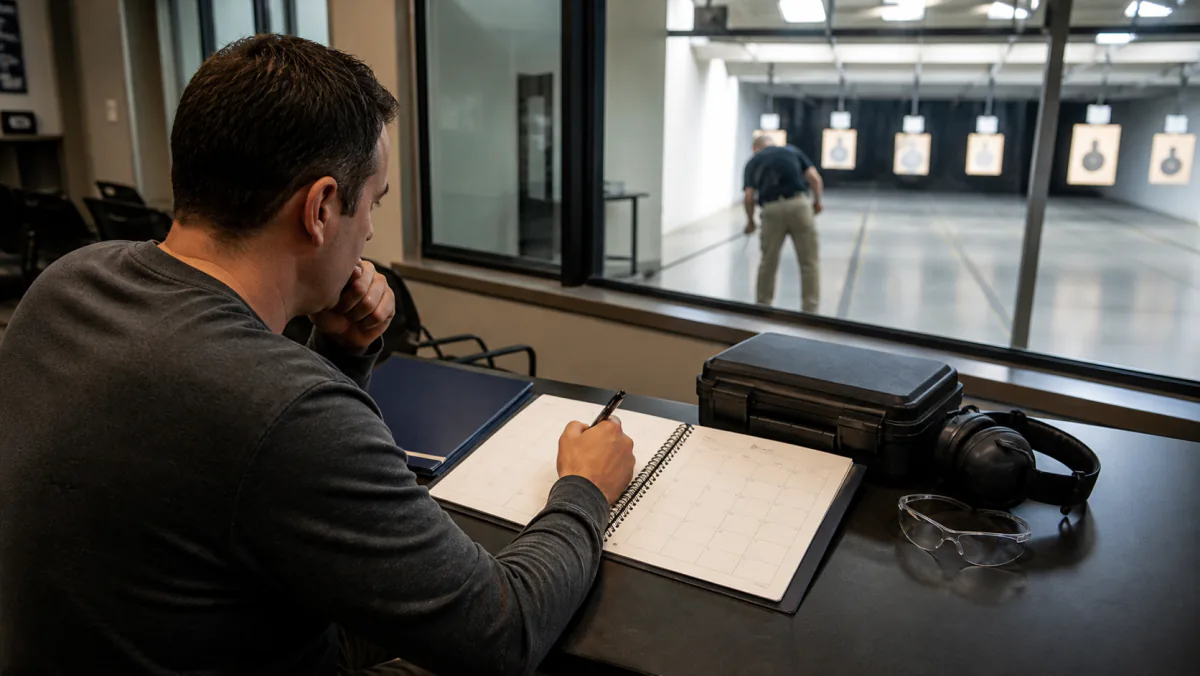
Create a simple practice notebook. Record:
- Date and location.
- Safety and skill goal.
- Ammunition used.
- Distance and target.
- Instructor feedback.
- What improved.
- What needs more work.
Early practice goals might include consistent safe handling under range rules, stable grip, sight management, smooth trigger control, accurate groups at manageable distances, and stopping correctly when something feels wrong.
Avoid inventing concealed-carry drills without qualified guidance. Drawing, movement, low-light work, use of cover, and decision scenarios require appropriate facilities, instruction, and policies. A public lane session is not permission to improvise advanced techniques.
Step 11: Build a secure-storage system
Storage should be planned before a firearm comes home, before a license arrives, and before a routine develops. Responsible storage protects against children, unauthorized adults, theft, impulsive access, and negligent handling.
Michigan’s secure-storage law took effect in 2024. The current Michigan Department of Health and Human Services secure-storage page explains that unattended weapons must be kept unloaded and locked with a locking device or stored in a locked box or container when it is reasonably known that a minor is likely to be present on the premises.
Read the full law and guidance for definitions, penalties, and vehicle considerations. Minimum legal compliance should not prevent a household from adopting stronger access controls.
Evaluate:
- Who lives in or visits the home?
- Where are keys, combinations, or access credentials controlled?
- What happens when a minor visits unexpectedly?
- How is the firearm secured in a vehicle when applicable?
- What is the plan during travel, maintenance, or a prohibited-location stop?
- Can an unauthorized person defeat the storage method easily?
A hidden but unlocked firearm is not a secure system.
Step 12: Plan for prohibited premises
A CPL does not authorize concealed carry everywhere. Michigan State Police maintains a current prohibited-premises page and points readers to MCL 28.425o for the complete statutory text.
Before carrying in the future, understand how prohibited premises, parking areas, private-property rules, federal property, courts, and other location-specific restrictions interact. Do not rely on an old laminated card as your permanent source.
Create a practical plan for destinations where carry is not permitted. The plan must comply with current law and protect the firearm from unauthorized access. “I will figure it out in the parking lot” is not a responsible storage strategy.
Step 13: Establish an impairment rule
Michigan State Police publishes a page on carrying under the influence and summarizes relevant alcohol and controlled-substance limits on its firearms portal. Responsible planning should remain well inside legal boundaries.
Adopt a personal rule before social pressure appears. If alcohol, cannabis, or another impairing substance is part of the day, remove firearm handling and carry from the plan in a lawful manner. Never combine range activity with impairment.
Medication also deserves attention. Lawful use does not automatically make a person alert, coordinated, or safe. Discuss effects with the prescribing professional and avoid handling when impaired.
Step 14: Keep legal information current
Class notes capture what was taught on one date. They are not a lifetime update service. Bookmark primary sources:
- Michigan Legislature firearms statutes.
- Michigan State Police CPL resources.
- Your county clerk.
- Official pages for any destination state.
Review these sources periodically and before a meaningful change such as travel, renewal, a move, or a new storage situation. When a legal question depends on individual facts, consult qualified counsel.
Be cautious with videos, forums, and social posts. Publication date, jurisdiction, and context matter. A confident explanation about another state or an older Michigan rule can still be wrong for you today.
Step 15: Develop a continuing-training ladder
One eight-hour minimum program cannot create complete skill. Build training in stages.
Stage one: safe fundamentals
Reinforce range procedure, grip, stance, sight use, trigger control, loading and unloading under approved conditions, and accurate shooting.
Stage two: equipment familiarity
Learn the controls, maintenance needs, storage system, ammunition guidance, and safe function of the specific pistol you may use. Confirm accessories do not interfere with reliability or operation.
Stage three: coached skill development
Use qualified instruction to address repeated errors. Consider private or small-group work when individual feedback is needed.
Stage four: decision-focused education
Study avoidance, de-escalation, legal updates, emergency response, first aid, and safe behavior around family members. A shooting skill plan without a judgment plan is incomplete.
Stage five: maintenance
Practice at a sustainable frequency. Short, purposeful sessions are often more useful than rare high-volume visits that end in fatigue.
Range 313 offers indoor lanes and training courses in Lincoln Park. Ask the team which next step fits your current experience rather than jumping directly to an advanced class.
Step 16: Understand that equipment is not a substitute for training
The period after class often produces a shopping list: pistol, holster, belt, safe, defensive ammunition, light, spare magazine, and more. Some equipment may be appropriate, but rushing creates expensive mistakes.
Start with secure storage, safe handling, and a reliable pistol you can operate. Test fit and controls under qualified guidance where possible. Follow manufacturer instructions and use only compatible equipment.
Do not assume the smallest pistol is easiest to shoot, the most expensive accessory fixes technique, or a social-media recommendation fits your body and intended use. Training should inform purchases.
Step 17: Prepare for issuance without changing behavior early
If the license is issued, verify your name, expiration, and other information. Read any accompanying instructions. Store copies or records appropriately, but protect personal information.
Do not let the arrival of a card create an overnight change in judgment. Carrying safely requires a tested storage system, appropriate equipment, familiarity with the firearm, current legal knowledge, and a sober plan.
Begin only when you can manage the entire routine from secure storage through lawful carry and return. A license permits conduct within the law; it does not require you to carry before you are ready.
Step 18: Put renewal on the long-term calendar
Michigan State Police says a CPL generally expires on a birth date not less than four years or more than five years after issuance or renewal. Its current CPL renewal information explains application windows, online eligibility, fees, receipts, and required training-review certification.
The current renewal page says an applicant signs a statement certifying at least three hours of review of required training and at least one hour of firing-range time in the six months immediately before the renewal application.
Do not wait until the final week. Put reminders six months and one year before expiration, then verify the current rules when those dates arrive. Laws and procedures may change during a license term.
A 30-day post-class plan
Use this schedule as a general framework:
Within 24 hours
- Secure the certificate.
- Record instructor feedback.
- Save official application links.
- Confirm the correct county clerk.
Within one week
- Review eligibility again.
- Gather only the required documents.
- Confirm clerk procedures and payment.
- Plan fingerprinting according to the official sequence.
- Evaluate home and vehicle storage.
Within two weeks
- Complete the application steps when eligible and ready.
- Keep receipts and documents secure.
- Schedule a fundamentals-focused practice session.
- Resolve equipment questions through qualified sources.
Within 30 days
- Establish a repeatable practice schedule.
- Review prohibited premises and impairment rules.
- Build a primary-source legal bookmark folder.
- Choose the next appropriate training goal.
The exact government timeline may differ. This plan organizes your responsibilities; it does not predict issuance.
Continue the process with patience
A CPL class gives Michigan students a foundation in safety, law, shooting, and judgment. What happens after class determines whether that foundation becomes a responsible routine.
Protect the certificate. Follow the county and state process accurately. Do not carry before lawful issuance. Build secure storage before access. Practice with clear goals. Revisit official legal sources. Plan for renewal long before expiration.
If you have not yet taken the course, review CPL Classes at Range 313 . The Lincoln Park class is $79.99 every Saturday at 10am, with a firearm rental and ammunition included. No advance sign-up is required, walk-ins are welcome, and successful students leave with their certificate the same day.