An accessible range visit starts with details. A statement that a building is welcoming does not tell you whether a bench works from a seated position, whether a doorway has an awkward threshold, or how an instructor will communicate while hearing protection is in use. Those practical questions can determine whether a visit is comfortable and productive.
Planning accessible shooting range visits in Michigan means matching a particular person’s needs to a particular facility and activity. Two visitors who use similar mobility equipment may need different arrangements. Someone who walks without assistance may still need seating, clear written information, or a shorter instructional session.
This article is a planning guide, not a certification of any facility’s accessibility. It offers a way to describe your needs, ask useful questions, and confirm arrangements before traveling. For Range 313 in Lincoln Park, contact staff directly about the features and support relevant to your visit.
Describe the task you need help completing
You can usually get a more useful answer by describing a practical requirement than by asking only whether a range is accessible. “I use a wheelchair and need to know the clear space under the shooting bench” gives staff something specific to check. “I need seated breaks between short periods of standing” identifies a different issue.
Share the information needed to plan the activity; you do not have to provide a detailed medical history to explain a doorway measurement or communication preference. If a health question affects participation, discuss it with your clinician separately. Range staff can describe the environment and instruction, but they cannot assess every personal medical consideration.
Consider writing down the three or four features that matter most. This keeps the initial conversation focused and makes it easier to distinguish a confirmed arrangement from something staff still needs to investigate.
Trace the route from the vehicle to the classroom
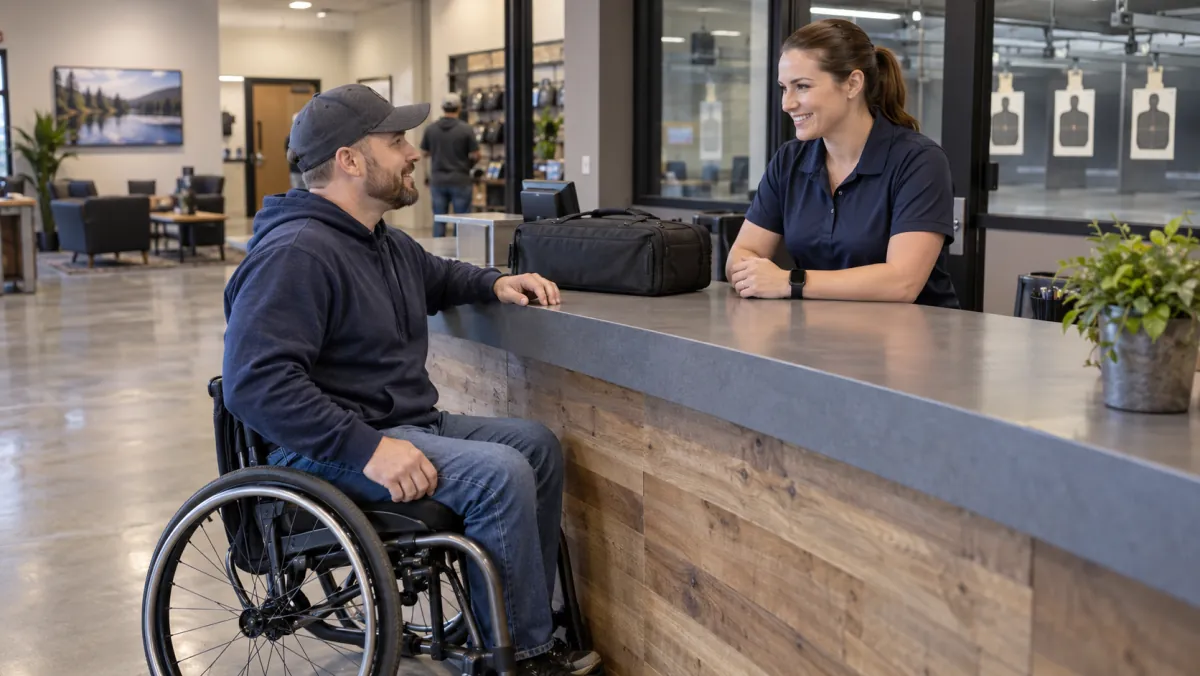
Accessibility is a sequence, not a single entrance. Ask about parking, the path to the door, thresholds, door operation, check-in counters, and the route to the classroom or firing area. If you need measurements, ask for actual measurements rather than estimates such as “there should be plenty of room.”
Michigan weather can affect that route. Snow, slush, heavy rain, and wet entry mats may change how a visitor moves through the entrance. Ask how to contact the facility on the day if conditions create a problem, and allow enough time to arrive without pressure.
Do not overlook the return trip. A route that feels manageable at the start may be harder after a long class. Knowing where you can sit, wait for transportation, or gather your belongings can make the whole visit easier to plan.
Ask about the specific lane and bench arrangement
The firing lane is a working space with safety requirements, not simply an open floor area. Discuss the width and layout, bench height and clearance, partitions, target controls, and the path to and from the lane. Ask which features are fixed and which, if any, can be adjusted by staff.
If seated participation is part of your plan, confirm that the instructor and facility can support it safely. Do not assume a chair can be added wherever it fits or that a personal support device can be moved into the lane without discussion. Any setup must preserve safe orientation, staff access, and compliance with range procedures.
It can be useful to arrange a visit to the reception or classroom area before booking live instruction, if the facility permits it. A conversation in the actual space can answer questions that are difficult to resolve over the phone. It should still be a planned visit, not an expectation that staff will improvise a full session on arrival.
Include restrooms, breaks, and waiting areas
People sometimes focus so closely on the shooting bench that they forget the rest of the visit. Ask about restroom access, seating outside the firing area, and where approved breaks can occur. For a longer class, those details may matter as much as the lane configuration.
Find out whether breaks follow a set schedule or can be coordinated individually. A recreational lesson and a course with mandatory instructional hours may have different limits. The instructor should explain how any pause affects participation or course completion before you commit to the format.
If you are traveling with a companion who will not shoot, ask where they may wait and whether the facility has any restrictions on that arrangement. Planning these ordinary details reduces the need to negotiate them while everyone is trying to begin instruction.
Establish communication before entering the firing area
Hearing protection and background noise can change how people communicate. Tell the instructor how you receive information most reliably and ask how range commands will be delivered. Discuss any written material, visual demonstration, or agreed attention signal that may help within the facility’s safety procedures.
Confirm the plan before live activity begins. It is not enough for two people to assume they will work it out when the room becomes noisy. You should understand what to do when a command is unclear and how to stop and request assistance without improvising unsafe movement.
For visitors who use hearing devices or have questions about hearing protection, consult the relevant device manufacturer or a qualified hearing professional as appropriate. Staff can explain required protective equipment and the range environment. Do not remove protection on the firing line as a workaround for a communication problem.
Give written information a practical role
Written instructions can help some visitors review details at their own pace. Ask whether forms, policies, or course materials are available in advance and whether a usable format can be provided. Clear headings, readable text, and an opportunity to ask follow-up questions may make orientation more manageable.
If you need help completing a form, ask what assistance is available while keeping your own answers accurate. A companion should not guess at eligibility information or sign something without the proper authority. Administrative convenience should not blur whose information is being provided.
Bring a short note of the arrangements you have confirmed, including the staff contact and any agreed arrival time. This is especially useful if a different employee is at the desk when you arrive. The note should describe the arrangement without unnecessarily exposing private health information.
Choose instruction that fits the learning situation
A large group class may work well for some visitors and be a poor fit for others. Ask about class size, instructor attention, room layout, and the pace of demonstrations. A private or smaller session may allow more time to assess an approved setup and explain unfamiliar procedures.
Do not assume a private lesson is automatically required or available. Describe what you need and ask the provider to explain the options. The aim is to find a format that supports safe learning, not to assign every visitor with an access need to the same category.
Our private training versus group classes guide can help frame that discussion. Whatever format you choose, the instructor should be able to explain how the session will work and which questions must be resolved before it begins.
Discuss equipment fit without rushing a purchase
Equipment selection can be affected by reach, grip comfort, control placement, and the way protective gear fits together. Those considerations deserve direct, supervised assessment. A recommendation based only on age, body size, or an internet label may miss the actual issue.
Ask whether suitable rental equipment is available and how staff assess fit before a lesson. If you already own equipment, describe it and follow the facility’s instructions for bringing it in. Keep cases closed until directed, and do not attempt to demonstrate a concern in the lobby.
Avoid modifying equipment yourself to solve an access problem. Discuss any proposed change with qualified professionals and the manufacturer as appropriate. A product or accessory that looks helpful online may interfere with safe operation or may not be permitted in the facility’s training environment.
Clarify a companion’s role while preserving independence
Some visitors want a friend, partner, or support person present. Others prefer to attend independently. State your preference clearly, and ask about the facility’s rules for companions, spectators, and assistance. A companion’s presence should be a planned part of the visit rather than a surprise on the firing line.
Staff should address the participating visitor directly. A support person can help communicate information with permission, but should not automatically become the decision-maker. The visitor’s own comfort, questions, and choices remain central to the session.
If help carrying a bag, opening a door, or organizing paperwork would be useful, identify that task specifically. Assistance with ordinary logistics does not imply permission to handle firearms or intervene in instruction. Keep those boundaries clear so the instructor can supervise the activity consistently.
Confirm what is agreed and what remains uncertain
Before booking, summarize the arrangement back to the provider. Include the date, arrival time, instructional format, relevant physical features, and any support that has been confirmed. Ask who will contact you if a key detail changes.
Distinguish an employee’s intention to investigate from a completed confirmation. “We will check the bench clearance” is useful progress, but it is not the measurement you need. Wait for unresolved essential information before making travel plans that depend on it.
If the facility cannot provide a workable arrangement for your needs, use that information to look for another appropriate option. A candid answer is more useful than an uncertain promise. The purpose of advance planning is to make a good decision before you have invested the effort of traveling and checking in.
Review the first visit and refine the next one
Afterward, record what worked and what you would change. Be specific: the arrival route was straightforward, the break timing needed adjustment, or a particular explanation was easier to understand in writing. Those observations can help the provider plan a better follow-up session.
Avoid judging the whole experience by how much shooting occurred. A first visit may reasonably focus on orientation, evaluating a safe setup, or establishing communication. If it answers important questions and produces a clear next step, it has served a useful purpose.
For an upcoming visit in the Downriver area, contact Range 313 with your practical requirements and preferred dates. Ask for confirmed details about the features that matter to you. Good access planning begins with a direct conversation and ends with an arrangement both the visitor and the instructor understand.